|
|
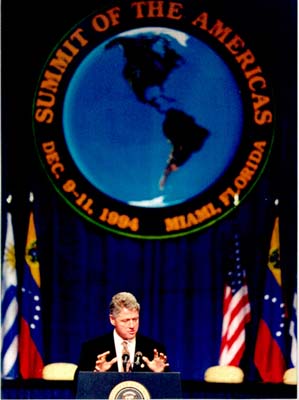
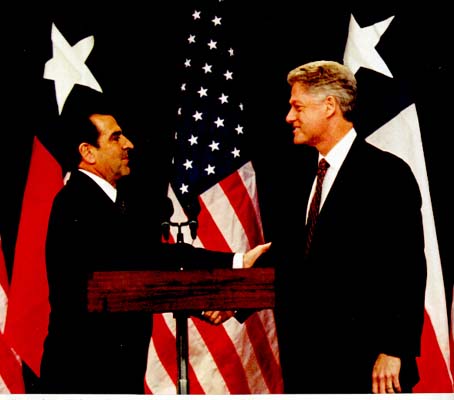
THE WHITE HOUSE WASHINGTON March 20, 1998 For three historic days in December of 1994, the eyes of the world were turned to Miami, where 34 freely elected leaders from throughout the Western Hemisphere gathered at the Summit of the Americas. Recognizing the dramatic changes taking place across our region¾ democratice governments in all but one nation, human rights and the rule of law increasingly respected, economic difficulties overcome by steady growth, increased trade and investment, and important efforts to alleviate poverty¾ we embarked on a unique enterprise. For the first time ever, we established an architecture for hemispheric relations from the Arctic Circle in the north to Argentina in the south. We created a work plan from which the democratic governments of the Americas could be judged by their people. We established a follow-on process to ensure that the decisiones we reached at the Summit would be carried out. And we built a framework for further discussions at this year´s Summit in Santiago, Chile, based on our sharded values, common interests, and joint mission to pusue a true partnership for hemispheric peace and prosperity. As the following report shows, the implementation of the Miami Summit's 23-point agenda has been impressive. In a variety of forms, from the 1996 Santa Cruz Summit Conference on Sustainable Development to numerous ministerial meetings to technical-level discussions, the Summit nations¾ along with the Organizations of American States, the Inter-American Development Bank, and other international organizations¾ have made real progress in support of our objectives. While additional work can and should be accomplished in all areas, the dedication and cooperation of the many governments, hemispheric organizations, nongovernmental organizations, and individual involved in Summit implementation have been unprecedented. We are seeing real results. The report highlights specific achievements and takes stock of overall
process to date. It reflects the dynamic, cooperative approach that has swept the region
in the areas of shared interest and common concern. Together, we are turning words into
deeds, moving with confidence from the 'Spirit of Miami' to the 'Promise of Santiago.' And
together, we are building a true hemispheric partnership, based on trust and mutual
respect and dedicated to improving the lives of all our people for the 21st
century. |
|
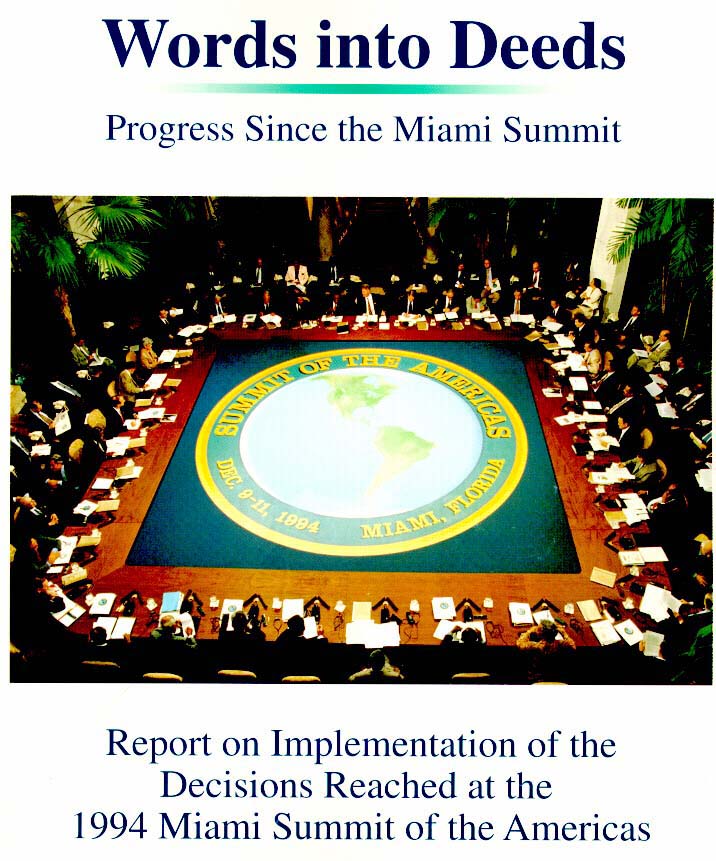
Words Into Deeds
Progress Since the Miami Summit
Report on the Implementation of the Decisions Reached at the 1994 Summit of the Americas
Table of Contents
Introduction
Executive Summary
Strengthening Democracy and Promoting and Protecting Human Rights
Invigorating Society/Community Participation
Promoting Cultural Values
Combating Corruption
Combating the Problem of Illegal Drugs and Related Crimes
Eliminating the Threat of National and International Terrorism
Building Mutual Confidence
Free Trade in the Americas
Capital Markets Development and Liberalization
Hemispheric Infrastructure
Energy Cooperation and Partnership for Sustainable Energy Use
Telecommunications and Information Infrastructure
Cooperation in Science and Technology
Tourism
Universal Access to Education
Equitable Access to Basic Health Care
Actions Taken in Combating Hunger
Strengthening the Role of Women in Society
Encouraging Microenterprises and Small Businesses
White Helmets¯Emergency and Development Corps
Partnership for Biodiversity
Partnership for Pollution Prevention
This report describes progress achieved in implementing the 23 separate initiatives contained in the Plan of Action approved by the 34 Western Hemisphere Heads of State and Government at the 1994 Summit of the Americas in Miami, Florida. It is based on inputs from governments that served as Responsible Coordinators for the various initiatives and on contributions from international organizations. Reports on individual initiatives were submitted by Argentina, Brazil, Canada, Colombia, Costa Rica, Chile, Ecuador, Jamaica, Mexico, Nicaragua, the United States, Uruguay, Venezuela, the Inter-American Development Bank, and the Pan American Health Organization, and useful inputs were received from the Organization of American States. The Coordinating Office for the Miami Summit edited the many excellent contributions to conform to a common format and drafted an Executive Summary for the report. That Office accepts responsibility for reformulating the original submissions and for the presentation of the material in the Executive Summary.
This report is not a policy document. The suggested actions under the "Future Steps" section of each chapter are informal recommendations for the continued implementation of the Miami Plan of Action. They are not meant to anticipate decisions that may be reached by Heads of State and Government at the April 1998 Summit of the Americas in Santiago, Chile.
Because of the extraordinary scope and specificity of the Miami Plan of Action, no report of this nature could describe all of the significant steps that have been taken to implement the Miami mandates. This report, therefore, is not meant to be an exhaustive compendium of actions. It is, however, intended to convey a clear idea of the extensive nature of the actions taken and of their value in enhancing the quality of life in the Hemisphere.
Note:
Each section of this report is followed by the text of the relevant initiative or initiatives from the Miami Plan of Action.
Since the Miami Summit, governments, international organizations, and civil society have worked hard to implement the decisions reached at that historic event. Together, they have made important progress in this endeavor.
I. Preserving and Strengthening the Community of Democracies in the Americas
Recent elections in the Hemisphere have been some of the fairest in history, and voter participation has reached extraordinary levels in some cases - e.g., 86 percent in the 1996 presidential election in the Dominican Republic and between 83 and 90 percent in the 1996 municipal elections in Paraguay. Democracy has become more firmly established in Haiti, where one constitutionally elected President succeeded another in 1997.
Many nations have taken steps to reform their judicial systems, and many have passed laws strengthening human rights. At the OAS, a strengthened Unit for the Promotion of Democracy has helped a number of countries modernize and improve their legislative institutions and has fielded election observer missions to ten countries.
In a precedent-breaking decision guided by the Miami Summit recommendations, the 1996 Summit of the Americas on Sustainable Development in Santa Cruz, Bolivia called for the participation of civil society in decision-making on public issues. The Bolivia Summit entrusted the OAS with the formulation of an Inter-American Strategy for the participation of civil society in decision-making on sustainable development. The U.S. Agency for International Development (USAID) has established a network linking 30 (potentially 80) NGOs throughout the Americas.
In its capacity as Responsible Coordinator for the Miami Summit initiative on Promoting Cultural Values, Costa Rica began hosting an Exhibition on Cultural Values of the Americas in San José in March 1998. Mexico, El Salvador, Guatemala, Peru, and the United States have signed international agreements on combating illegal traffic in archeological artifacts.
The Inter-American Convention Against Corruption, a direct result of the Miami Summit and the first of its kind in the world, was negotiated in record time and has already been signed by 23 OAS member states and ratified by nine. At the national level, many governments have taken specific anti-corruption measures, including the passage or strengthening of legislation against corruption and the approval of codes of ethics for public officials.
Through a series of coordinated actions, the Summit governments have launched an unprecedented offensive against drugs and related crimes. The Summit partners have developed new and creative hemispheric initiatives, including an Anti-Drug Strategy for the Hemisphere, a coordinated action plan to combat money laundering, and a convention against illicit firearms. Illicit coca cultivation has been reduced by 40 percent in Peru and in the Andes as a whole by at least 10 percent.
At a hemispheric Specialized Conference on Terrorism in Lima in 1996, participants issued a 23-point Plan of Action calling for a wide range of specific steps against terrorism. Bilateral and multilateral cooperation agreements have been signed. Peru has dealt severe blows to its two terrorist organizations, and the United States has brought major terrorists to justice.
At a regional conference on Confidence and Security Building Measures (CSBMs) in Santiago, Chile in 1995, governments agreed on eleven CSBMs to be implemented on a voluntary basis. Peru and Ecuador, working closely with the Rio Protocol countries, are now moving toward a historic resolution of their long-standing border dispute. Over 6,000 land mines have been destroyed in three Central American countries under the aegis of the OAS.
II. Promoting Prosperity Through Economic Integration and Free Trade
The Hemisphere's Trade Ministers have held four major meetings at which basic principles for a Free Trade Area of the Americas (FTAA) were adopted. Based on this extensive preparatory work, Heads of State and Government are expected to launch FTAA negotiations at the Second Summit of the Americas in Santiago, Chile, April 18-19, 1998.
Working together, governments have taken important steps to strengthen and modernize their financial markets. There is now a regional commitment to implement the Basle Committee´s Core Principles for Effective Banking Supervision as well as programs to train key bank personnel, improve clearance and settlement systems, and facilitate access to finance by microenterprises and small businesses.
Numerous major infrastructure projects have been completed or initiated in a wide range of categories, including energy, transportation, water and sanitation, and pollution prevention. Since 1995, the IDB has loaned some $1.4 billion for private infrastructure, mobilizing investments in that sector for a total of $4 billion. Transportation Ministers have developed a Western Hemisphere Transportation Initiative aimed at promoting integrated transportation systems that foster the economic development of the Hemisphere.
Energy Ministers have built a well structured and effective framework for hemispheric cooperation across a broad spectrum of energy objectives, including integration of energy markets, the increased production and distribution of sustainable energy, environmental protection, and the promotion of private investment in energy initiatives. Ministers have agreed to promote policies and actions supportive of the commitments that their governments will assume within the context of the negotiation of the Free Trade Area of the Americas. In addition, they have called for hemispheric cooperation in addressing the important issue of climate change.
At an unprecedented meeting of senior telecommunications officials in Washington in 1996, participants issued a comprehensive and detailed Plan of Action whose implementation over time will result in dramatic and fundamental improvements in telecommunications throughout the Hemisphere. These improvements will support numerous critical objectives in such areas as education, health care, and public safety.
Ministers responsible for science and technology, meeting in Cartagena, Colombia in March 1996, approved a Plan of Action of extraordinary scope designed to accelerate economic development and integration in the Hemisphere through cooperation in science and technology. The Plan of Action´s 43 specific commitments cover a vast array of actions¯from joint projects in basic and applied research, to cooperation in agriculture, education, and health, to efforts on specific issues such as the El Niño phenomenon, to special projects of benefit to small and relatively less developed countries.
Governments and the OAS have taken important steps to increase tourist flows and improve the tourism industry. Between 1994 and 1997, revenue from international tourism in the Americas (excluding international transportation costs) increased from $95.4 billion to $119.8 billion, and the number of tourists entering each of the major regions of the Hemisphere rose substantially.
III. Eradicating Poverty and Discrimination in our Hemisphere
Today over 90 percent of the children of the Hemisphere between the ages of 7 and 12 are receiving some form of basic education, and large percentages of indigenous children are benefiting from bilingual education. Programs in adult literacy, teacher training, and school nutrition have been expanded and improved. In Haiti, the goal is to teach 2 million people to read and write by the year 2000.
In 1995, U.S. First Lady Hillary Rodham Clinton launched a Measles Elimination Program at the Pan American Health Organization (PAHO). Measles cases were reduced from 23,583 in 1994 to only 2,109 in 1996. An upsurge of cases in 1997, which resulted almost exclusively from an outbreak in Brazil, underscores the need for aggressive vaccination programs. PAHO has launched a series of efforts against dengue, malaria, and HIV/AIDS. Over 80 percent of children under one year of age are receiving immunizations against the major childhood diseases.
An Inter-American Conference on Hunger, convened in Buenos Aires in October 1996 at the initiative of Argentina, issued a 15-point agenda for the battle against hunger. Proposed actions include the establishment of food banks and of national committees for the fight against hunger.
Numerous countries have changed their electoral codes to increase female participation in elections and, therefore, in political decision-making. At least seven countries have adopted the approach of establishing quotas for female participation in elections. Several countries have improved penal codes to protect women and girls from violence, abuse, and discrimination. The Inter-American Convention on the Prevention, Punishment and Eradication of Violence Against Women, the 'Convention of Belém do Pará,' came into force on March 5, 1995, and has been ratified by 26 governments since the Summit.
The Inter-American Development Bank (IDB) and other development agencies have committed close to $1 billion dollars to the promotion of microenterprises and small businesses throughout the Hemisphere. The IDB alone plans to invest $500 million over the next five years in loans and technical assistance for microenterprise promotion.
The White Helmets Committee of Argentina, established in 1995 in response to the Summit mandate, worked quickly with the United Nations Volunteers (UNV) to establish the White Helmets Initiative as a functioning element within the U.N. system. Efforts thus far have included land mine clearance in Angola, election monitoring in Armenia, improvement of food aid distribution in Haiti, sanitation and vaccination programs in Paraguay, and an initiative for the eradication of Chagas´ disease carriers in Bolivia.
IV. Guaranteeing Sustainable Development and Conserving our Natural Environment for Future Generations.
In Brazil, a new 2.35 million hectare Amazon forest reserve has been added to two existing parks, creating a total reserve larger than Switzerland. Also in Brazil, the size of the protected Atlantic Coastal Rain Forest in Bahia has been doubled. The size of Bolivia's Noel Kempff Park has been doubled, and Peru has established the first new national park since 1986, protecting 537,000 hectares. Progress has been made in protecting the mesoamerican coral reef systems and in preserving the unique biodiversity of the Galapagos Archipelago.
In the area of pollution prevention, thirteen countries have eliminated the sale of leaded gasoline, several more are scheduled to do so by 2001, and virtually all gasoline sold in the Hemisphere is expected to be lead free by 2007. A $2 billion dollar pipeline to carry gas, a clean form of energy, is being built between Santa Cruz, Bolivia and São Paulo, Brazil. USAID has launched numerous pollution prevention projects throughout the Hemisphere, including a $25 million cooperative effort with the Central American countries.
Action Initiatives 1 and 2
I. Actions Taken Since December 1994
There has been major progress at the national level in a wide range of areas of critical importance to democracy and human rights. Recent elections in the Hemisphere have been some of the fairest in history, and voter participation has reached extraordinary levels in some cases¯e.g., 86 percent in the 1996 presidential election in the Dominican Republic and between 83 and 90 percent in the 1996 municipal elections in Paraguay. Democracy has become more firmly established in Haiti, where one constitutionally elected President succeeded another in 1997. Many nations have taken steps to reform their judicial systems, and many have passed laws strengthening human rights. Progress in the area of women's legal rights has been exceptional and is reported in the section on Strengthening the Role of Women in Society. Numerous programs are underway to improve the administration of justice, the training of police, and the effectiveness of criminal investigations. At the OAS, a strengthened Unit for the Promotion of Democracy has helped a number of countries modernize and improve their legislative institutions and processes. It has fielded election observer missions to ten countries, provided support for education programs in democracy in schools and universities, and conducted programs of political reconciliation in four countries. The Inter-American Commission on Human Rights has taken up and decided an increasing number of cases, established closer links with national human rights commissions, and provided support for investigations conducted by the National Committee for Truth and Justice in Haiti. Five separate international human rights instruments have been ratified by additional governments since the Summit. Brazil and Canada, as co-coordinators for the Summit initiatives on democracy and human rights, produced a joint proposal for the implementation of the two initiatives. It has proved useful not only as a tool for carrying out the Miami decisions but also as a basis for recommendations for the Santiago Summit.
National and Cooperative Efforts
There have been major improvements at the national level in a wide range of areas of critical importance to democracy and human rights¯fair elections, high voter participation in elections, separation of court administration from judicial decision-making, effective training of justice professionals, effective criminal investigations, and the protection of the rights of women, minorities, indigenous people, and other disadvantaged groups. The following is an illustrative list of some key achievements.
In the Dominican Republic, 86 percent of eligible citizens voted in the 1996 presidential election, which was considered one of the fairest in Dominican history.
In Nicaragua, the 1996 national elections confirmed the effectiveness of democratic structures and led to a peaceful and orderly transfer of power. National and international observers declared the elections free, fair, and open.
In preparation for the 1996 municipal elections in Paraguay, the nation's electoral tribunal created a new voter registry. Within a three month period, 1.8 million voters had been registered¯some 70 percent of the total eligible voting population. The elections were considered the fairest in Paraguayan history. Voter participation was over 90 percent in Asuncion and 83 percent nationwide.
In Nicaragua, the Supreme Court is working with the National Assembly to reorganize and improve the entire judicial system.
In El Salvador, a new and improved criminal procedures code was approved by the legislature in December 1996.
In Bolivia, free legal defense for indigent people is now provided in all nine departments, and 50 public defenders have been made available.
In Bolivia, a law regulating campaign financing was enacted in 1997. All parties must now report all sources of campaign financing to the National Electoral Court.
For the first time, the Peruvian Congress opened its deliberative proceedings to civil society and to opposition political groups in a debate on major legislative changes.
In Bolivia, Congress granted permanent legal status to a congressional modernization committee (CML). The CML has taken the lead in modernizing committee structure and legislative regulations and in allowing public hearings.
There has been significant improvement in the human rights climate in Haiti since the restoration of elected government in October 1994 and since the Miami Summit. Strides have been made in the sustainability of impartial security, judicial, and economic institutions in pursuit of good governance, social development, and economic growth. Primary indicators of progress are the existence of a free press, a reduction in the number of reported human rights violations, and the cessation of illegal mass migration. A 5,700 strong civilian police force has been trained, and the Haitian National Police is now responsible for maintaining public safety.
In Guatemala, the 36-year armed conflict between the Government and the Guatemalan National Revolutionary Unity (UNRG) guerrillas came to an end with the signature of a final peace accord on December 29, 1996. Under the leadership of President Alvaro Arzu significant progress has been made in the area of human rights.
In Peru, President Fujimori carried out a series of positive human rights actions, including putting an end to the system of faceless judges and signing a law stipulating that torture, forced disappearance, and genocide are crimes that must be tried in civilian courts.
In Paraguay, the President of the Republic endorsed a program to enhance civil-military dialogue. For the first time, members of Congress, key politicians, academic leaders, and senior military officers met to discuss the role of the military in a democracy.
The United States has promoted democracy domestically by enacting in 1993, and amending in 1996, the National Voter Registration Act (popularly known as the 'Motor Voter' law). The Act makes it more convenient for citizens to register to vote. It has created the most significant expansion in U.S. voter registration since the nineteenth century.
The United States government enhanced its own transparency by enacting the Lobbying Disclosure Act of 1995, the first overhaul in 50 years of rules governing the activities of those who lobby government.
The United States established the Family and Childhood Education program, a collaborative effort of the U.S. Government's Office of Indian Education Programs, parent organizations, the National Literacy Foundation, and the High/Scope Foundation. The program works with children under five years of age. Accomplishments have included increasing the numbers of children entering school ready to learn, increasing parental participation in learning, and early detection of learning problems.
On a hemispheric basis, the United States has strengthened the Inter-American Institute of Human Rights, which provides human rights training for government officials and organizations, and has contributed to the efforts of governments to develop fair and professional electoral processes in the Hemisphere. The United States has supported programs in 14 nations to strengthen the administration of justice and human rights.
Canada has taken a number of important steps domestically. The Government has established a Federal Task Force on Disability Issues and has worked in partnership with provinces and territories on revamping the Vocational Rehabilitation of Disabled Persons program. National educational programs against racism have been launched, and improvements have been made to the accountability and support programs for Canada's official languages.
The Canadian Government has launched an action plan to renew its relationship with aboriginal people. The plan has four objectives: to renew partnerships, to strengthen aboriginal governance, to develop a new fiscal relationship, and to support strong communities, people, and economies.
In Chile, the Ministry of Justice has implemented a New Penitentiary Policy designed to improve the living conditions of prisoners and promote their rehabilitation in preparation for their return to society. The Ministry of Justice has asked the Gendarmerie of Chile, which is in charge of prisons, to implement a series of actions designed to improve the health care given to prisoners, improve the system of prison visits, segregate prison populations based on the seriousness of the offenses, and ensure that prisoners are trained in productive work. In the period 1995-1997, several new jails were constructed and others were expanded and improved. The use of private contractors in running the prison system has markedly increased¯from six private firms under contract in 1994 to 56 in 1997.
OAS Actions
The OAS has been very active in implementing the Miami Summit initiatives on democracy and human rights. The following are key examples of OAS actions under each initiative.
Strengthening Democracy
The OAS Unit for the Promotion of Democracy (UPD) has been strengthened and has received increased resources. In 1995, the Secretary General modified the UPD's structure to reflect its responsibilities in the areas of technical assistance with elections, the strengthening of democratic institutions, and special programs.
The UPD has provided support to election bodies in member states, primarily by identifying reliable new technologies, organizing meetings for the exchange of information, and promoting institutional and juridical strengthening of electoral systems in those states that have requested such assistance. The UPD has provided support to electoral agencies in Belize, Bolivia, Chile, Ecuador, El Salvador, Guatemala, Honduras, Panama, Peru, and Venezuela.
At the request of interested states, the UPD organizes election observer missions. Since the Summit, ten missions have been fielded¯to Peru, Guatemala, the Dominican Republic, Ecuador, Nicaragua, Suriname, Haiti, El Salvador, Colombia, and Guyana.
The UPD has worked with a number of countries on programs to modernize and improve legislative institutions and processes. It has carried out programs to examine legislative functions in Argentina, Bolivia, Chile, Guatemala, Paraguay, and Uruguay, and has developed support programs for the regional parliaments of Central America and the Andean Community.
The UPD has provided support for teaching institutions in developing education programs on democracy at the primary, secondary and university levels, and it has initiated training programs for young political leaders. The UPD has cooperated in democracy education programs in Grenada, Mexico, Nicaragua, Paraguay, Peru, and Trinidad and Tobago.
Finally, the UPD has been active in the area of political reconciliation and peaceful resolution of disputes. Programs with these objectives have been carried out in Guatemala, Haiti, Nicaragua, and Suriname.
In Haiti, the OAS has worked jointly with the United Nations to implement programs for consolidating democratic institutions.
Promoting and Protecting Human Rights
The Inter-American Commission on Human Rights (IACHR) broadened its efforts to promote and defend human rights in the Hemisphere. It has taken up and decided an increasing number of cases, and it has established closer links with National Human Rights Commissions and similar institutions in member countries. The IACHR has conducted seminars on jurisprudence in Brazil, Paraguay, and Argentina that were attended by several hundred justice officials from each of those countries and from neighboring countries.
In 1995, the IACHR provided support for the National Committee for Truth and Justice in Haiti in its investigations of human rights abuses.
Within the OAS, efforts are underway to prepare a draft Inter-American Convention on the Elimination of All Forms of Discrimination by Reason of Disability with a view to submitting the draft to the 28th session of the OAS General Assembly in 1998.
The Inter-American Children's Institute plans to present a program of concerted action on behalf of children to the next OAS General Assembly.
The IACHR has established working groups on the rights of migrant workers and on prison conditions. Work on migrant workers is in a preliminary, information gathering phase. The IACHR has conducted on-site visits to prisons and other detention centers in several countries, and it plans to submit a report on Prison Conditions in the Americas to the next session of the OAS General Assembly.
The work of the OAS on women's rights is described in the section of this report dealing with implementation of Miami Summit Initiative 18, Strengthening the Role of Women in Society.
The 1996 OAS General Assembly instructed the Permanent Council to 'evaluate the workings of the inter-American system for the protection and promotion of human rights so as to initiate a process leading to its improvement, possibly by modifying the respective legal instruments as well as the methods and working procedures of the Inter-American Commission on Human Rights, for which it shall request the cooperation of the Commission and the Inter-American Court of Human Rights….' Over the past two years, the OAS has taken a number of steps to evaluate this mandate. Particularly relevant in this regard is a report issued by the Secretary General in November 1996 entitled Toward a New Vision of the Inter-American Human Rights System. The 1997 General Assembly passed two resolutions calling for continued efforts to strengthen the inter-American system for the protection and promotion of human rights. The General Assembly asked that the IACHR prepare a draft inter-American program for the international promotion of human rights and submit it to the Permanent Council for consideration.
Adherence to International Instruments Designed to Support Democracy and Human Rights
The following is a list of developments since the Summit in this area (information current as of December 20, 1997):
The following conventions have received no new ratifications since the Summit:
Brazilian-Canadian Implementation Proposal
At the May 5, 1995 meeting of the Summit Implementation Review Group (SIRG), held in San Salvador, a number of governments endorsed the concept of 'responsible coordinators,' i.e., countries that would offer to play a leadership role in promoting the implementation of specific Miami Summit initiatives. Shortly thereafter, Brazil and Canada became coordinator and co-coordinator, respectively, of Miami Plan of Action initiatives 1 and 2, dealing with strengthening democracy and promoting and protecting human rights. In December, 1995, Brazil and Canada held consultations in Ottawa that resulted in a joint proposal for the implementation of these two initiatives.
The Brazilian/Canadian proposal sets forth a comprehensive and detailed agenda for improving democracy and human rights in the Hemisphere. The document identifies the following four major actions as essential to progress in this important area:
the document suggests that, within the shortest possible time, special efforts be made to achieve significant results in the following areas:
The following is a partial, illustrative list of the many specific actions recommended in the implementation proposal:
The proposal also calls for a range of specific steps to strengthen the rights of women, minority groups and the indigenous community, the disabled, and migrant workers and foreign communities within Summit countries.
The proposal suggest that governments formulate national human rights plans, as recommended by the World Conference on Human Rights held in Vienna in 1993. The document recommends that, to facilitate a hemispheric dialogue and exchange of experiences, the national plans should have a common structure. Included as integral parts of the proposal are the following annexes: (1) a list of specific results that should be obtained in the area of democracy and human rights; (2) a suggested structure for the national human rights plans; and (3) a list of nine human rights instruments that the Brazilian-Canadian document recommends be ratified by Summit governments.
Brazil and Canada presented their implementation proposal to a SIRG meeting in Santiago in January, 1996. The SIRG requested that the OAS Special Committee on Summit Management examine the Brazil-Canada proposal. In April, 1996, the Special Committee created a Working Group on Democracy and Human Rights with the broad mandate of assisting in the development of follow-up activities on Summit commitments in those areas. At the first meeting of the Working Group, held on May 6, 1996, Dr. Jose Gregori from Brazil and Ms. Mary McLennan from Canada were elected as co-chairs of the Group. The co-chairs asked member states to submit written comments on the Brazilian-Canadian proposal.
A second meeting of the Working Group was held in December 1996. The meeting discussed various suggested amendments to the Brazilian-Canadian proposal, exchanged views on the development of human rights plans, and identified administration of justice as the thematic priority that would guide the future work of the group. Within that priority, three particular issues were identified: (1) police training; (2) the necessary steps to remedy inhumane conditions in prisons and to minimize the number of pre-trail detainees; and (3) human rights education for judges, magistrates and other court officers. There was also agreement that, in carrying out its future activities, the working group should seek to avoid duplication with activities of other organs of the OAS involved in the areas of democratic development, human rights and technical assistance, and should seek cooperation with those organs.
In early 1997, representatives from the co-chairs visited a number of donors including the World Bank, the Inter-American Development Bank , the U.S. Agency for International Development, and the National Democratic Institute (Latin America Programs) all in Washington, D.C., and the Ford Foundation and the United Nations Development Program in New York. The main objectives of the visits were to gather information on organizations that might have an interest in developing partnerships to support future activities of the working group; to acquaint those organizations with the existence and work already undertaken by the working group; and to explore, in a preliminary fashion, their interest in the priority area and sub-categories established at the second meeting of the working group in December. In general, the meetings revealed the existence of a significant number of projects being carried out in the sub-categories identified by the working group. In addition, it became clear that the donors were interested in cooperating in these areas and in sharing their experience and expertise with the working group.
The Brazilian-Canadian proposal has been useful not only as a tool for implementation of the Miami initiatives but as a source of ideas for recommendations for the second Summit of the Americas to be held in Santiago, Chile, April 18-19, 1998.
II. Future Steps
Recommended actions include:
*******
The texts of Initiatives 1 and 2 follow:
1. Strengthening Democracy
The strengthening, effective exercise and consolidation of democracy constitute the central political priority of the Americas. The Organization of American States (OAS) is the principal hemispheric body for the defense of democratic values and institutions; among its essential purposes is to promote and consolidate representative democracy, with due respect to the principle of non-intervention. The OAS has adopted multilateral procedures to address the problems created when democratic order has been interrupted unconstitutionally. In order to prevent such crises, the OAS needs to direct more effort toward the promotion of democratic values and practices and to the social and economic strengthening of already-established democratic regimes.
Governments will:
- Encouraging exchanges of election-related technologies and assisting national electoral organizations, at the request of the interested state.
- Strengthening the Unit for the Promotion of Democracy so that it can provide assistance at the request of the interested state on such matters as legislative and judicial processes, government reforms (including administration of justice, technical modernization of national legislative bodies, simplification of government regulations and promotion of participation by community organizations in local democracy), and other institutional changes.
- Encouraging opportunities for exchange of experiences among member states' democratic institutions, particularly legislature-to-legislature and judiciary-to-judiciary.
- Fostering understanding, dialogue and political reconciliation, at the request of the affected state and bearing in mind that national reconciliation comes from within.
- Requesting the OAS to promote and follow up on these commitments.
2. Promoting and Protecting Human Rights
Great progress has been made in the Hemisphere in the development of human rights concepts and norms, but serious gaps in implementation remain. While courts ultimately have the responsibility for enforcing legal rights and obligations, reforms in other institutions are needed to contribute to the further development of a climate of respect for human rights. There must also be universal access to justice and effective means to enforce basic rights. A democracy is judged by the rights enjoyed by its least influential members.
Governments will:
Action Initiative 3
I. Actions Taken Since December 1994
In a precedent-breaking decision guided by the Miami Summit recommendations, the 1996 Summit of the Americas on Sustainable Development in Santa Cruz, Bolivia called for the participation of civil society in decision-making on public issues. The Summit entrusted the OAS with the formulation of an Inter-American Strategy for the participation of civil society in decision-making on sustainable development. To design the strategy, the OAS has initiated a 15-month program to develop relevant information and experience. As part of its effort, the OAS has selected three sites (in Dominica, Peru, and the Gulf of Honduras) for pilot projects on environmental protection designed to demonstrate effective means of involving civil society in public initiatives. National focal points to guide the formulation of the participation strategy have been established in 27 countries, and $1.2 million in contributions have thus far been received to support the pilot projects and other aspects of work on the strategy. Initial steps have been taken toward the possible creation of an IDB-sponsored Foundation of the Americas to strengthen civil society in the Hemisphere, and the U.S. Agency for International Development has established a network linking 30 (potentially 80) NGOs throughout the Americas. Many national governments have taken specific steps to enhance the role of civil society in public affairs, for example through new legislation, innovative programs, and financial assistance.
Hemispheric Initiatives
OAS Efforts
The December 1996 Summit of the Americas for Sustainable Development in Santa Cruz, Bolivia took an important step forward in implementation of the Miami initiative on civil society/community participation. In the Bolivia Summit Declaration, the Heads of State and Government strongly supported 'broad participation by civil society in the decision-making process, including policies and programs and their design, implementation, and evaluation.' In the relevant section of the Bolivia Summit's Plan of Action, the hemispheric leaders state that governments will: '… entrust the OAS with assigning priority to the formulation of an Inter-American Strategy for the promotion of public participation in decision-making for sustainable development, taking into account the recommendations of the Inter-American Seminar on Public Participation held in Montevideo in 1996.' The Seminar had identified three areas for progress: (1) enabling responsible participation; (2) strengthening representative institutions; and (3) expanding avenues for participation.
Soon after the Santa Cruz Summit, the OAS began a 15-month program to formulate an Inter-American Strategy for Public Participation in Environment and Sustainable Development Decision-Making in the Americas (ISP). As part of the effort, the OAS is conducting pilot projects on participatory environmental management at three sites (in Dominica, Peru, and the Gulf of Honduras) to demonstrate effective means of involving civil society in public initiatives. The lessons learned will serve to guide Summit governments' efforts in civil society participation in the future.
Contributions totaling some $1.2 million in direct support of the ISP have been received from the Global Environment Facility, the OAS, USAID, and UNESCO. National focal points (a government official or group of officials) have been established to guide the ISP process with input from experts from civil society and donor representatives. To date, national focal points have been designated by 27 Summit countries.
The following consultations and other actions have been undertaken to support ISP formulation:
A web site has been created to help governments and civil society keep abreast of progress on implementation of the ISP. The Internet address is: www.ispnet.org.
Other Regional Efforts
In 1995, the U.S. Agency for International Development established the Inter-American Democracy Network, which currently links 30 NGOs and is intended eventually to link more than 80 throughout the Hemisphere. Through the Network, the six founding members, five of which are based in Latin America, provide technical assistance to other civil society organizations throughout Latin America and the Caribbean. Technical assistance is focused on the following areas: capacity building, voter education, citizen participation in local government, and deliberation.
Another significant initiative is the Charter of Civil Society of CARICOM, established by the CARICOM Heads of State and Government at a meeting in Antigua and Barbuda in February 1997. This initiative grew out of the recognized need to develop structures of unity and integration within and among eastern Caribbean states to complement efforts to establish a single market economy in the region. The Charter articulates a political value system that emphasizes collaborative relationships within civil society and between civil society and the state. The Charter promotes freedom of the press, fair and open democratic processes, morality in public affairs, respect for civil, political, economic, social, and cultural rights, the rights of women and children, respect for religious diversity, and greater accountability and transparency in government.
The Inter-American Development Bank, on the initiative of senior bank staff, has proposed a new Foundation of the Americas to strengthen civil society in Latin America and the Caribbean. In September 1997, a committee was established to promote the creation of the Foundation, which the IDB hopes will work in the coming years in partnership with governments and businesses to strengthen democratic institutions, achieve equitable economic growth, and advance social justice in the region.
The IDB's Foundation Committee, chaired by former Bolivian President Gonzalo Sanchez de Lozada, has already begun meeting with business and political leaders to plan for the creation of the Foundation. This preliminary effort to develop a new Foundation is a substantial step forward in meeting the Miami Plan of Action's call upon the IDB to consider the development of a 'Civil Society Program to encourage responsible and accountable philanthropy and civic engagement in public issues.'
In March 1997 the IDB published an important sub-regional summary of laws and regulations for civil society organizations in South America in collaboration with the United Nations Development Program, the International Center for Not-for-Profit Law, and the Esquel Group Foundation. The publication provides a comparative review of legal frameworks for civil society in South America, and serves as an important reference for further progress.
The Government of Chile, with the support of other Summit governments, has taken important steps to integrate civil society into decision-making by consulting civil society members during preparation of the agenda for the Santiago Summit of the Americas to be held April 18-19, 1998. Consultations took place at two separate meetings in Santiago hosted by the Corporación Participa and sponsored by various donors and the Government of Chile. There were also numerous informal consultations regarding the Summit between government delegations and civil society representatives at the national level. Through the efforts of Jamaica and Uruguay, civil society members have had significant input into the proposed Summit agenda and have made substantial contributions to the language proposed for inclusion in the final Summit Plan of Action.
National Efforts
The following is an illustrative list of significant actions that have been undertaken by national governments.
In Argentina the role of civil society in public affairs has steadily increased thanks in large measure to a legal framework that guarantees great freedom for the creation and operation of NGOs. The number of volunteers in Argentina has grown as a result of the positive publicity surrounding President Menem's successful initiative to create an international 'White Helmets' volunteer corps. The Argentine government has placed increasing emphasis on engaging the academic world, the press, and NGOs in domestic sustainable development activities such as the management of protected natural areas. Argentina has also worked to integrate civil society into the foreign policy area, which traditionally was considered the exclusive province of the federal government.
Belize has made important strides in operating the Official Charities Fund in a manner that maximizes transparency and financial accountability among social welfare and youth programs. Belize has also encouraged the active involvement of beneficiaries of these programs in development initiatives, including those operated through the Social Investment Fund, the Sustainable Human Development Program, and the Overseas Development Agency.
In Brazil there are approximately 170,000 registered civic associations that have a significant interest in government activities. In December 1995 a large national forum on the role of civil society was held, attended by representatives of the federal government, state governments, NGOs, the Inter-American Development Bank, international agencies, the private sector, and several national foundations. The forum made a series of recommendations to strengthen civil society in Brazil, including the establishment of a 'Brazilian Network for the Organization of Civil Society.'
Bolivia has continued to expand and strengthen activities under its model Popular Participation Law, which established a national Secretariat for Popular Participation and seeks to integrate civil society into all levels of sustainable development decision-making. In 1997 the Secretariat introduced a Program of Strategic Actions in Natural Resources, Environment and Planning for La Paz, and has offered institutional support for public participation programs at the regional level as well.
Canada has markedly expanded its efforts to engage the public in policy decision-making. The Canadian Centre for Foreign Policy Development was created in 1996 to help Canadians outside government contribute to the development of Canadian foreign policy. In 1996 and 1997, Canada involved civil society to an exceptional degree in conferences at Geneva and Ottawa on the effort to secure a global ban on land mines. At the Ottawa conference, Ministers and officials shared plenary and ued a Program to Eradicate Poverty as a basic instrument to support policies and programs that will transform relations between the state and civil society. The new program recognizes the state's role as 'facilitator' and the vital importance of participation by all social and economic sectors, including industrial and business organizations and NGOs. Ecuador has also given special attention to increasing the participation of indigenous populations, Afro-Ecuadorians, women and youth in government decision-making.
As part of a new Local Government Reform Programme, Jamaica has established a National Advisory Council on Local Government and collateral local councils comprised of political parties, trade unions, the private sector, the NGO community, and women and youth organizations. Jamaica has also implemented a National Policy and Programme for Poverty Eradication, which focuses on project identification and implementation through community partnership and consensus. Moreover, the Jamaican Government has established an NGO Portfolio to coordinate NGO/government relations. In 1996 Jamaica published a Directory of NGOs Engaged in Social Development in Jamaica. The Directory is serving to facilitate interaction among the 114 NGOs listed in it and between them and the Government of Jamaica. Jamaica recently turned over operational management of its two national parks to NGOs.
Mexico modified its Federal Code of Institutions and Electoral Processes to create a basis for the participation in decision-making by organizations with a political character through the Agrupación Politica Nacional. Mexico has also passed and begun to implement the December 1996 Law of Ecological Equilibrium and Protection of the Environment, which includes provisions that guarantee the participation of private persons, individually and collectively, in environmental protection efforts. In 1996 the Mexican Senate established a Subcommittee on the New Relationship of Government with Civil Society with a view to encouraging the participation of civil society in government decision-making. The Subcommittee held a number of workshops on ways of involving civil society in public policy to a greater degree.
Nicaragua has worked to ensure high levels of civil society participation in efforts to combat poverty and generate jobs. In May 1997, Nicaragua enacted a Law of Juridical Not-for-Profit Persons, which regulates the formation and operation of NGOs.
Trinidad and Tobago established a Community Development Fund with a loan from the IDB designed to encourage NGO participation in community based efforts to provide basic social services and improve community infrastructure. The Fund, which is available to community groups acting collectively, represents a landmark effort to engage civil society in social policy and to build a capacity for collective action.
In the United States, President Clinton joined three former Presidents and retired General Colin Powell in April 1997 for the Presidents' Summit for America's Future. The Summit's goal was to call Americans to a new level of civic action to help millions of disadvantaged and at-risk children. The President's Council on Sustainable Development has continued to function as a joint public-private advisory entity that integrates civil society into development decision-making. The United States enacted tax law changes that (a) increase the financial transparency of public charities and other tax-exempt organizations; (b) protect charitable organizations from losing their tax-exempt status because of wrongdoing by individuals associated with them; and (c) promote the ability of tax-exempt organizations to receive funds from private donors. The U.S. Government has involved citizens groups and NGOs in its implementation of the Miami Summit Plan of Action, notably by including the private sector in the Denver Trade and Commerce Forum in May 1995, by inviting NGO representatives to the meeting of science and technology ministers in Cartagena, Colombia in March 1996, and by utilizing inputs from many NGOs in formulating U.S. negotiating priorities for the December 1996 Summit on Sustainable Development in Santa Cruz, Bolivia.
Uruguay has worked to integrate public interest organizations into efforts on structural poverty and other key issues, and has sought to develop a social dialogue between civil society and the highest levels of government. Uruguay has also worked to integrate NGOs into its regional and international activities.
II. Future Steps
*******
The text of Initiative 3 follows:
3. Invigorating Society/Community Participation
A strong and diverse civil society, organized in various ways and sectors, including individuals, the private sector, labor, political parties, academics, and other non-governmental actors and organizations, gives depth and durability to democracy. Similarly, a vigorous democracy requires broad participation in public issues. Such activities should be carried out with complete transparency and accountability, and to this end a proper legal and regulatory framework should be established to include the possibility of obtaining technical and financial support, including from private sources.
Governments will:
Action Initiative 4
I. Actions Taken Since December 1994
In its capacity as Responsible Coordinator for the Miami Summit initiative on Promoting Cultural Values, Costa Rica began hosting an Exhibition on Cultural Values of the Americas (Exhibición Valores Culturales de las Américas) in San José in March 1998. On display are photographs, handicrafts, and videos on the culture of each of the Summit countries. Many governments have taken important national actions in the cultural area. Bolivia has created an organization to carry out cultural activities among the various ethnic and linguistic groups in the country. Chile is helping each of the 13 regions of the country to develop its unique cultural traditions and has stressed the importance of bringing culture to economically disadvantaged people. In the United States, the White House announced a multi-year Millennium Program to celebrate the achievements of the 20th Century and to preserve the national cultural heritage for future generations. Mexico signed international agreements with Belize, El Salvador, Guatemala, Peru, and the United States on combating illegal traffic in archaeological artifacts and on the preservation and maintenance of archaeological areas. The United States signed agreements with El Salvador, Guatemala and Peru instituting restrictions on the importation of unregistered archeological and cultural artifacts into the United States. The OAS enhanced its commitment to the promotion of cultural values, approved a new Inter-American Program of Culture, and established a new Office of Cultural Affairs with a strong 16 point mandate to foster the promotion and preservation of the cultural heritage of the Americas.
National Efforts
Costa Rica
In its capacity as Responsible Coordinator for the Miami Summit initiative on Promoting Cultural Values, Costa Rica began hosting an Exhibition on Cultural Values of the Americas (Exhibición Valores Culturales de las Americas) in San José in March 1998. The exhibition is designed to reflect the cultural values of the countries that participated in the Miami Summit of the Americas. On display are photographs, handicrafts, and videos on the culture of each of the Summit countries. A report on this exhibition will be sent to every diplomatic mission accredited in San José.
Costa Rica has developed a program to investigate and conserve buildings and other sites of cultural value throughout the country. It has further developed an education and public information program to make people aware of their cultural patrimony and the need to protect it. Costa Rica has stressed that preservation of cultural patrimony is a shared responsibility among the state, civil society, and the people. Special efforts are being made to involve young people in the cultural life of the country.
Barbados
Barbados recently assumed the responsibilities of the Secretariat pro tempore of the Forum of Ministers of Culture and Officials Responsible for Cultural Policy in Latin America and the Caribbean. In that capacity, Barbados is preparing activities leading to the 10th meeting of that group. This task is in addition to the responsibility Barbados has for the coordination of cultural programs of the Association of Caribbean States. Projects being carried out in these contexts are: (a) the establishment of a cultural database (Sistema de Información Cultural de Latinoamerica y el Caribe¯SICLAC) that will be available on the Internet and that will provide information on the cultural heritage of the Americas; and (b) a 'cultural integration' project designed to bring the people of the Americas closer together by encouraging them to learn the languages spoken in the Western Hemisphere.
Bolivia
Bolivia has created an Intercultural Relations Unit to organize activities among various cultural, ethnic, and linguistic groups within the country. An international cultural exchange program called Casa de los Pueblos has established centers throughout Bolivia for the strengthening of non-governmental cultural relations with foreign countries as a 'people-to-people' effort.
Chile
Chile's cultural policy stresses the concept of decentralization, which means helping each of the 13 regions of the country to develop its potential and its own unique culture and traditions. Chile also emphasizes the importance of bringing culture to economically disadvantaged people, not as a luxury but as an essential part of life. The Government promotes a program called 'cultural street corners' (Esquinas Culturales), featuring cultural activities in outdoor public places. Government policy also stressed the importance of the cultural dimension in formal , and the United States on combating illegal traffic in archaeological artifacts and on the preservation and maintenance of archaeological areas. In addition, Mexico has established a web site listing its cultural legislation (http://www.uam.mx/difusion/concul/leyes).
Nicaragua
The Nicaraguan Institute of Culture is supporting local and ethnic cultures of the Atlantic coast of the country in order to improve understanding among Nicaraguans. It is also providing material aid to elderly national artists and is helping to publicize their works.
The Dominican Republic
The Presidential Council of Culture coordinates cultural affairs and is laying the groundwork for the establishment through legislation of a national Department of Culture (Secretaría de Estado de Cultura). Cultural projects underway or planned include (a) creation of a national system of literary workshops; (b) establishment of provincial and municipal houses of culture and regional cultural centers; (c) creation of a system of child and youth symphony orchestras; and (d) an inventory of national patrimony. In 1997, the Dominican Republic established an Internet web site that provides information on cultural activities in the country.
United States
Thousands of public-private partnerships in the United States further cultural values, and the number grows daily. Examples range from community public broadcasting services and innumerable programs supported in part by the National Endowment for the Arts and the National Endowment for Humanities, to ad hoc local government partnerships with citizen and church groups.
In August 1997, the White House announced a multi-year Millennium Program to celebrate the accomplishments of this century, engaging every sector of U.S. society in conveying the American heritage to future generations. By focusing on culture, scholarship and scientific exploration, the White House Millennium Program provides opportunities to learn more about history and preserve the national cultural heritage.
The United States signed agreements with El Salvador, Guatemala and Peru, instituting import restrictions on unregistered archeological and cultural artifacts into the United States. Discussions continue with these and other countries to find better means to protect cultural property and to enhance knowledge and appreciation of indigenous cultures and cultural artifacts.
U.S. Information Agency (USIA) each year funds visits to countries of the hemisphere by approximately 200 U.S. speakers and academic specialists. The U.S. visitors share with audiences experiences in such areas as museum management, university administration, and the arts.
U.S. government broadcasts via 'Worldnet' to the Hemisphere feature topics such as library management, preventing the transfer of illegally acquired art, Latin American film industry growth, cultural fund raising and jazz developments. Voice of America broadcasts also address a wide variety of cultural topics.
The Partners of the Americas and Sister Cities International programs consist of partnerships between individual U.S. states and municipalities and other countries and municipalities. Areas addressed include exchanges of performing, visual and folk artists, and the development of linkages among libraries, museums and other cultural centers in order to promote understanding and appreciation of the Hemisphere's rich cultural heritage.
The Smithsonian Institution has several dozen scientific, artistic and cultural research projects ongoing with Central and South America, and a variety of other cultural programs operating in the Hemisphere, some in coordination with the OAS.
The American Dance Festival sponsors workshops, training and performances, and develops linkages with dance groups in Latin America and the Caribbean.
Uruguay
The cultural division of the Ministry of Education and Culture has been restructured with a view to improving the promotion of cultural values. The cultural division now has four sections, one for each cultural area, as follows: Theater Arts, Plastic Arts, Letters, and Musical Arts. Uruguay has also taken steps to improve its system of libraries, museums, and houses of culture.
OAS Efforts
In response to the Summit mandate, guidance provided by the 1995 OAS General Assembly on strengthening the inter-American system included a call for a broader OAS role in promoting and disseminating culture. The 1996 OAS General Assembly reiterated the importance of culture for the integral development of the member states as well as the need for the OAS to strengthen and enhance the Inter-American Program of Culture. The General Assembly entrusted the General Secretariat with the task of submitting quarterly reports on the implementation of the cultural program of the OAS. That mandate was renewed by the 1997 General Assembly.
The Inter-American Council for Integral Development (CIDI), at its second regular session held in Mexico in April 1997, approved a Strategic Partnership for Development Plan 1997-2001, which includes cultural development among the priorities of the OAS. CIDI reaffirmed the commitment of member states to prepare and adopt a new Inter-American Program of Culture.
Recognizing that the greatest wealth of a region is its people and their diverse cultural expressions, the Third Regular meeting of CIDI in Buenos Aires in March 1998 approved the new Inter-American Program of Culture (PIC). The PIC establishes the strategic areas of action of the OAS in promoting the cultural development of the Hemisphere. The Program, which takes its mandates from the Miami Summit and the OAS General Assembly, will concentrate on four areas of action: (1) cultural diversity; (2) the dissemination and protection of the Hemisphere's cultural heritage; (3) the training of human resources and the encouragement of creativity; and (4) the promotion of cultural tourism.
In an effort to enhance the efforts of the OAS in cultural matters, the Secretary General created the Office of Cultural Affairs on April 30, 1997, replacing the old Department of Cultural Affairs. The new Office was given a broad, 16 point mandate. The following is a partial, illustrative list of the tasks, presented here in abbreviated form:
In the brief period of its existence, the Office of Cultural Affairs has carried forward and built on the work of its predecessor organization, the Department of Cultural Affairs. The Office has performed technical analyses of cultural projects submitted by member states on such varied issues as library user information for indigenous communities (Peru), restoration of heritage furniture (Panama), and research on and documentation of heritage dances (Domnica). It has participated in numerous meetings on cultural matters, including a meeting of the Directors of Cultural Preservation in Cartagena de Indias in May 1997, the 56th Session of the Advisory Committee of the International Council of Museums in Paris in June 1997, and a meeting of Business Volunteers for the Arts in Sacramento, California in September 1997. The Office has also sponsored publications springing from activities carried out under the former Regional Cultural Development Programs. Examples are:
Since 1994, the OAS has produced a number of videos as part of its program to disseminate information about the Americas. They are designed primarily for schools and colleges, museums, NGOs, and community groups. The following are examples:
II. Future Steps
Recommended actions include:
*******
The text of Initiative 4 follows:
4. Promoting Cultural Values
Cultural development is a fundamental and integral component of development in the Americas and has an inherent capability to enrich our societies and to generate greater understanding among our countries.
In order to promote cultural values, governments will:
Action Initiative 5
(The President of the Republic of Venezuela, Rafael Caldera, proposed the anti-corruption initiative and specifically recommended an Inter-American Convention Against Corruption.)
I. Actions Taken Since December 1994
The Inter-American Convention Against Corruption, a direct result of the Miami Summit and the first of its kind in the world, was negotiated in record time and has already been signed by 23 OAS member states and ratified by nine. In another hemispheric effort in 1997, governments approved the Inter-American Program for Cooperation in the Fight Against Corruption. In December 1997, Argentina, Brazil, and Chile joined the 29 OECD member countries (including Canada, Mexico, and the United States) in signing a newly established OECD Convention on Combating Bribery of Foreign Public Officials in International Business Transactions. At the national level, many governments have taken specific anti-corruption measures, including the passage or strengthening of legislation against corruption and the approval of codes of ethics for public officials. Further such national efforts are planned.
Negotiation and Signature of Inter-American Convention
Only one month after the Summit¯on January 11, 1995¯the Venezuelan representative to the OAS submitted to the Permanent Council a Draft Inter-American Convention Against Corruption. During the 25th Regular Session of the OAS General Assembly in Haiti in June 1995, delegates adopted a resolution entitled 'Integrity and Public Ethics,' which included an approved schedule of work on the Inter-American Convention. Based on this mandate, the OAS Working Group on Probity and Ethics prepared a new draft text, which incorporated the comments of Summit governments and which was submitted to the Inter-American Juridical Committee of the OAS. That Committee provided a timely response in the form of an alternative draft, which served as a basis for subsequent meetings by a group of experts from Summit governments.
Following three meetings of the group of experts (from November 1995 to March 1996), a text was approved, which, after minor modifications, became the Inter-American Convention Against Corruption. It was signed by 21 governments at a meeting in Caracas on March 29, 1996 and by two in June 1996. Thus far the Convention has been ratified by nine Summit states.
Content of the Convention
The Convention is a comprehensive 28-article document that outlines a series of firm commitments by the States Parties. The following are examples:
Other Hemispheric and Global Efforts
The 1997 OAS General Assembly in Lima approved the Inter-American Program for Cooperation in the Fight Against Corruption. The Program calls for the improvement of legal instruments for combating corruption, the strengthening of institutions involved in the anti-corruption effort, the intensification of contacts with other international organizations, and the participation of civil society in anti-corruption initiatives.
The Inter-American Juridical Committee of the OAS is drawing up model anti-corruption legislation for the consideration of governments and plans to submit the results of its work to governments in March 1998.
In order to facilitate work on anti-corruption legislation, the OAS Secretariat of Legal Affairs maintains a documentation center listing anti-corruption legislation that already exists in many countries of the Hemisphere.
In response to one of the Summit mandates, the OAS has established contact with the OECD Working Group on Bribery in International Business Transactions, and the OAS Secretariat of Legal Affairs is exchanging information with the OECD on means of mounting a more effective anti-bribery effort in the Western Hemisphere.
In December 1997, Argentina, Brazil, and Chile joined the 29 OECD member states and two other non-member states¯Bulgaria and the Slovak Republic¯in signing a newly established OECD Convention on Combating Bribery of Foreign Public Officials in International Business Transactions. The Convention sets forth a standard for effective national laws to criminalize bribery of foreign public officials as well as a basis for international judicial cooperation.
Most countries of the Hemisphere are implementing integrated financial management systems to improve accountability and transparency in the area of public resources.
National Efforts
Argentina is vigorously implementing its 1992 Financial Management and Control Law. A National Office of Public Ethics has been established and a Code of Ethics has been drafted.
In Brazil the Senate has passed a bill, now awaiting presidential approval, that would criminalize money laundering and create a Council for the Control of Financial Activities under the Finance Ministry. In addition, the government has prepared a Code of Professional Ethics for Public Officials of the Federal Government.
Bolivia is developing a forensic auditing capability under a project financed by the World Bank. A National Integrity Workshop was held in Bolivia in March 1998 in cooperation with the World Bank's Economic Development Institute.
In February 1995, Canada approved a Code of Conduct and Conflict of Interests, which regulates the conduct of employees of the Department of Foreign Affairs and International Trade.
In Chile a National Committee on Public Ethics, established in 1994, has made 41 proposals to improve public ethics, most of which have been implemented. Internal audit units have been established in every government ministry over the past three years, and the Congress is considering six anti-corruption bills.
In Colombia an Anti-Corruption Statute was approved in 1995. In 1996 a Presidential Program called the Transparency Plan was introduced aimed at reforming the management of government based on three essential principles¯government responsibility, administrative transparency, and corruption control. The administrators of the Transparency Plan are conducting a campaign on administrative ethics at all levels of government, and their work is being supplemented by the efforts of the National Commission on Integrity and the Citizens' Commission for Combating Corruption.
In the Dominican Republic, an IDB-funded project has strengthened the Prosecutor's office and focused the attention of civil society on anti-corruption issues.
In Ecuador, an Anti-Corruption Commission has been established to investigate corruption.
In El Salvador the Ministry of Justice is drafting a law to create a code of conduct for public officials and a legislative subcommittee is investigating means of making political campaign funding more transparent. In addition, the Government has established an office to receive citizen complaints of corruption by public officials.
In Paraguay the Office of the Comptroller General of the Republic and the Bicameral Committee on Illicit Activity of the National Congress are engaged in the anti-corruption effort. The city of Asuncion has passed a 'sunshine law,' which authorizes citizen access to municipal records.
In December 1996, Peru enacted a new banking reform law designed to fight corruption, and in July 1997, Peru approved a Code of Ethics of the Public Prosecutor, which sets forth principles that will guide the work and personal conduct of all public prosecutors. The Comptroller General's Office has established comprehensive procedures for citizen complaints about corruption and inefficiency in government.
In Mexico the basic law on Public Administration was amended, and thereby improved, in 1996. Internal regulations of the Office of the Comptroller General and Administrative Development were approved in April 1995.
In the United States, significant resources have been devoted to assisting governments in the Hemisphere to implement the Inter-American Convention Against Corruption, including through the establishment of national ethics offices. The U.S. Government has taken every opportunity to publicize, domestically and internationally, the importance of this Convention. The United States is exchanging information with Argentina related to its recent establishment of an Ethics Office.
The United States has provided support to the Berlin-based Transparency International NGO and to many other NGOs and associations that are active in the Hemisphere in the fight against corruption and in the improvement of public sector financial management.
Bribery of foreign officials by U.S. businessmen has long been criminalized by the Foreign Corrupt Practices Act. In 1996, the U.S. Departments of State and Commerce agreed to require U.S. businesses to certify that they and their affiliates have not bribed and will not bribe officials, and that they will maintain policies to that effect, before the U.S. Government will provide advocacy assistance. Similar commitments are required by the Department of Commerce from companies participating in official trade missions.
The U.S.-initiated U.N. Declaration on Corruption and Bribery in Transnational Business Transactions was passed by General Assembly consensus in December 1996. Within the WTO the United States is seeking to ensure that the international procurement process is open and transparent. At the December 1997 Singapore WTO Ministerial, the United States obtained agreement for the WTO to study a possible arrangement on transparency, due process, and openness in government procurement.
In order to promote the values underlying the transnational anti-corruption effort, the U.S. Government has participated in conferences in the U.S. with anti-corruption on the agenda that have involved the American Bar Association, the International Association of Lawyers, and the Inter-American Bar Association. The United States has also taken part in panel discussions on anti-corruption themes at international conferences. These included, in 1996, a U.S.-funded 'Respondacon III' teleconference and, in 1997, the 8th International Anti-Corruption Conference and a 'Respondacon IV' teleconference, both in Lima, and a conference in Mexico focused on the role of primary and secondary education in combating corruption.
In Venezuela, the post of Presidential Commissioner for Public Administration Oversight was established by decree in January 1995. The functions of the Presidential Commissioner include making recommendations to the Executive Branch on measures to reform government and make it more effective. He may act on the basis of complaints or press reports or on his own initiative. His recommendations are submitted to the President of Venezuela and to the appropriate senior official. They can also be sent to other entities, including the Office of the Comptroller, the Office of the Public Prosecutor, the Courts, and the Technical Judicial Police. In June 1996 the Presidential Commissioner announced a National Plan for a Commitment to Anti-Corruption Through Education.
Also in Venezuela, a Code of Ethics for Public Officials has been drafted and reviewed and will soon be presented to the President for his approval under a Regulatory Decree.
II. Future Steps
Key steps should include:
*******
The text of initiative 5 follows:
5. Combating Corruption
The problem of corruption is now an issue of serious interest not only in this Hemisphere, but in all regions of the world. Corruption in both the public and private sectors weakens democracy and undermines the legitimacy of governments and institutions. The modernization of the state, including deregulation, privatization and the simplification of government procedures, reduces the opportunities for corruption. All aspects of public administration in a democracy must be transparent and open to public scrutiny.
Governments will:
Action Initiative 6
I. Actions Taken Since December 1994
Through a series of coordinated actions, the Summit governments have launched an unprecedented offensive against drugs and related crimes. The Summit partners have developed new and creative hemispheric initiatives, including an Anti-Drug Strategy for the Hemisphere, a coordinated action plan to combat money laundering, and a convention against illicit firearms. Illicit coca cultivation has been reduced by 40 percent in Peru and in the Andes as a whole by at least 10 percent. Major drug kingpins have been arrested in Bolivia, Colombia, Peru, and Mexico. In the United States overall drug use is declining, and the proposed U.S. anti-drug budget for 1999 is the largest in history.
Hemispheric and Global Initiatives
The Hemisphere has been successful in defining and agreeing on a common set of standards and principles for use in guiding and focusing all anti-drug efforts. The following are examples of success in this area:
Sub-Regional Efforts
Governments have undertaken other important initiatives at the sub-regional level. For example, the May 1997 Central American and Caribbean summits, which were attended by President Clinton, provided a strong impetus to narcotics control and law enforcement in those regions. In August 1997, U.S. Attorney General Janet Reno and the Director of the U.S. Office of National Drug Control Policy, General Barry R. McCaffrey, chaired a Central American Ministerial Conference in Washington that resulted in pledges to work together to make the region's legal systems more mutually compatible and to forge alliances that transcend traditional donor/recipient bilateral relations. As for the Caribbean area, the U.S. Government and CARICOM have agreed to form a joint committee on justice and security matters to further their cooperation on common concerns in these areas. In addition, the Caribbean countries are considering a draft regional maritime counterdrug agreement that would broaden the legal basis for maritime cooperation.
Bilateral Efforts
Countries have also developed important bilateral initiatives to address particular concerns. The United States and Mexico, for example, have established a Cabinet-level contact group that meets routinely to coordinate national drug policies and strategies. It has improved efforts in the areas of operational planning and information sharing. The several Eastern Caribbean states that comprise the Regional Security System (RSS) are improving cooperative maritime operations against drug smugglers, and the RSS model is being considered by the wider Caribbean region for maritime law enforcement cooperation. Peru and Colombia are cooperating in tracking down fugitive traffickers who cross the borders from each of the two countries.
National and Collective Actions
Anti-Money Laundering Efforts: Almost all of the 34 Summit countries have taken positive steps to implement the money laundering provisions of the Buenos Aires Communiqué. At least ten countries have passed legislation or issued regulations giving effect to the Communiqué in some respect, another seven have introduced new or amending legislation or regulations, and six additional countries are in the process of drafting new or amended legislation and regulations. Eight Summit governments have signed Mutual Legal Assistance Treaties with the United States. CICAD has reconvened its Experts Group on Money Laundering to assist members in implementing the provisions of the Communiqué. The Inter-American Development Bank is helping fund a CICAD program to prevent money launderers from undermining the region's financial institutions. Also, the Caribbean Financial Action Task Force (CFATF) has accelerated its anti-money laundering initiatives, including a rigorous mutual evaluation program. Finally, CFATF is the leading candidate to implement a comprehensive regional anti-money laundering training and technical assistance program, jointly funded by the European Union and the United States.
Interdiction: Drug interdiction remains an area of strong multilateral cooperation. The United States, Colombia, and Peru have sustained a complex and well-coordinated attack against drug-laden aircraft traversing the 'air bridge' from coca-growing areas of Peru to the processing centers in Colombia. This effort has included sharing information on detection, monitoring, and other matters with a view to tracking and forcing down these planes. The success of this program has been one of the reasons for the recent collapse of the coca economy in Peru and for the dramatic reduction in cultivation there (see below). Interdiction efforts in Central America and the Caribbean are also benefiting from greater multilateral cooperation. Several Latin American and European governments have assigned liaison officers to U.S.-run Joint Interagency Task Forces in Panama and Florida, which have broad responsibilities to detect and monitor drug shipments through these regions and to convey the resulting information to law enforcement authorities for appropriate action. The liaison officers assist in passing information between the United States and their countries and in acquiring clearances for drug enforcement-related flights that cross their borders.
Reduction of Cultivation: Efforts to reduce the cultivation of illicit drug crops are also picking up pace. These efforts are increasingly relying on, and making more effective use of, a combination of alternative development and enforcement measures. Success of these endeavors is most apparent in Peru, where a nearly 40 percent reduction in illicit coca cultivation has resulted from the simultaneous application of interdiction efforts¯which have disrupted the coca market¯and alternative development programs¯which are helping to create replacement incomes. Bolivia is working on a similar strategy. Colombia, meanwhile, is pursuing a major eradication program to eliminate poppy and stem the rapidly expanding coca cultivation that is occurring in part because of traffickers' efforts to offset declining cultivation in Peru. As a result of all of these efforts, there has been a net reduction of at least 10 percent in coca cultivation in the Andes as a whole. In order to address the illicit cultivation problem, CICAD recently reconvened its experts group on alternative development.
Enforcement: Law enforcement efforts in the sed funding for its international programs from $329.4 million in 1994 to $548.1 million requested for 1999. These efforts are supported by approximately $15 billion per year in anti-drug spending by state and local governments. All of these actions are having an effect by curbing use in some sectors: the number of cocaine users is dropping and marijuana use, while still too high, appears to have leveled off. Recent data, however, show that heroin use, especially among youth, is rising. The increasing abuse of methamphetamine and other synthetic drugs, such as Rohypnol, is also alarming.
The United States has responded quickly to an escalating methamphetamine problem with a comprehensive national and international strategy. The U.S. Congress passed the Comprehensive Methamphetamine Control Act, and the government formed a task force focused on all aspects of the problem, including public awareness and education to prevent use, stiffer laws and penalties for trafficking in methamphetamine's precursor chemicals or processing the drug, and increased cooperation with Mexico to stop smuggling and diversion of precursor chemicals into illicit channels.
The United States continues to target major trafficking organizations with complex, nationwide conspiracy and money laundering investigations. Operations Reciprocity and Limelight, for instance, highlighted the emergence of Mexican cocaine organizations in the United States and, together, resulted in over 80 arrests and the seizure of 11 metric tons of cocaine and $18 million in cash. Beginning in 1995, U.S. authorities began making unprecedented use of the International Emergency Economic Powers Act (IEEPA), which allows authorities to freeze the assets of businesses suspected of operating as fronts for Colombian cocaine cartels and to block persons in the United States from engaging in trade with such groups. To date, 426 persons or businesses have been put on a list of such suspects. IEEPA sanctions have closed bank accounts, disrupted wholesale supply networks, and isolated cartel-controlled companies involved in international business.
President Clinton recently provided Congress with a comprehensive report on U.S.-Mexican counter-narcotics cooperation and a report on ways to improve multilateral counternarcotics cooperation in the Hemisphere entitled Report on Enhanced Multilateral Drug Control Cooperation. This latter report seeks to build on progress since the Summit, especially on the initiatives outlined in the Buenos Aires communiqué and the Anti-Drug Strategy in the Hemisphere and its implementation plan. In particular, the report calls for the development of national drug control plans and for the establishment by CICAD of a multilateral group to monitor progress in the implementation of national plans and to promote opportunities for enhanced hemispheric cooperation. The United States shared the enhanced multilateral cooperation report with all the countries in the Hemisphere and, at the November 1997 CICAD meeting in Lima, requested that they review it and comment on it.
Demand Reduction: A severe and in some cases worsening drug abuse problem continues to drive the illicit drug trade. Many of the Summit countries have a growing abuse problem and most are taking additional steps to confront it, including conducting surveys to measure the scope of the problem; placing more emphasis on education, treatment, and rehabilitation; and strengthening laws against drug abuse. Brazil recently helped host a major international conference of Mayors Against Drugs to mobilize resistance to legalization of illicit drugs and to build support for other initiatives to reduce demand and abuse. Canada has a comprehensive demand reduction program that features close cooperation with provincial and territorial governments and local entities. (For U.S. demand reduction efforts, see the U.S. Initiatives section, above.)
II. Future Steps
Key steps should include the following:
*******
The text of Initiative 6 follows:
6. Combating the Problem of Illegal Drugs and Related Crimes
The problems of illegal drug and related criminal activities pose grave threats to the societies, free market economies, and democratic institutions of the Hemisphere. Drug use imposes enormous social costs; drug money and income are net drains on economic growth; and drug lords and criminal organizations endanger the security of our people through corruption, intimidation, and violence. While drug trafficking continues to be a significant source of illegal funds, the money laundering industry increasingly deals with the proceeds of all types of criminal activity. An integrated and balanced approach that includes respect for national sovereignty is essential to confront all aspects of these problems. For these reasons, a broad coordinated hemispheric strategy to reduce drug use and production, including new enforcement methods that can disrupt drug trafficking and money laundering networks and prosecute those engaged in such activities, is required. In this context, governments note the work of the 1992 San Antonio Summit, endorse the efforts of the Inter-American Commission on Drug Abuse Control, and agree to work together to formulate a counter-narcotics strategy for the 21st Century.
Governments will:
Action Initiative 7
I. Actions Taken Since December 1994
In response to the Summit mandate and against a backdrop of significant terrorism in the Hemisphere, governments have moved aggressively to counter the terrorist threat. In August 1995, Argentina hosted a meeting on terrorism attended by several Summit governments. Participants condemned terrorism in all its forms and helped lay the groundwork for a hemispheric Specialized Conference on Terrorism, convened by the OAS in Lima in April 1996. The Lima Conference issued a 23-point Plan of Action calling for a wide range of specific steps, including exchange of information on terrorists; improved cooperation in border security, transportation and travel documents; timely compliance with extradition treaties; and adoption of measures to prevent terrorist use of conventional weapons or of nuclear, chemical, or biological materials. Bilateral and multilateral cooperation agreements have been signed, and Peru has dealt severe blows to its two terrorist organizations, the Revolutionary Tupac Amaru Movement (MRTA) and the Shining Path. The United States has strengthened its anti-terrorism laws, designated 30 organizations as foreign terrorist organizations, taken steps to freeze their assets, and brought major terrorists to justice, including those responsible for the bombing of the World Trade Center in New York City.
Hemispheric Efforts
As a criminal phenomenon, terrorism is not limited to a specific geographic region or country. No society is immune to this scourge, and our Hemisphere has suffered first hand from the acts of terrorist groups that have extended their activities worldwide and diversified their methods and actions. No country that is a responsible member of the international community can remain neutral in the fight against terrorism.
For these reasons and as an early step in response to the Miami Summit mandate, the Government of Argentina hosted a Consultative Meeting on Cooperation to Prevent and Eliminate Terrorism in Buenos Aires in August 1995. The meeting was attended by representatives of the governments of Argentina, Brazil, Canada, Chile, Paraguay, the United States, and Uruguay. Participants condemned terrorism in all its forms and mentioned, in particular, the brutal attacks on the Israeli Embassy and the Jewish Mutual Association in Buenos Aires and on the World Trade Center in New York. In order to combat terrorism effectively, the participants agreed on the need to enhance cooperation among their governments, including in the following areas:
In direct fulfillment of the Miami Summit mandate, the OAS convened a Specialized Conference on Terrorism in Lima in April 1996. Participants issued the Declaration of Lima to Prevent, Combat, and Eliminate Terrorism. In the Declaration, they condemned all terrorist acts, 'wherever and by whomever perpetrated, and all methods used to commit them, regardless of the motivation invoked to justify the acts.' They emphasized that terrorist acts are serious common crimes or felonies and, as such, should be tried by national courts in accordance with domestic law and the guarantees provided by the rule of law.
Participants in the Lima Conference issued to a 23-point Plan of Action. The actions agreed to include the following, presented here in abbreviated form:
The 1996 OAS General Assembly in Panama issued a resolution asking the Permanent Council to consider convening the meeting of experts referred to in the Lima Plan of Action. In May 1997, a Meeting of Government Experts to Examine Ways to Improve the Exchange of Information among the Member States in order to Prevent, Combat and Eliminate Terrorism was held in Washington, D.C. The experts identified a range of measures for use in combating terrorism, including the exchange of information, border cooperation, and the exchange of experiences in counterterrorism training. The experts also discussed the need to define the types of information that OAS members should share among themselves, and suggested the establishment of a directory listing the agencies responsible in each country for preventing and combating terrorism.
The 1997 OAS General Assembly in Lima approved a resolution instructing the Permanent Council to examine the recommendations and proposals prepared by the Meeting of Experts and to continue considering appropriate means and mechanisms for implementation of the Lima Plan of Action. The General Assembly also asked the Inter-American Juridical Committee to continue its study of the topic 'Inter-American Cooperation to Confront Terrorism' in the light of the decisions reached at the Lima Conference.
During the November 1997 OAS General Assembly session in Washington, D.C., member governments signed the Inter-American Convention against the Illicit Manufacturing of and Trafficking in Firearms, Ammunition, Explosives, and Other Related Materials.
Cooperative and National Efforts
Important progress has been made in bilateral and multilateral cooperation among the governments of the Hemisphere. For example, Mexico and the Central American countries signed the Treaty on Democratic Security, some of whose articles address the important issue of terrorism. Argentina, Brazil, and Paraguay signed the Agreement on the Triple Boundary, in which the three countries pledge to coordinate counterterrorism and counternarcotics efforts in the area of their shared boundary. They agreed to establish a joint database, to interconnect existing information systems, and to establish joint mechanisms to combat crime and terrorism.
A Mercosur Police Council has been established to study and confront common crime in the context of international terrorism. Increased use of Interpol in identifying transiting terrorists is also envisaged.
Peru dealt severe blows to its two terrorist organizations, the Revolutionary Tupac Amaru Movement (Movimiento Revolucionario Tupac Amaru¯MRTA) and the Shining Path (Sendero Luminoso). Both were weakened by effective police and intelligence work and by the capture of top leaders. The MRTA was further weakened in the wake of its December 1996 seizure of the Japanese Embassy along with some 500 hostages. The crisis was eventually resolved by force, which saved all but one of the remaining 72 hostages.
United States anti-terrorism laws have been greatly strengthened. In October 1997, Secretary of State Madeleine Albright formally designated 30 organizations as foreign terrorist organizations, pursuant to the Anti-Terrorism and Effective Death Penalty Act of 1996. As a result, assets of those organizations in U.S. financial institutions are subject to being frozen, and it is illegal within the jurisdiction of the United States to provide material support or resources to such groups. The law also makes representatives and members of these groups ineligible for U.S. visas and subject to exclusion from the United States.
Eight major industrialized nations, including the United States, proposed a new international convention on the suppression of terrorist bombing. The convention, now open for signature, strengthens the international legal regime against terrorism.
U.S. law enforcement experts met in May 1997 in Washington with officials from Latin American and Caribbean countries to explore ways to improve the exchange of information and other measures to prevent and combat terrorism.
The U.S. terrorism rewards program pays for information that leads to the prevention of acts of international terrorism or to the apprehension of terrorist suspects. The program has saved lives and put terrorists behind bars. The use of the Internet to advertise this program has been very successful.
The United States has succeeded in bringing to justice virtually all of the persons who bombed the World Trade Center in New York City, as well as the gang that attempted to blow up the United Nations, the Holland Tunnel, and the federal office building in New York, and those who attempted to blow up U.S. aircraft over the Pacific in 1996. In June 1997, U.S. authorities located Mir Aimal Kansi, indicted for the 1993 shooting attack outside CIA headquarters, and brought him to the United States, where he was tried and convicted. Such successes in the fight against terrorism rely upon the cooperation of friendly governments around the world that share a common interest in defeating the threat that terrorism poses to civil order everywhere.
II. Future Steps
Recommended actions include:
*******
The text of Initiative 7 follows:
7. Eliminating the Threat of National and International Terrorism
National and international terrorism constitute a systematic and deliberate violation of the rights of individuals and an assault on democracy itself. Recent attacks that some of our countries have suffered have demonstrated the serious threat that terrorism poses to security in the Americas. Actions by governments to combat and eliminate this threat are essential elements in guaranteeing law and order and maintaining confidence in government, both nationally and internationally. Within this context, those who sponsor terrorist acts or assist in their planning or execution through the abuse of diplomatic privileges and immunities or other means will be held responsible by the international community.
Governments will:
Action Initiative 8
I. Actions Taken Since December 1994
Since the Miami Summit, governments and the OAS have taken unprecedented steps to enhance mutual confidence throughout the Hemisphere. At a regional conference on Confidence and Security Building Measures (CSBMs) in Santiago, Chile in 1995, governments agreed on eleven CSBMs to be implemented on a voluntary basis. At the Conference, governments called for peaceful resolution 'as soon as possible' of 'ongoing disputes,' and Ecuador and Peru issued a statement describing the various CSBMs that they had begun to observe. Working closely with the Rio Protocol countries (Argentina, Brazil, Chile, and the United States), Peru and Ecuador are now moving toward a historic resolution of their long-standing border dispute, partly as a result of the new atmosphere of mutual confidence generated by the Miami Summit. Following the Santiago Conference, two hemispheric defense ministerial meetings were held, the first in the United States and the second in Argentina. Ministers reached consensus on a range of major principles, notably the need to increase transparency in defense matters and to resolve disputes through negotiation and the widespread use of CSBMs. Over 6,000 land mines have been destroyed in three Central American countries under the aegis of the OAS, and the OAS has set the goal of completing mine clearing in Central America by the year 2000. Finally, national governments have markedly increased their use of CSBMs and have taken a range of other measures designed to ensure transparency and build mutual trust with their neighbors in the Hemisphere.
Conference on Confidence and Security Building Measures
In response to the Summit mandate, a Regional Conference on Confidence and Security-Building Measures was held in Santiago, Chile, November 8-10, 1995. It was attended by representatives from 23 OAS member states and from over 30 observer states and organizations, including numerous countries of Western and Central Europe, Israel, the United Nations, the OAS, CARICOM, the IDB, PAHO, and various commissions and private academic organizations. At the Conference, governments adopted the Declaration of Santiago, in which they reaffirmed their commitment to the basic principles of international law, faithful compliance with treaties, the peaceful settlement of disputes, prohibition of the use of force, and respect for the full sovereignty of States. The Declaration lists the following 11 confidence and security-building measures, which the governments of the Hemisphere recommended be applied in the manner that is most suitable:
- Gradual adoption of agreements regarding advance notice of military exercises;
- Exchange of information and participation of all member states in the United Nations Register of Conventional Arms and the Standardized International Reporting of Military Expenditures;
- Promotion of the development and exchange of information concerning defense policies and doctrines;
- Consideration of a consultation process with a view to proceeding towards limitation and control of conventional weapons.
- Agreements on invitation of observers to military exercises, visits to military installations, arrangements for observing routine operations, and exchange of civilian and military personnel for regular and advanced training;
- Meetings and activities to prevent incidents and increase security for transport by land, sea, and air;
- Cooperation programs in the event of natural disasters or to prevent such disasters, based on the request and authorization of the affected states;
- Development and establishment of communications among civilian or military authorities of neighboring countries in accordance with their border situation;
- Holding of seminars and courses, and studies on mutual confidence and security building measures and policies to promote confidence involving the participation of civilians and military personnel, and on the special security concerns of small island states;
- Holding a high level meeting on the special security concerns of small island states; and
- Programs of education for peace.
The Declaration stressed the voluntary nature of the above measures, and stated that their application could help create a climate conducive to the effective limitation of conventional weapons, making it possible to devote more resources to the economic and social development of the OAS member states.
The Declaration called for follow-up and for periodic evaluation of the implementation of the above measures. It asked the OAS Committee on Hemispheric Security to take on these tasks, and it made the General Assembly responsible for convening a second regional conference to follow up the agreements of the Santiago Conference. The regional conference was held in San Salvador, February 25-27, 1998 (see below).
The Declaration also called for peaceful resolution 'as soon as possible' of 'ongoing disputes.' During the Conference Peru and Ecuador issued a statement describing the various CSBMs they had begun to observe. In addition, Argentina and Chile signed an agreement to conduct annual consultations on security cooperation.
The Declaration called for continued international negotiations on the prohibition of, traffic in, and indiscriminate use of anti-personnel mines, and it recognized the mine-clearing work the OAS is performing in Central America.
OAS Actions
Mine Clearance
Three separate OAS resolutions have established as an OAS objective the completion of mine-clearing in Central America by the year 2000. Mine clearing efforts are currently underway in Costa Rica, Honduras, and Nicaragua, and will begin in Guatemala in early 1998. Thus far a total of over 6,000 land mines have been destroyed and over 50,000 metal objects (suspected land mines) have been detected and are candidates for removal. Demining is carried out under the aegis of the OAS Unit for the Promotion of Democracy with technical support and planning assistance from the Inter-American Defense Board (IADB). The IADB has fielded an on-site military mission of over 20 trainers and supervisors. The Central American governments provide demining troops and medical and administrative support. The demining is financed by the OAS Special Demining Fund, sustained by contributions from the United States, France, Germany, Japan, Spain, Sweden, and the United Kingdom.
Other OAS Initiatives
In June 1995, the OAS General Assembly adopted a resolution instructing the Permanent Council to establish a Committee on Hemispheric Security. The result was the creation of the Hemisphere's first permanent forum for the consideration of arms control, nonproliferation, and other security issues.
On the basis of two OAS resolutions on Confidence and Security Building Measures in the Americas, OAS member states have begun to provide the Organization with information conveyed to the United Nations Register of Conventional Arms as well as information made available for the United Nations Standardized Reporting of Military Expenditures. The two OAS resolutions also call on member states to take a range of additional steps such as exchanging information on defense policies and doctrines, providing lists of experts in security issues, holding seminars on security issues, and inviting observers to military exercises.
A Special Meeting of the Committee on Hemispheric Security, held in Washington, D.C. in October 1997, addressed the issue of the Special Security Concerns of Small Island States and agreed to convene a high level meeting on the issue. In February 1998, the high level meeting was held jointly with the San Salvador Conference on Confidence and Security Building Measures. Participants in the CSBMs Conference agreed to recommend that the Committee on Hemispheric Security study the recommendations of this most recent high level meeting and identify new measures of cooperation to address the concerns of the small island states.
Through Resolution AG/RES.1500 (XXVII-0/97) on 'Mutual Confidence in the Americas,' the OAS General Assembly instructed the Permanent Council 'to consider, through the Committee on Hemispheric Security, the desirability of approving a legal framework on the issue of advance notification of major arms acquisitions covered by the United Nations Register of Conventional Arms.' This issue is currently awaiting negotiation.
The OAS General Secretariat is working with the Committee on Hemispheric Security to draw up a peace education program. An outline of such a program is being developed for consideration by governments.
Defense Ministerials of the Americas
Williamsburg Meeting: Within the spirit of the Miami Summit initiative on Building Mutual Confidence, a meeting of the senior defense officials of the Hemisphere was held at Williamsburg, Virginia in July 1995. All 34 Summit governments sent representatives. The very fact of the Conference was a significant CSBM for the entire Hemisphere. At the meeting consensus was reached on the need to acknowledge the critical role of military and security forces in defending the legitimate interests of sovereign democratic states, ensure the subordination of the Hemisphere's armed forces to democratically constituted authority, increase transparency in defense matters, resolve disputes through negotiation and the widespread adoption of CSBMs, and promote greater defense cooperation in support of U.N. peacekeeping operations and the fight against narcoterrorism.
The U.S. Government announced at the meeting that it would henceforth notify in advance all significant multilateral exercises in the region and that it would provide the other Summit governments with White Papers on defense issues, such as the Secretary of Defense's Annual Report to the President and the Congress
San Carlos de Bariloche Meeting: A second meeting of senior defense officials of the Hemisphere was held in San Carlos de Bariloche, Argentina in October 1996. It addressed, inter alia, the issues of international peacekeeping, CSBM implementation, land mine removal, and efforts against illegal drug trafficking and other international crimes. The United States announced a new, unilateral CSBM consisting of advance notification of U.S. acquisition of significant weapons such as those covered by the United Nations Register of Conventional Weapons. In addition, the United States announced the establishment of an Inter-American Center for Defense Studies devoted to strengthening civilian expertise in defense issues, and the U.S. authorities offered to host a workshop on the development of white papers dealing with defense policy and doctrine.
Second Regional Conference on Confidence and Security Building Measures
At this conference, held in San Salvador, February 25-27, 1998, the 27 participating governments issued a consensus Declaration of San Salvador on Confidence and Security Building Measures. In the Declaration, governments recommended the application of additional CSBMs to complement those identified at the 1995 conference in Santiago. The new measures include: encouraging contact and cooperation among legislators on CSBMs and on peace and hemispheric security, including a meeting of parliamentarians; extending the seminars, courses and studies envisioned in the Santiago and San Salvador Declarations to diplomatic training institutes, military research centers, and universities; identifying and carrying out activities that promote cooperation among neighboring countries along their border regions; promoting the exchange of information through, inter alia, the publication of books on defense or official documents; encouraging the preparation of studies to establish a common methodology in order to facilitate the comparison of military expenditures in the region; developing a cooperation program to address the concerns raised by the maritime transport of nuclear and other waste; continuing to support the efforts of small island states to address their special Steps
Key steps should include:
*******
The text of Initiative 8 follows:
8. Building Mutual Confidence
The expansion and consolidation of democracy in the Americas provide an opportunity to build upon the peaceful traditions and the cooperative relationships that have prevailed among the countries of the Western Hemisphere. Our aim is to strengthen the mutual confidence that contributes to the economic and social integration of our peoples.
Governments will:
Support actions to encourage a regional dialogue to promote the strengthening of mutual confidence, preparing the way for a regional conference on confidence-building measures in 1995, which Chile has offered to host.
Action Initiative 9
I. Actions Taken Since December 1994
Over the past three years, the Hemisphere's Trade Ministers have vigorously carried out a comprehensive, multi-tiered effort to prepare for negotiations on the Free Trade Area of the Americas (FTAA) and to ensure concrete progress by the turn of the century. Adhering strictly to the schedule mandated by Heads of State and Government at Miami, Ministers have held four major meetings at which basic principles for an FTAA were adopted, working groups were established, and detailed recommendations for Heads of State and Government were prepared. Based on this extensive preparatory work, Heads of State and Government are expected to launch FTAA negotiations at the Second Summit of the Americas in Santiago, Chile, April 18-19, 1998. When realized, the FTAA will be the largest free trade arrangement in history, with an expected combined GDP of over $9 trillion and a market of 765 million people.
Preparations for FTAA Negotiations
1995 Denver Trade Ministerial: The first Trade Ministerial meeting, held in June 1995 in Denver, established several fundamental principles for an FTAA: that it be consistent with the provisions of the World Trade Organization (WTO); that it be balanced and comprehensive, covering all areas in the Miami Summit document; and that it be a 'single undertaking' (i.e., countries would adhere to all, not just some of, the FTAA obligations). As a means of making progress toward concluding negotiations by 2005, Ministers recognized that parties to the FTAA must have detailed information on each other's trade regimes. Accordingly, the Ministers agreed to establish hemispheric working groups with terms of reference. The first seven groups established were: market access (chaired by El Salvador); customs procedures and rules of origin (Bolivia); investment (Costa Rica); subsidies, anti-dumping and countervailing duties (Argentina); standards and technical barriers to trade (Canada); sanitary and phytosanitary measures (Mexico); and smaller economies (Jamaica).
Ministers asked each working group to identify and examine trade-related measures in its respective area with a view to identifying possible approaches to negotiations in that area. The OAS Special Committee on Trade submitted a preliminary version of a compendium of integration agreements in the Hemisphere and a preliminary study on tariffs and rules of origin in the Americas. The first Americas Business Forum followed the Trade Ministerial, offering representatives of the Hemisphere's private sector an opportunity to express their views on the goals and objectives of the FTAA process.
Most working groups met three times in different parts of the Hemisphere between June 1995 and early 1996. Country participation was strong and significant progress was made in developing databases and inventories with the support of the OAS, the IDB and ECLAC (the Tripartite Committee). Trade Vice Ministers also met several times to oversee this preparatory work and to develop recommendations for Ministers to review at their second meeting.
1996 Cartagena Trade Ministerial: At the second Trade Ministerial meeting in March 1996 in Cartagena, Ministers created four additional working groups: services (chaired by Chile); competition policy (Peru); intellectual property rights (Honduras); and government procurement (United States). They also agreed to establish a twelfth working group on dispute settlement, which started meeting after the Belo Horizonte Trade Ministerial. Each of the new working groups was instructed to examine and identify trade-related measures in its respective area, and to make recommendations on approaches to FTAA negotiations in that area. A greater leadership role was assigned to Vice Ministers of Trade, who were tasked with preparing an assessment and recommendations on appropriate negotiating processes. The Ministers also agreed to ica, and significant progress has been made in defining objectives and principles to guide the negotiating phase of the FTAA.
1998 San José Trade Ministerial: The fourth Trade Ministerial, held in March 1998 in San José, Costa Rica, concluded the three-year long preparatory phase of the FTAA. The Ministers approved and forwarded to the Hemisphere's Leaders recommendations on a framework defining objectives, principles, structure and organization for FTAA negotiations.
II. Future Steps
At the Santiago Summit, Heads of State and Government are expected to launch FTAA negotiations, based on the recommendations of the March 1998 San José Ministerial.
*******
The text of Initiative 9 follows:
9. Free Trade in the Americas
1) While pursuing economic integration and free trade in the Hemisphere, we reinforce our strong commitment to multilateral rules and disciplines. We endorse full and rapid implementation of the Uruguay Round, active multilateral negotiations in the World Trade Organization, bilateral and subregional trade agreements, and other trade arrangements that are consistent with the provisions of the GATT/WTO and that do not raise barriers to other nations.
2) Extraordinary achievements have been made by countries of the Hemisphere in trade liberalization and subregional integration. Free trade and increased economic integration are key factors for sustainable development. This will be furthered as we strive to make our trade liberalization and environmental policies mutually supportive, taking into account efforts undertaken by the GATT/WTO and other international organizations. As economic integration in the Hemisphere proceeds, we will further secure the observance and promotion of worker rights, as defined by appropriate international conventions. We will avoid disguised restrictions on trade, in accordance with the GATT/WTO and other international obligations.
3) We will strive to maximize market openness through high levels of discipline as we build upon existing agreements in the Hemisphere. We also will strive for balanced and comprehensive agreements, including among others: tariffs and non-tariff barriers affecting trade in goods and services; agriculture; subsidies; investment; intellectual property rights; government procurement; technical barriers to trade; safeguards; rules of origin; antidumping and countervailing duties; sanitary and phytosanitary standards and procedures; dispute resolution; and competition policy.
4) We recognize that decisions on trade agreements remain a sovereign right of each nation. In addition, recognizing the importance of effective enforcement of international commitments, each nation will take the necessary action, in accordance with its own legislation and procedures, to implement the agreements in the areas covered by this Plan of Action.
5) As we work to achieve the 'Free Trade Area of the Americas,' opportunities such as technical assistance will be provided to facilitate the integration of the smaller economies and increase their level of development.
Immediate Action Agenda
We direct our ministers responsible for trade to take the following concrete initial steps to achieve the 'Free Trade Area of the Americas.'
6) With the objective of ensuring full and complete discussion among the parties to the various trade agreements in the Hemisphere, we direct that meetings be held under existing trade and investment fora. Members of these fora will determine areas of commonality and divergence in the particular agreements under review and should consider the means of improving disciplines among them and bringing them together. We further direct that members of these fora inform ministers of the status of their discussions and make recommendations for achieving the 'Free Trade Area of the Americas.'
7) Transparency in, and a clear understanding of, the subregional and bilateral agreements achieved to date among the nations in the Hemisphere are critical for advancing trade and investment integration in the Americas. We will direct the OAS Special Committee on Trade, with the support of the IDB, ECLAC, and other specialized regional and subregional organizations, to assist in the systematization of data in the region and to continue its work on studying economic integration arrangements in the Hemisphere, including brief comparative descriptions of the obligations in each of the Hemisphere's existing trade agreements. We will further direct the Special Committee on Trade to prepare a report of its work by June 1995 for the meeting of ministers.
8) We direct our ministers responsible for trade to: (a) review the progress of work undertaken in the fora noted in paragraphs 6 and 7; (b) provide guidance with respect to further work; and (c) consider areas for immediate attention¯such as customs facilitation and product testing and certification with a view to mutual recognition agreements¯that could be taken up in the appropriate fora.
9) Therefore, today we launch the 'Free Trade Area of the Americas' by initiating the following process. We will direct the OAS to assist the host country in arranging the ministerial meetings.
January 1995
Initiation of work programs and establishment of schedules in the fora in paragraph 6 and in the Special Committee on Trade.
June 1995
Meeting of Ministers responsible for trade.
-- preliminary report on status of work in the fora
described in paragraph 6.
-- preliminary Special Committee on Trade report.
-- areas for immediate consideration.
March 1996
Meeting of Ministers responsible for trade.
-- final report to ministers by the Special Committee on
Trade.
-- final reports to ministers from the fora described in paragraph 6.
-- timetable for further work.
Action Initiative 10
I. Actions Taken Since December 1994
Working together, governments have taken important steps to strengthen and modernize their financial markets, and they are developing and pursuing financial policies to advance the economic integration of the Hemisphere as the Free Trade Area of the Americas. In fact, the region's progress in building strong financial systems since the Mexican peso crisis has helped shield it from global financial turbulence. Finance Ministers, through the Committee on Hemispheric Financial Issues, have launched a series of initiatives to strengthen financial systems further in order to ensure continued stability and growth. These include a regional commitment to implement the Basle Committee's Core Principles for Effective Banking Supervision; programs to train bank and securities market supervisors, examiners, and regulators; a program to support the hemispheric anti-money laundering effort; an initiative to improve clearance and settlement systems; and an initiative to facilitate access to finance by microenterprises and small businesses. In addition, many individual nations have undertaken significant steps to develop and liberalize their financial systems and to facilitate the process of regional financial integration.
Establishment and Work of the Committee on Hemispheric Financial Issues (CHFI)
The CHFI was established pursuant to the Miami Plan of Action as a Committee of the region's Finance Ministries, and it met at the Deputy Finance Minister level for the first time in July 1995. The mandate of the Committee was broadened at its inception to include not only examination of steps to promote capital movement liberalization and the progressive integration of capital markets, but also macroeconomic policy issues, financial system development and integration in a broad sense (including combating financial crimes), and other finance-related issues of importance to the region. The work of the Committee in its first year culminated in the May 1996 Meeting of Western Hemisphere Finance Ministers in New Orleans, Louisiana. The Second Meeting of Western Hemisphere Finance Ministers was held in December 1997 in Santiago, Chile. Results of both ministerials are set forth below.
List of National Capital Regulations/Survey of Financial Systems. To meet the mandate for a list of national capital regulations, the Committee asked the IDB to prepare a Survey of Financial Systems. The Survey, completed in December 1997, consists of a database and analysis of the region's financial systems, including banking and insurance operations; equity, bond, currency, commodities and derivatives markets; financial disclosure requirements; and banking and securities markets supervision. It is available from the IDB on CD-ROM or on the Internet at the IDB web site.
Support for Regional Associations. The Committee is cooperating with the Association of Latin American and Caribbean Bank Supervisors and the Council of Securities Regulators of the Americas (COSRA) on matters of common interest. In May 1996, the region's Finance Ministers asked the IDB to establish a training program for bank and securities market regulators in coordination with these two organizations (see the New Orleans initiative on regulator training below). In addition, in both their New Orleans and Santiago communiqués, Ministers set clear goals for financial market strengthening and integration, and charged these two organizations to play an active role in achieving those goals.
Reviewing Problems of Debt. The Committee has reviewed problems of debt in the Hemisphere and identified the multilateral debt problem of the heavily indebted poorest countries as a priority. Through the multilateral financial institutions, the governments in the region have participated in the establishment of the Heavily Indebted Poorest Countries (HIPC) initiative to address this problem as well as in decisions that Bolivia and Guyana are eligible for relief under this initiative. The Finance Ministers in Santiago welcomed this progress.
Small Economies Working Group. In order to ensure that the concerns of the smaller nations are addressed, the Committee established a Working Group on Small Economies in February 1997.
First Finance Ministers' Meeting: The New Orleans Initiatives
At their meeting in New Orleans, Louisiana in May, 1996, Finance Ministers highlighted the importance of maintaining a sound macroeconomic policy environment for private investment, improving accounting and regulation and supervision within the region's financial markets, and combating financial crimes. The New Orleans initiatives reflected these concerns.
Training Program for Supervision and Examination. The Finance Ministers asked the IDB to establish a technical training program to help develop and train more highly skilled bank and securities market supervisors and examiners, in cooperation with other organizations, including the Association of Latin American and Caribbean Bank Supervisors and the Council of Securities Regulators of the Americas. This activity is underway through a series of pilot training programs. In 1997, two two-week pilot programs were held, one for bank supervisors in five Andean Community countries and one for securities market regulators in the English-speaking Caribbean countries and Belize and Suriname. In the first half of 1998, the IDB expects to sponsor two programs for regulators from Central America and the Dominican Republic: a training program in securities market supervision for mid-level regulators and a workshop on policy issues for senior-level regulators.
The IDB also expects to support further training programs for technical staff of bank and securities market supervisory agencies in the region through a $1.3 million Multilateral Investment Fund (MIF) operation approved in January 1998. The MIF operation includes a special fund to finance technical assistance to relatively less developed countries for conducting diagnostic studies of their training needs in these areas.
Technical Assistance for Combating Financial Crimes. The Finance Ministers asked that the IDB, in conjunction with the OAS, establish a comprehensive training and technical assistance program to support nations in their implementation of commitments in the December 1995 Buenos Aires Ministerial Communiqué on Money-Laundering. To fulfill this mandate, the IDB is working to develop a regional technical cooperation program to train financial regulators in the best practices in the detection and prevention of money laundering. The executing agency will be an autonomous agency of the OAS, namely, the Inter-American Drug Abuse Control Commission (CICAD). The program is being designed as a pilot project in three to five countries which will be financed in part by the IDB's Multilateral Investment Fund.
Identifying Priorities for Financial Market Development. At the request of the region's Finance Ministers, the IDB organized a series of conferences to provide input to the Committee on Hemispheric Financial Issues and to the Ministers. The first conference, on banking, was held in Buenos Aires in August 1997 and was co-sponsored by Argentina's Central Bank. The second, on capital markets, was held in October 1997 in Washington, D.C. The third, on financial market integration, was held in December 1997 and was co-sponsored by Chile's Ministry of Finance.
Second Finance Ministers' Ministerial: An Agenda for the Future
At their second meeting in Santiago, Chile in December 1997, the Finance Ministers articulated an agenda for continued economic and financial development for the region. In their statement of Principles for Strengthening, Modernizing, and Integrating Financial Markets, Ministers urged particular attention to: (a) improving transparency and disclosure through high quality internationally acceptable accounting and auditing standards; (b) strengthening prudential regulation and supervision of banking activities; (c) strengthening the legal, regulatory and supervisory environment for securities markets and addressing specific operational issues; (d) promoting integration of financial markets within the hemisphere; and (e) combating financial crimes through both domestic action and greater regional and international cooperation.
In the Santiago action plan, Ministers called for (1) implementation of the Basle Committee's Core Principles for Effective Banking Supervision, along with the establishment of a Working Group on Transparency and Disclosure in banking; (2) implementation of high quality bank supervisor training programs; (3) policy review and reforms to promote efficient and secure clearance and settlement systems consistent with international standards; (4) the establishment of special units, where they do not exist, or the strengthening of existing procedures to combat financial crimes, including money laundering, along with the development of improved mechanisms for information sharing among governments; (5) the establishment of an FTAA financial services negotiating group; and (6) development of guidelines for (a) legal, supervisory and regulatory reforms for increasing the availability of credit for microentrepreneurs and small businesses; and (b) a legal, supervisory, and regulatory framework for specialized microfinance institutions.
National and Sub-Regional Actions
There has been considerable progress at a national level in strengthening and deepening financial systems in the region since December 1994. For example, Mexico, Argentina and Brazil have undertaken major restructurings of their financial sectors. Chile has taken several steps to internationalize its financial sector. A number of countries (e.g., Venezuela, Bolivia, Paraguay, and Peru) are strengthening their bank and securities market supervisory capabilities. Bolivia, Mexico and Argentina have initiated important pension reform programs. Chile and Peru's earlier pension reforms have demonstrated their potential for deepening capital markets. Eleven countries have passed legislation or issued new regulations on money laundering, and other countries have similar reforms in their Congresses. Banking and corporate accounting practices are improving, partly due to stricter domestic accounting requirements, as in Mexico, and partly due to a surge in new equity and bond issues in international capital markets over the past two years.
Mexico's reforms have included introducing a flexible exchange rate to reduce rigidities in the currency market and allow for a more flexible response to international financial developments, and establishing a mechanism to improve bank capitalization and reduce non-performing loans. Chile's reforms to internationalize its financial sector include a new banking law that expands banking opportunities both domestically and abroad, and other legislation creating international investment and mutual funds and providing for the negotiation of bilateral double taxation treaties. Chile also recently increased the maximum amount pension funds can invest abroad from 4 percent to 12 percent of a fund's portfolio.
In both Central America and the Caribbean, countries are working to strengthen and harmonize domestic capital markets' procedures and regulatory structures, as a step toward establishing integrated sub-regional exchanges in these two subregions. In Central America, the countries involved are Costa Rica, El Salvador, Guatemala, Nicaragua and Panama; in the Caribbean, they are the Bahamas, Barbados, the Dominican Republic, Jamaica and Trinidad and Tobago. In addition, the Organization of Eastern Caribbean States (OECS) is working to establish an over-the-counter stock exchange for its member countries.
Further north, Canada announced a new foreign bank entry regime in February 1997 that will allow foreign banks to branch directly into Canada; the relevant legislation will be made public in early 1998. The United States has undertaken a number of significant regulatory and legislative liberalizations since 1994, e.g., increased opportunities for interstate banking, regulatory expansion of permissible banking activities, reduced regulatory burdens, and the introduction of legislation to remove barriers restricting competition among financial services industries.
In September 1997, Canada co-sponsored with the World Bank the creation of the Toronto Centre for Executive Development of Financial Sector Supervisors. The Centre will advise and work with senior executives from emerging economies to improve and develop their technical and leadership skills so that they can invigorate their institutions from within and deal proactively with a rapidly changing global financial environment. The Centre will complement the training programs of the Association of Latin American and Caribbean Bank Supervisors.
II. Future Steps
Key steps should include:
*******
The text of Initiative 10 follows:
10. Capital Markets Development and Liberalization
The availability of capital at competitive rates is essential to finance private sector investment¯a vital ingredient in economic development. Developing, liberalizing and integrating financial markets domestically and internationally, increasing transparency, and establishing sound, comparable supervision and regulation of banking and securities markets will help to reduce the cost of capital by enhancing investor and depositor confidence.
Governments will:
The Committee on Hemispheric Financial Issues should also review problems of debt in the Hemisphere, taking account of ongoing work and drawing, as appropriate, on a broad range of expertise.
Action Initiative 11
I. Actions taken since December 1994
Since the Miami Summit, numerous major infrastructure projects have been completed or initiated in a wide range of categories, including energy, transportation, water and sanitation, and pollution prevention. For the years 1995-1997, the IDB Group's average annual infrastructure financing was $1.6 billion, with the private sector taking an increasing portion. Since 1995, the IDB has loaned some $1.4 billion for private infrastructure, mobilizing investments in that sector for a total of $4 billion. Infrastructure investments by the World Bank Group have also been substantial, with the International Finance Corporation funding projects at the level of $300 million per year. Billions of dollars have been invested in projects in the energy, transportation, pollution prevention and other areas within and between NAFTA countries, further strengthening the integration of the region. Transportation Ministers have developed a Western Hemisphere Transportation Initiative aimed at promoting integrated, viable, and safe transportation systems that foster the economic development of the Hemisphere. In Central America a number of highway resurfacing projects are underway, including improvement of the Pan American Highway. Many infrastructure efforts are being carried out under at least eleven other Miami Summit initiatives, particularly those dealing with energy, telecommunications and information infrastructure, health services, science and technology, biodiversity, and pollution prevention. Those projects are described in the relevant sections of this hemispheric report.
Hemispheric Efforts - Support from Multilateral Institutions
In the past three years, governments, multilateral institutions, and the private sector have paid increased attention to infrastructure development, and, as a result, numerous new infrastructure projects are underway throughout the Hemisphere. Multilateral institutions have contributed significant technical and financial resources to support infrastructure efforts.
The Inter-American Development Bank Group has been instrumental in supporting infrastructure development in the region in terms of financing, fostering the proper environment, and disseminating the advantages of private sector participation. This effort is based on three pillars¯the Bank itself, the Multilateral Investment Fund (MIF), and the Inter-American Investment Corporation (IIC).
In order to guide the actions of the Group, the Bank prepared a strategy entitled Fostering Infrastructure Development in Latin America and the Caribbean: A strategy Proposal. This document, which was favorably considered by the IDB Board of Directors in July 1995, recommends that infrastructure should continue to be one of the main components of the IDB's lending portfolio. It emphasizes the importance of private sector financing and guarantees.
In 1995 the Bank started its program of direct lending and guarantees for private infrastructure without government counter guarantees. Since its inception in 1995, the program has financed 16 infrastructure projects, mobilizing investments for a total of almost $4 billion. The projects¯in energy production and distribution, water and sanitation, and transportation¯are located in Argentina, Brazil, Colombia, Honduras, Peru, Mexico, and Uruguay.
In addition, the Inter-American Investment Corporation, the private sector arm of the Group, can also provide direct lending and equity investment for infrastructure without government guarantees, catering to a smaller market. Since 1995, the IIC has approved seven operations with loans for $27 million and equity investments for $10 million.
Very important and lesser known are the efforts of the MIF in fostering the proper enabling environment for private infrastructure. Since its inception in 1994, the MIF has made 32 grants in 22 countries for a total of over $33 million for developing regulatory frameworks, strengthening regulatory entities, and supporting privatization of utilities. These operations are geared to streamlining the process of private investment and reducing regulatory risk.
Furthermore, the Bank has used its ability to work with governments to disseminate the advantages of infrastructure development and, in particular, of private sector participation. In the past two years it has organized or sponsored five meetings of ministers responsible for infrastructure issues to decide on means of accelerating infrastructure development. It has also organized three international conferences on infrastructure finance and held two training seminars for representatives of the public and private sector on private participation. It has published and disseminated 12 best practices papers and one journal on infrastructure development, and it produced the Latin America and Caribbean section of the Directory of Regulatory Institutions, published by the World Bank. The IDB is executing a technical cooperation program with the goals of supporting best practices in regulation in smaller economies, alternative risk mitigation measures, and incentives for private sector participation.
The World Bank Group has also increased its infrastructure development activities in the Hemisphere in the past three years through its members¯the Bank itself, the International Finance Corporation (IFC), and the Multilateral Investment Guarantee Agency (MIGA). The IFC has continually increased its financing activities to levels that now reach $300 million per year. MIGA has reached exposure limits in several countries and is working on authority to increase the limits. The World Bank has created a Private Participation in Infrastructure Group and a Coordination Vice Presidency to deal with the increased activity in infrastructure financing.
At a meeting in Santiago, Chile in April 1996, Ministers responsible for transportation issued a Plan of Action calling for steps to improve transportation system safety, efficiency, financial viability, and environmental friendliness. This effort has evolved into a Western Hemisphere Transportation Initiative aimed at promoting market-oriented, integrated, financially viable systems of land, air and sea transportation throughout the Hemisphere. Such systems will foster the economic growth and development of the Summit countries. A mandate to implement the Transportation Initiative is expected to be approved by Heads of State and Government at the Santiago Summit.
Governments in many countries have passed legislation and developed regulations and regulatory institutions with a view to attracting and facilitating private investment in infrastructure. The increased interest of the private sector has been reflected in the creation of several equity and quasi-equity funds with several billion dollars in resources to invest in infrastructure projects in the Hemisphere. These include the Latin Infrastructure Fund for equity and the Trust Company of the West for mezzanine financing. An unprecedented number of projects have reached capital markets via bonds, and some projects have started accessing the significant pool of pension fund resources. These developments reflect a positive assessment by the markets of the reform measures being undertaken to allow for private participation in infrastructure projects.
Projects in the NAFTA Area
The North American Free Trade Agreement-inspired Border Environment Cooperation Commission, a joint U.S.-Mexico international organization, has approved 17 water and wastewater projects valued at $260 million. To date, funding for four of the projects has been approved by the North American Development Bank. The bilateral International Boundary and Water Commission, with the U.S. Environmental Protection Agency, Mexican agencies and state and local authorities, completed two large international sewage treatment facilities (at Nuevo Laredo and at San Diego/Tijuana) which, when combined with an ocean outfall now under construction, will resolve a fifty-year-old problem of trans-boundary pollution.
Since the Summit, billions of dollars in private trans-border investment in energy infrastructure has been stimulated, with approvals granted for a number of new pipelines, including pipelines transporting petroleum products and natural gas between the United States and Mexico and major new petroleum pipelines from Canada to the United States. These commercial projects increase the integration of North America and provide efficiencies on both sides of the shared borders.
In 1995, the United States and Canada began the ongoing implementation of the Accord on Our Shared Border. The bilateral cooperation objectives include new shared border-crossing facilities, utilization of technology to process an increasing number of customs transactions, harmonization of border processes, and delivery of public services with greater efficiency and at less cost.
In keeping with the focus of Initiative 11 on bilateral and sub-regional solutions, the United States has made infrastructure projects on its borders with Canada and Mexico a national priority, with both public and private participation.
The United States and Mexico have been working cooperatively and productively to improve border infrastructure. Since 1994, the two governments have: opened a new international bridge at Pharr/Reynosa; opened a bridge, and broken ground for another bridge, at Brownsville/Matamoros; nearly completed work on a bridge at El Paso/Juarez; authorized construction of a second bridge at Eagle Pass/Piedras Negras; and opened a new border station at Calexico/Mexicali. These infrastructure improvements facilitate cross-border trade and other private economic activity.
The U.S. Department of Transportation (DOT) has advanced implementation of its strategic plan to ensure that the United States has a fast, safe, efficient, accessible and convenient transportation system. The infrastructure stock (transportation means and equipment, communications, energy, and other essential elements) is primarily privately owned and operated, and in many cases it is regulated by the Federal government.
Efforts in Central America
Since the Summit, Meetings of Ministers of Public Works and Transportation of the Central American Countries have resulted in significant regional accords aimed at implementing freight controls, traffic regulation, and actions designed to ensure the availability of resources to preserve roadway infrastructure, with due regard for private sector participation.
The Salvadoran private sector, represented by the Fundación Salvadoreña para el Desarrollo Económico y Social (FUSADES) [Salvadoran Foundation for Economic and Social Development], and the Honduran private sector signed a letter of understanding for the construction, financing, and administration of a dry canal with an estimated length of 400 km between the ports of La Unión, on the Gulf of Fonseca in El Salvador (Pacific Ocean) and Puerto Cortés, on the Atlantic coast of Honduras. This canal, which is a long-range project, would be designed to serve as an alternative to the Panama Canal.
The Government of El Salvador has carried out several highway resurfacing projects that will facilitate surface travel across the country between the Guatemalan and Honduran borders. These projects cost approximately $173 million and are funded by the Central American Bank for Economic Integration (CABEI) and the Inter-American Development Bank (IDB). In western El Salvador, work has been completed on resurfacing a 27.6-km section of the Pan-American Highway between Santa Ana and the Guatemalan border at a cost of $11.3 million, funded by the IDB.
II. Future Steps
The coordination and monitoring of this initiative have been difficult because of the very general nature of the Miami Summit mandate and because the term 'infrastructure' covers a wide range of efforts carried out under at least eleven other Miami Summit initiatives, particularly those dealing with energy, telecommunications and information infrastructure, health services, science and technology, biodiversity, and pollution prevention. The responsible coordinators have called for more specificity in future mandates, whether from national leaders or ministers. They also suggest that more attention be paid to the identification of specific infrastructure projects that should be carried out, the establishment of target dates for their completion, and the clear assignment of implementation responsibilities.
Recommended steps include:
*******
The text of Initiative 11 follows:
11. Hemispheric Infrastructure
Development in this Hemisphere depends on urgent infrastructure measures, including the priority allocation of financial resources, in accordance with national legislation and with the participation of both the public and private sectors. Strengthening the flow of private productive capital to economically and environmentally sound projects has become increasingly vital to countries throughout the Hemisphere as the growth of official sources of capital has failed to keep pace with the area's needs.
Governments will:
Action Initiatives 12 and 21
I. Action Taken Since December 1994
Governments have dynamically pursued the energy goals of the Miami Summit, working increasingly through the private sector and the free market. Although the pace of shift to the private sector has varied, the basic principle of reducing the role of government in the energy sector has been adopted by all Summit governments. Energy Ministers, following the mandate to implement Miami Action Initiatives 12 and 21, have built a well structured and effective framework for hemispheric cooperation across a broad spectrum of energy objectives, including integration of energy markets, the increased production and distribution of sustainable energy, environmental protection, and the promotion of private investment in energy initiatives. Ministers have also agreed to promote policies and actions supportive of the commitments that their governments will assume within the contect of the negotiation of the Free Trade Area of the Americas. At a meeting in Caracas in January 1998, the Ministers called for hemispheric cooperation in addresssing the important issue of climate change and agreed to activate a working group on the issue. The United States and Venezuela have served as the co-responsible coordinators for the hemispheric energy cooperation initiated at the 1994 Summit of the Americas.
Building a Framework for Hemispheric Cooperation
The Hemispheric Energy Initiative
At a Summit-mandated Sustainable Energy Symposium in Washington, D.C. in October 1995, Energy Ministers launched the Hemispheric Energy Initiative as a means of implementing the two Miami energy initiatives in a coorinated manner. Ministers were assisted at the symposium by government officials, energy experts from the private sector, officials of multilateral banks, and representatives of NGOs. Participants developed action plans to facilitate the achievement of the Miami Summit objectives, including the establishment in Summit countries of policies and regulatory principles that would encourage the capital investment required to fuel economic growth in a sustainable manner. A Hemispheric Energy Steering Committee was established to guide the implementation of the action plans. The Steering Committee's members are drawn from national governments, and they periodically meet along with representatives from the following international organizations: the World Bank, the Inter-American Development Bank, the United Nations Development Program, the Latin American Energy Organization (OLADE), and Renewable Energy in the Americas.
At its first meeting in Santiago, Chile in February 1996, the Hemispheric Energy Steering Committee established eight working groups, each with a coordinator, to implement energy action plans under the Steering Committee's guidance. The objective of each group and the coordinator for each objective follow:
- Increase Investment in the Energy Sector (United States)
- Promote Clean Energy Technologies in Electric Power Markets (OLADE) (The coordination of this Group was transferred to Colombia during the Third Hemispheric Meeting of Energy Ministers at Caracas in January 1998.)
- Advance Regulatory Cooperation in the Hemisphere (Argentina)
- Increase the Economic and Environmental Sustainability of the Petroleum Sector (Venezuela)
- Create New Opportunities for Natural Gas (Bolivia)
- Make Energy Efficiency a Priority Throughout the Hemisphere (Brazil)
- Develop Workable Hemispheric Rural Electrification Strategies (Chile)
- Activities Implemented Jointly (United States)¯later renamed 'Share Information on Voluntary Efforts to Reduce the Global Buildup of Greenhouse Gases Generated in the Energy Sector')
An Internet home page has been created to disseminate information about cooperative activities under the Hemispheric Energy Initiative. The home page's address is http://www.eia.doe.gov/summit/summit.html.
A second hemispheric meeting of Energy Ministers was held in Santa Cruz, Bolivia in July 1996. Ministers confirmed the key role of the energy sector in the achievement of sustainable development and recognized the need to promote private investment in the energy sector. They stressed that energy supply to rural areas is imperative to sustainable human development and resolved to collaborate on strategies to increase access to energy services in rural areas. They set the goal of coverage of 80% of the total population of the Hemisphere by the year 2010. The Ministers signed a joint communiqué, outlining future cooperation and new work-plans for each of the eight working groups.
The Summit on Sustainable Development in Santa Cruz, Bolivia in December 1996 recognized and endorsed the work of the Hemispheric Energy Steering Group in advancing sustainable development in the Americas.
A third meeting of Energy Ministers was held January 15-16, 1998 in Caracas, Venezuela. Ministers agreed to promote policies and actions supportive of the commitments that their governments will assume within the context of the negotiation of the Free Trade Area of the Americas. They acknowledged that development of regional links in the energy sector and increased energy trade strengthen and foster the integration of the Americas. They endorsed the integration of energy markets, transparent and investor friendly regulatory frameworks, investment promotion, and rural One of the most important aspects of the Hemispheric Energy Initiative has been cooperation on the strengthening of market mechanisms that will support the sustainable development goals of the Miami Summit. Efforts have included support for the creation of markets for new technologies and efficiency, development of strategies for the integration of natural gas markets, and discussion of regulatory schemes to support private sector investment.
Sustainable Markets for Sustainable Energy
In response to the Miami Summit's call for the multilateral development banks to give full support to sustainable energy projects, the Inter-American Development Bank is supporting a new program called Sustainable Markets for Sustainable Energy. The program's objective is to serve as a catalyst for the development of long-term markets for energy efficiency and clean (including renewable) energy services and products in the Hemisphere. The vision is to mainstream investment in these sustainable energy strategies through new and innovative delivery mechanisms appropriate to the restructured markets now appearing in the countries in this region. The program interacts with all of the financial windows available within the IDB, both public and private, including both the Inter-American Investment Corporation and the Multilateral Investment Facility. It is expected that these windows will become more comfortable working with relevant projects and will, therefore, increase their support of such projects in the future. Projects now under development include support for an existing rural renewable energy services project in Brazil; energy efficiency projects in Peru, Argentina and El Salvador; and urban transportation projects in Brazil and Ecuador.
Integration of Energy Markets and Investment Promotion
The Hemisphere's Energy Ministers have rder infrastructure development, and the increased competition for investment capital faced by the energy sector. Representatives from the Summit governments and the private sector met in La Paz, Bolivia in June 1996 to develop an understanding of the issues related to the increased use of natural gas that needed to be addressed by the Miami Summit energy initiatives and to devise a list of the elements that should be included in a comprehensive hemispheric strategy for natural gas. A draft outline of a Hemispheric Natural Gas Strategy supportive of the development of a hemispheric natural gas market was developed and circulated to governments and the private sector.
Hemispheric Energy Regulation
One of the most important steps in the transition from state controlled energy markets to private markets is the creation of fair, predictable, and transparent regulatory regimes that balance and protect the interests of all parties, including industry, consumers and governments. Countries in the Hemisphere have had a wide range of experiences in regulating the energy sector. Some of the countries have well developed regulatory mechanisms and others are just beginning to evaluate the type of regulatory regimes they will need. In order to begin a direct dialogue among the countries on the key issues related to regulation, the Mexican Energy Regulatory Commission hosted the first Western Hemisphere conference of energy regulators in July 1996. The conference established direct communication among regulators regarding policy and technical issues they face in fostering sustainable energy development in their countries, including means of developing transparent regulatory procedures, attracting private investment, maintaining energy reliability and security, protecting the environment, and providing benefits to consumers.
In accordance with the legal and constitutional rules of every state, the Energy Ministers have agreed to take steps to ensure that national regulations allow market forces to (a) operate with the greatest freedom and transparency; (b) promote the creation and strengthening of transparent and predictable regulatory systems; and (c) facilitate the integration of natural gas and electricity markets via fixed grids.
Making Energy Production and Consumption Cleaner
The Summit governments recognize the importance of their commitment to ensure the sustainability of energy development through cooperation in the search for, and application of, clean technologies.
Promoting Clean Energy Technology in Restructured Electric Power Markets
Under the Hemispheric Energy Initiative, Working Group 2 has analyzed the electric power system expansion plans of the Hemisphere's countries and has developed a hemispheric framework to advance significantly the strategic selection and application of clean energy technologies. In December 1996, the group produced a report entitled Clean Energy Technologies for the Americas, which contains a database of current and projected electric power demand and capacity by country. The identification of a baseline and projections provided the basis for evaluating clean energy options for the future. Working Group 2 also researched and identified 12 projects representative of various advanced technologies in both fossil and renewable fuels.
Cleaner Petroleum Products for the Hemisphere
At the Miami Summit, Heads of State and Government agreed to develop and implement national action plans to phase out lead as a gasoline additive under the Partnership for Pollution Prevention. To promote and facilitate these plans, international, regional and national organizations initiated a project called Elimination of Lead in Gasoline in Latin America and the Caribbean. In March 1997, Working Group 4 began to participate in the project's effort to harmonize fuel specifications. In January 1998, a report entitled Fuel Harmonization in Latin America and the Caribbean was produced containing recommendations on the specifications and on the time frames for their introduction. In addition, in order to analyze the investment required to modernize the Hemisphere's refining industry a report was produced entitled Promoting Investment in the Petroleum Sector in the Americas. In September 1997, a workshop was held in Montevideo to evaluate the last mentioned report; as a result, the World Bank agreed to consider the concept of 'potential granting of guarantees' to entities interested in investing in the refining sector in Latin America and the Caribbean.
Other Efforts
NGOs have carried out parallel efforts, among which the Renewable Energy in the Americas (REIA) initiative stands out. REIA is a collaboration of public and private sector entities that have identified numerous renewable energy projects throughout the Hemisphere.
The Environment Forum for Petroleum and Gas in the Western Hemisphere brings together oil and gas company representatives for discussion on fostering the cooperation of the energy sector in the promotion of health, safety, and environmental protection.
The U.S. Clean Cities program focuses on the reduction of air emissions by the transportation sector. The United States and Chile are currently involved in a cooperative effort to implement the program in both countries.
Using Energy More Efficiently
Creating a Framework to Advance Energy Efficiency Investments
The countries of the Hemisphere have a wide range of experiences with policies, strategies and programs to improve the efficiency of energy use and to stimulate investment in more efficient technologies. A major objective of the cooperative efforts under the Hemispheric Energy Initiative has been to establish a framework for the effective sharing of these experiences so that all countries can benefit from the efforts of individual countries. The mechanism chosen to provide this framework was the creation of a Home Page on the Internet to share information on energy efficiency in the Hemisphere. This Home Page links the various Internet sites that countries have already created for their energy efficiency programs. It also provides a site to report on individual experiences and strategies that can be useful to all countries.
Setting Standards for Efficiency
A key area of cooperative work is the coordination and standardization of energy efficiency standards and testing procedures for the Hemisphere. This effort will be particularly valuable as markets become more open and integrated, allowing overall standards for efficiency to be raised. A workshop was held in Toronto in June 1997 to: (a) share information on the barriers to greater energy efficiency in equipment and buildings in the Americas and on possible ways of eliminating those barriers; (b) agree on areas for cooperation among interested countries on the energy efficiency of equipment and/or buildings; (c) agree on a process to implement this hemispheric cooperation over the next few years. An additional conference and a training session in energy efficiency labeling were held in Washington, D.C. in September 1997. A Training and Study Tour on Energy Efficiency Equipment Labeling was organized by the International Institute of Education in Washington from August 25 to September 11, 1997. It was held to begin to provide hemispheric training on this key issue. It was followed by the Workshop on Hemispheric Cooperation on Energy Efficiency Testing and Labeling of Equipment. The purpose of this workshop was to (a) identify several potential follow-up activities such as surveying differences in standards and laboratory testing capabilities; (b) develop a central depository of information (possibly on the Internet) on labeling and standards within the Hemisphere; and (c) establish a joint project involving those countries about to launch labeling programs for the first time, an initiative that would be put to the development banks and/or agencies for financing
Meeting the Energy Needs of Rural Communities
Access to dependable, reasonably priced energy services is a critical factor in providing basic health services, education and employment opportunities. The Miami Summit as well as the 1996 Summit on Sustainable Development recognized rural electrification as one of the most important energy issues for the Hemisphere. Within the Hemispheric Energy Initiative a working group was established to promote and accelerate the deployment of economically sustainable rural electrification solutions that will increase energy services in rural and indigenous communities. The working group developed a survey, in which 14 hemispheric countries participated, on the status of rural electrification. The working group issued a Report on Rural Electrification which estimates that approximately 50 million rural inhabitants or 10 million rural homes do not have access to basic electrical supply services. The report further provides background on the progress countries have made in putting in place programs to provide energy services to rural communities. The working group has recommended the establishment of a Hemispheric Rural Electrification Office to serve as an active focal point for the collection and dissemination of rural electrification information.
Developing Human Capacity for Sustainable Energy Markets
Building Effective Regulatory Institutions
The establishment of credible and effective regulatory institutions is a key factor in the successful transition from state control of the energy sector to private control. Under the Hemispheric Energy Initiative, a working group has developed a strategy to allow countries in the Hemisphere to cooperate on the training of personnel for regulatory agencies. One of the latest accomplishments is an Internet web site that offers a collection of information on the activities that are taking place throughout the region. There are four databases within the web site that address different aspects of regulatory cooperation. The first database identifies available financial resources to assist the implementation of regulatory training. The second and third databases contain information on available training opportunities and training requests listed by topic and category for most all of the hemispheric nations. The fourth database, related to the second and third, lists the appropriate contact person within the region where the training is offered or requested.
Training Personnel for the Energy Sector
Private energy markets will provide important opportunities for employment in countries in the Hemisphere. Special attention needs to be given to developing the skills and knowledge necessary for employment in competitive energy markets.
To address this need the Government of Venezuela hosted the 'Hemispheric Petroleum Forum of the Americas: Human Resources' in Caracas on May 27 and 28, 1997. Forum participants exchanged experiences on personnel training and discussed the barriers to, and opportunities for, the development of human resources in the petroleum sector.
Climate Change
In June 1996, Working Group 8 on Joint Implementation met in Miami to exchange views among the countries of the Hemisphere regarding the Joint Implementation mechanism and its relationship to the energy sector. At the meeting, some countries expressed an interest in keeping discussions within the context of the United Nations Framework Convention on Climate Change.
At the Second Hemispheric Meeting of Energy Ministers, it was decided to reorient the activities of the Group to the exchange of information and experiences.
At the Third Hemispheric Meeting of Energy Ministers, it was agreed to activate the Working Group on Climate Change in order to exchange information and analyze cooperation activities and mechanisms among the countries of the Hemisphere in light of the United Nations Framework Convention for Climate Change, the decisions taken at the Conference held at Kyoto, and the results of the discussions that will take place in a meeting to be held in Buenos Aires in November 1998.
II. Future Steps
Future actions will be essentially those set forth in the Declaration issued at the Third Hemispheric Meeting of Energy Ministers held in Caracas, January 15-16, 1998. These actions will, of course, be taken in the light of decisions reached by Heads of State and Government at the Santiago Summit of the Americas to be held April 18-19, 1998.
The principal objectives agreed to at the Caracas Ministerial are:
The full text of the Caracas Declaration can be accessed on the Internet at http://americas.fiu.edu/state/.
*******
The texts of Initiatives 12 and 21 follow:
12. Energy Cooperation*
The nations of the Hemisphere have begun a new era of economic growth. This new era is based on greater economic cooperation, freer trade, and open markets. Sustainable economic development requires hemispheric cooperation in the field of energy.
Governments will:
- Consideration of ways to use the energy sector to promote sustainable economic growth.
- Cooperation to study ways to optimize and facilitate the financing mechanisms of international financial institutions to support the development of projects in the energy sector, especially including those pertaining to the enhancement of efficiency in the use of energy and to non-conventional renewable energy.
- Cooperation to promote capital investment and to foster the use of innovative financial mechanisms to increase investment in the energy sector and the enhancement of efficiency in the use of energy and non-conventional renewable energy, in accordance with each country's legislation and developmental needs.
- Promotion of the use of efficient and non-polluting energy technologies, both conventional and renewable, leading to a higher degree of knowledge and technical expertise in this area.
- Consideration of the enhancement of ongoing efforts to establish electric and other energy facilities in accordance with domestic regulatory frameworks and, where appropriate, under sub-regional agreements.
* This initiative is integrally linked with the Partnership for Sustainable Energy Use item.
21. Partnership for Sustainable Energy Use*
Consistent with Agenda 21 and the Framework Convention on Climate Change, sustainable energy development and use promote economic development and address environmental concerns. Governments and the private sector should promote increased access to reliable, clean, and least cost energy services through activities and projects that meet economic, social, and environmental requirements within the context of national sustainable development goals and national legal frameworks.
Governments will:
*This initiative is integrally linked with the Energy Cooperation item.
Action Initiative 13
1. Actions Taken Since December 1994
Governments and international organizations have taken major steps to facilitate the information revolution and to direct it toward objectives that serve sustainable development and enhance the quality of life of the people of the Hemisphere. At an unprecedented meeting of senior telecommunications officials in Washington in 1996, participants stated in their Declaration of Principles that adequate access to telecommunications services and networks should be a "basic objective" of the governments of the Americas. The senior officials issued a comprehensive and detailed Plan of Action whose implementation over time will result in dramatic and fundamental improvements in telecommunications throughout the Hemisphere. These improvements will support numerous critical objectives in such areas as education, health care, and
-American Telecommunications Commission (CITEL),
public safety. The OAS Inter which is helping to implement the Plan of Action, has already taken numerous useful steps. Internet use has expanded greatly throughout the Hemisphere, revolutionizing public access to important information. In the United States, developments have been guided by the Administration's vision of a Global Information Infrastructure. Reform of the U.S. telecommunications regulatory system has already led to major increases in private investment, and the U.S. Government has taken steps to ensure that the benefits of the telecommunications revolution are available to all members of society.
Hemispheric Efforts
Meeting of Senior Teleconununications Officials
In response to the Summit mandate, a Meeting of Senior Telecommunications Officials, chaired by Chile, was held in Washington in September 1996. The senior officials adopted a Declaration of Principles and a Plan of Action.
The Declaration of Principles states that an adequate level of access to telecommunications services and networks should be a "basic objective" of governments of the Hemisphere. It calls for "well defined, coordinated actions," and states that many of them should be initiated through CITEL in coordination with other regional and international telecommunications organizations.
The Plan of Action adopted at the meeting sets forth a comprehensive and ambitious agenda whose implementation will necessarily be a long-term endeavor. The, document calls for numerous detailed actions under ten general objectives, as follows:
1. Promote measures to meet in a timely manner the demand for all telecommunications services at reasonable rates, and seek universal access and service.
(The detailed commitments include promoting mechanisms to increase telephone service density and coverage in rural areas and for low income groups, promoting access to the global information network, and examining the introduction of new global satellite services.)
2. Put in place flexible regulatory frameworks that can easily adapt to rapid changes and innovation in telecommunications markets and technology that facilitate implementation of the Global Information Infrastructure.
(The commitments include promoting the installation of network systems using the latest technology and seeking the adoption of flexible regulatory frameworks that promote innovation, encourage private sector investment, and foster competition and universal service.)
3. Support training of human resources for the sector.
(The commitment is to encourage operators, the academic sector, and other official institutions to establish programs for training human resources in the sector.)
4. Develop a framework to protect the rights of users.
(The commitments are to implement user protection mechanisms, use appropriate mechanisms to make the benefits of the information infrastructure accessible to the population, and promote means, where appropriate, for broad public participation in the telecommunications sector.)
5. Encourage the use of telecommunications to support education and health care.
(Commitments include encouraging educational and health institutions to install suitable telecommunications and informatics infrastructure and promoting the development and exchange of viable tele-education and tele-medicine programs.)
6. Seek efficient use of the radio spectrum.
(The commitment is to promote application of the latest technologies and harmonization of the use of the radio spectrum at the hemispheric level.)
7. Encourage fair competition among providers of services and interconnections, according to the principles of transparency and nondiscrimination.
(Commitments include promotion of flexible regulatory frameworks that allow fair competition and regulation in an impartial manner of matters related to interconnection and, where applicable, numbering plans.)
8. Promote common positions among CITEL countries for world conferences.
(The commitment is to develop common positions, where appropriate, for meetings with other organizations.)
9. Promote the use of telecommunications to preserve human life and for public safety in case of emergency or natural disaster.
(The commitment is to establish mechanisms for emergency telecommunications in the Americas.)
10. Promote regional coordination in the areas of value-added services, equipment certification, and coordination of standards.
(The commitments includes approval of the CITEL guidelines on value-added services as well as various other steps in the areas of equipment certification, coordination of standards, and promotion of investment in value-added services.)
OAS Efforts
The OAS has redoubled its efforts since the Summit and has implemented a range of projects in the legal, technical, and regulatory areas. The following are examples:
Guidelines have been adopted to promote greater consistency among OAS member states as regards certification procedures for telecommunications equipment. implementation of the guidelines is already being carried out with the objective of harmonizing certification procedures throughout the Hemisphere.
The OAS Inter-American Telecommunications Commission (CITEL), working with the International Telecommunications Union (ITU), has prepared a report entitled Recommendations on Telecommunications Policies for the Countries of the Americas, also known as the "Blue Book." It sets forth proposed standards and guidelines to improve and expand the information superhighway in the Americas.
The CITEL Working Group on Legal Matters is carrying out a project to identify differences in the administrative procedures of OAS member states on telecommunications matters.
An ad hoc group has been established to examine alternative methods for establishing international distribution rates for telecommunications services.
Guidelines on Value-added Services in the Americas have been approved within the OAS, and work is underway on drafting an inter-American convention to implement these guidelines. In this connection, CITEL has drawn up standards that will help to introduce new technologies throughout the Hemisphere.
CITEL is working with the ITU to compile a database on the allocation of frequencies (spectrum use) within the Hemisphere. The database will be of value in connection with multilateral agreements on the assignment and management of the frequency spectrum.
A program has been initiated to implement a Global Information Infrastructure for the Americas initiative, which is designed to extend telecommunications service to remote and rural areas in the less developed countries.
Several CITEL working groups have been reinforced, including those on Basic Telecommunications Services and Network Modernization.
CITEL has expanded its cooperation with other telecommunications organizations, including the Hispanic American Association of Centers of Investigation and Telecommunications Enterprises (Asociación Hispanoamericana de Centros de Investigación y Empresas de Telecomunicaciones), the Caribbean Telecommunications Union, and the International Telecommunications Union.
CITEL submitted more than 40 proposals for telecommunications improvement to the ITU's Radiocommunications Conference held in October-November 1997.
The OAS Office of Science and Technology is providing support for a Hemisphere-Wide Inter-University Scientific and Technological Information Network. Under the project, technical assistance and equipment are being provided to many OAS member countries with a view to establishing Internet connections for multiple uses, including on environmental issues.
Expansion of Internet Use
Internet use is expanding greatly throughout the Hemisphere, particularly in the United States, Canada, Mexico, Brazil, and Argentina. It has become truly an information superhighway, placing seemingly unlimited amounts of information at the disposal of any person or institution in a position to log on to the net. It is revolutionizing access to important information by educational institutions, public libraries, hospitals, government agencies, and other institutions, and it is creating a vast array of new commercial opportunities.
U.S. Efforts
Since the Miami Summit, developments in the United States have been guided by the Administration's comprehensive vision of a Global Information Infrastructure (GII) and by prospects for market liberalization opened up by passage in 1996 of the Telecommunications Reform Act. Throughout this period of rapid regulatory and technological change, U.S. policy has been to support the goal enunciated by the Heads of State and Government in Miami to liberalize telecommunications services, improve their quality and quantity, and extend them to all members of the community.
Comprehensive reform of the U.S. telecommunications regulatory regime has already led to major increases in private investment in telecommunications and information infrastructures as companies prepare for expanded competition.
In implementing a congressional mandate to liberalize markets, the Federal Communications Commission (FCC) had adopted an inclusive approach, encouraging and responding to private sector and NGO inputs to its rule-making activities. The FCC has also encouraged the introduction of new services made possible by such advances in digital technology as digital broadcast television, digital audio radio by satellite (DARS), and digital wireless cable television. The FCC has noted that the latter two technologies may be particularly well suited to currently under-served communities. DARS, for example, is expected to make it commercially feasible to maintain national programming for groups of people (e.g., speakers of minority languages) that, on a local basis, would constitute too small an audience to be served profitably.
The U.S. Federal Government has taken steps to ensure that the benefits of the telecommunications revolution are available to all members of society. The Government has dramatically increased its use of the Internet to provide services to the public in areas as diverse as applying for student loans and obtaining income tax forms.
Recognizing the profound effect that government can have on the growth of commerce on the Internet, the Administration issued a Framework for Global Electronic Commerce in July 1997 as a guide for working toward international agreements to facilitate the growth of commerce on the Internet.
II. Future Steps
Recommended steps include:
Continued vigorous implementation of the comprehensive Plan of Action, described above, agreed to by Senior Telecommunications Officials at their 1996 meeting in Washington;
Strong efforts to implement the OAS Global Information for the Americas program (see above);
Strong efforts to expand Internet access throughout the Hemisphere, particularly to educational institutions, libraries, and hospitals;
Consideration of international agreements to facilitate the growth of commerce on the Internet;
Provision of additional funding for the work of the OAS Inter-American Telecommunications Commission (CITEL), whose numerous and useful efforts cannot be adequately supported by current budgets.
*******
The text of Initiative 13 follows:
13. Telecommunications and Information Infrastructure
A country's information infrastructure-telecommunications, information technology, and broadcasting-is an essential component of political, economic, social and cultural development. The information infrastructure development needs in the Americas are immense. The governments of the Americas intend to meet these needs by engaging in multiple actions, where consistent with their respective governing laws, such as: encouraging private sector investment to increase participation in the telecommunications and information infrastructure sectors; promoting competition; implementing flexible regulatory regimes; stimulating diversity of content, including cultural and linguistic diversity; providing access to information networks for service and information providers; and ensuring universal service, so that the benefits of the information infrastructure will be available to all members of our societies.
Governments will:
Engage in ongoing discussions at the international level of the actions referred to above and endeavor to take those actions in their own countries, taking account of domestic conditions and circumstances.
Undertake efforts to make government information more publicly available via electronic means.
Review the availability and interoperability of connections to international networks that facilitate trade, improve education and improve access to health care.
Encourage major universities, libraries, hospitals and government agencies to have access to these networks, building on the work of the OAS Hemisphere-Wide InterUniversity Scientific and Technological Information Network.
Via the OAS Inter-American Telecommunications Commission (CITEL), and in coordination with the sub-regional telecommunications organizations, develop and carry out a work program to:
Evaluate regulatory, technical and legal means to promote liberalization, common standards, interoperability of networks and compatible use of the radio spectrum.
Examine ways to promote greater consistency of the certification processes for telecommunications equipment among member countries.
1. Actions Taken Since December 1994
Acting under the Miami Summit mandate, Ministers responsible for science and technology met in Cartagena, Colombia in March 1996 and approved a Plan of Action of extraordinary scope designed to accelerate economic development and integration in the Hemisphere through cooperation in science and technology. The Plan of Action's 43 specific commitments cover a vast array of actions-from joint projects in basic and applied research, to cooperation in agriculture, education, and health, to efforts on specific issues such as the El Niño phenomenon, to special projects of benefit to small and relatively less developed countries. Implementation of this ambitious agenda is now underway. A Regional Agricultural Fund, which was established in 1996 under the IDB, is expected to generate $ 10 million a year to finance research on agricultural technology and on sustainable use of natural resources. The lbero-American Program for Science and Technology for Development is supporting some 70 projects in applied research and technological development. The environmental science and education program called GLOBE (Global Learning and Observations to Benefit the Environment), an initiative launched by U.S. Vice President Gore, has been expanded to include seven additional Summit countries. Several major electronic information systems have been established for the exchange of data and experiences in key subject areas, and numerous workshops have been held throughout the Hemisphere to advance the science and technology agenda.
Hemispheric Meeting of Ministers Responsible for Science and Technology
In response to the Summit mandate, Ministers responsible for science and technology from the Summit countries met in March 1996 in Cartagena, Colombia. Representatives of the OAS, the IDB, and UNESCO also attended. At the end of the meeting, the Ministers issued a Declaration of Principles and a Plan of Action.
In the Declaration, Ministers call for the strengthening of hemispheric cooperation in science and technology based on mutual benefit and on cost sharing among the participating countries and institutions. They also state that they attach the "utmost importance" to the formulation and implementation of national policies for the development of science and technology. They affirm that such policies should address the training of human resources, the strengthening of innovation leading to technological change, and the application of knowledge to achieve country-wide sustainable and equitable development.
The Plan of Action, which Ministers ask be implemented expeditiously, calls for numerous detailed actions under three major objectives, as follows:
1. Development of Scientific and Technological Capacity in the Countries of the Hemisphere
A partial list of the 10 detailed actions under this heading (with some actions abbreviated for this presentation) include:
- Foster joint programs and projects for basic and applied research;
- Promote advanced training of researchers;
- Support the development of indicators in science and technology;
- Support the creation of centers of excellence in strategic areas of scientific and technological development;
- Facilitate the establishment of binational and multinational enterprises or institutes related to the generation, dissemination, and application of knowledge and technology;
- Support the creation of centers to popularize science and technology among primary and secondary students and the general public.
2. Strengthening the Interface Between Science, Technology and Development
Twenty-eight detailed actions under this general heading include the following, presented here in abbreviated form:
- Promote research related to improving the capacity and effectiveness of social development policies and social intervention programs;
- Pay attention to ensure gender equality in human resource training and in scientific and technological development programs;
- Foster the sharing of experiences and information, and the development of cooperative programs, that support innovative education programs, the production of low cost and high nutritional value foods, and the introduction of innovation within national health systems and basic health services, in close cooperation with PAHO;
- Strengthen support for the Inter-American Metrology System to harmonize weights, measures and standards and to facilitate technical certification in the region;
- Promote the exchange of information on intellectual property and patent rights legislation in the region;
- Promote research on tropical ecosystems, the impact of climate change on biodiversity, and the El Niño phenomenon;
- Encourage public-private partnerships to develop and implement clean technologies;
- Support research, technological development and monitoring processes related to the study, conservation and use of genetic resources;
- Strengthen the International System for Agricultural Research, paying special attention to the development of sustainable agricultural production and the management of fragile ecosystems;
- Act to improve the development of national information infrastructures;
- Promote the involvement by countries of the region in building and standardizing the Global Information Infrastructure and encourage their interconnection through global networks such as the Internet.
3. Measures to Assure the Effective Participation of Small and Relatively Less Developed Countries
Five detailed actions under this heading include the following (presented in abbreviated form):
- Seek to ensure that policies to facilitate the access and effective participation for small and relatively developed countries be included in bilateral and multilateral cooperation programs;
- Ask the IDB to consider supporting projects in small and relatively less developed countries;
- Request that the Permanent Council of the Common Market of Scientific and Technological Knowledge (MERCOCYT) organize a specialized forum within the framework of the Inter-American Council for Integral Development of the OAS to agree on how to mobilize resources to support scientific and technological development plans of small and relatively less developed countries.
Decision on the Issue of a Council on Science and Technology; Future Ministerials
As directed by Heads of State and Government at the Miami Summit, the Ministers explored the possibility of establishing a Council on Science and Technology. They decided that the needs of the Hemisphere would best be served by periodic science and technology ministerial meetings, held approximately every three years, or as needed. They requested the assistance of the Secretary General of the OAS in organizing future ministerial meetings as well as in providing support for the implementation of decisions taken at the 1996 meeting and future meetings.
Implementation of the 1996 Ministerial Decisions
Ministers asked that the MERCOCYT Permanent Council establish an Executive Committee to begin implementation of their decisions. They suggested that the Executive Committee establish ad hoc working groups to address priority areas, and that these working group include members of the scientific community and other stakeholders. Ministers asked that the Secretary General of the OAS consider providing the necessary resources to the Technical Secretariat of MERCOCYT.
A Provisional Executive Committee of MERCOCYT was established as an implementing entity and held its first meeting in San José, Costa Rica in June 1996. Participants examined mechanisms for implementing the Plan of Action at the national, regional, and hemispheric levels, and reviewed possible mechanisms for coordination with the OAS and the IDB. At a meeting of the MERCOCYT Permanent Council in Washington in October 1996, rules were formulated for electing a permanent Executive Committee, and a blueprint was drawn up for establishing ad hoc working groups.
At the second meeting of the Provisional Executive Committee, held in Bogotá in May 1997, two ad hoc working groups were formed, the first in the area of S&T capacity and the second on interface among science, technology, and development. The first working group was subdivided into five subgroups, each covering a different topic and assigned to a different country as follows: Policy (Bolivia); Indicators (Argentina); Research (Colombia); Human Resources (Venezuela); and Popularizing S&T (Uruguay). The second Working group was subdivided into Subgroups for: Innovation and the Business Sector (Chile and the United States); Social Development (Jamaica); Sustainable Development (Brazil); and Information Technologies (Costa Rica). The countries were also asked to submit a proposal to build a MERCOCYT web site and to formulate several draft OAS resolutions on funding follow-up activities.
At a meeting of the MERCOCYT Permanent Council in October 1997, a permanent Executive Committee was formed, responsible for continuing follow-up work on the Plan of Action. Its member countries, each representing a major region, are as follows: the United States (North America); Jamaica (Caribbean); Costa Rica (Central America); Colombia (the Andes); and Chile (Southern Cone). At the first meeting of the newly elected Executive Committee, operating regulations were adopted and a recommendation was made that the countries instruct their respective missions to the OAS to transform MERCOCYT into a Special Committee of the Inter-American Council for Integral Development (CIDI) and increase the allocations of funds recommended by CIDI's Permanent Executive Committee.
Initiatives and Actions in the Science and Technology Area
A Regional Agricultural Technology Fund was established during the Annual Assembly of IDB Governors in Buenos Aires in March 1996. An Interim Executive Committee was established to initiate the Fund's activities. The Fund will be used to finance cooperative projects on agricultural technology research and development and on sustainable use of natural resources. Twelve Summit governments are now members and the membership of several others is pending. At a meeting of the Fund's Interim Executive Board in Cartagena, Colombia in July 1996, the First Mid-Term Plan of Action was approved as a strategic framework to guide regional cooperation. The Fund is based on the endowment concept; its member countries have proposed establishing a base of $200 million, with support from the IDB. The Fund is expected to generate approximately $10 million a year for the financing of projects.
The IDB has launched an effort called Information Technology Initiative 2000, which is exploring proposals to expand the Hemisphere's information technology infrastructure. Working groups comprised of leaders form the public and private sectors have been established to examine how information science can contribute to economic development. Recommendations are being sent to governments participating in the Santiago Summit.
The Global Learning and Observations to Benefit the Environment Program (GLOBE), an initiative of U.S. Vice President Al Gore, is a hands-on environmental science and education program that unites students, educators, and scientists around the world in studying the global environment. GLOBE has expanded to include Canada, Costa Rica, the Dominican Republic, Guatemala, Honduras, Mexico, and Suriname. Additionally, the GLOBE Country Coordinators of Latin America have established a committee to develop regional GLOBE initiatives and assist in regional GLOBE cooperation.
The Ibero-American Program for Science and Technology for Development (CYTED) is now developing close to 70 projects in the areas of applied research and technological development, with an average of eight countries participating in each project. The primary focus of the projects is information exchange and training. The CYTED program directly involves nearly 200 scientists and technologists from the Hemisphere.
The Inter-American Institute for Social Development has been established. Its main objectives are human resource training on the management of social development projects and programs, and operational research on the performance and functioning of social programs designed to satisfy basic needs,
The Science and Technology Task Force of the Pacific Economic Cooperation Council, which includes Canada, Colombia, Chile, Peru, Mexico, and the United States, met in Colombia in September 1996 and recommended that a Pacific Rim Network of Technology Centers be established. The objective of the Network would be to strengthen strategic alliances and commercial/technological trade among the Western Hemisphere Pacific Rim countries. A group of experts that met in Canada in July 1997 has been entrusted with the design and organization of the network.
Through the Inter-American Institute for Global Change Research and the International Research Institute for Climate Prediction, hemispheric efforts have contributed significantly to the development of climate forecast tools, to their application to the 1997-1998 El Niño, and to improved understanding of the impact of El Niño on human societies.
The U.S. National Science Foundation (NSF), like GLOBE, has strengthened hemispheric collaboration through the Internet. NSF staff have collaborated with the OAS in helping to provide access and in fostering the linkage to the Internet of national networks of several countries in the region. NSF is currently working with various countries of the region in developing an Americas Net of materials research centers that will link materials research centers in the Hemisphere and ultimately span the globe.
Additionally, the NSF has cooperated extensively with the OAS in developing common instruments and procedures for science and technology indicators. NSF also runs several collaborative research programs with countries of the Hemisphere, providing early international scientific experience to young researchers.
The U.S. National Institutes of Health (NIH) established a web site on international opportunities for cooperation among U.S., Latin American, and Caribbean biomedical and behavioral scientists. This site covers all fields of health sciences supported by the NIH, including biotechnology, natural product development, emerging infectious diseases, HIV/AIDS, and environmental health. The NIH has many research programs supporting collaborative work between the NIH and scientists in Latin America, including a Biotechnology Research Grants Program. Additionally, the NIH has entered into bilateral agreements with Mexico and Chile for cooperative research programs in the biomedical and behavioral sciences.
The U.S. Geological Survey (USGS) and USAID have worked with the Canadian International Development Agency and the IDB to continue outreach to partners in Panama, El Salvador, Jamaica, and Costa Rica by establishing "electronic nodes" to link Internet web sites. Technical assistance and training have been provided for node installation and periodic update technologies. Also, a series of electronic, multi-media atlases will be developed for Latin America on CD-ROM computer media.
The USGS supports activities for Geographic Information Infrastructure Enhancement in Latin America and the Caribbean region through strengthening of the Inter-American Geospatial Data Network (IGDN). The data gathered will consist of computerized maps and associated socioeconomic and biophysical data files used by governments, businesses, universities, and NGOs for a wide range of planning and management activities. USAII) worked closely with USGS to develop a web site for the IGDN.
The U.S. National Oceanic and Atmospheric Administration (NOAA) is assisting the Hemisphere with the development of regional climate forecasting on El Niño that has been used to mitigate the impacts of associated natural disasters. NOAA has also furthered research for better understanding and predicting the climate of the Americas and adjacent ocean regions, with an emphasis on El Niño and the North and South American monsoons. NOAA is working with international partners to develop a multinational plan to address the variability of the American monsoon system.
NOAA's Pilot Program for the Application of Climate Forecast Information has implemented four applications workshops that brought together scientists and representatives of climate sensitive sectors in the Hemisphere to develop plans to apply forecast information on a pilot basis. The Program has developed two training courses on the application of global forecast information to regional decision-making processes. All of these NOAA projects have advanced scientific research in areas of critical importance to the sustainable development of the Americas.
An information system called SIMBIOSIS, accessible through the Internet, provides information on biotechnology and food technology of interest to Latin America and the Caribbean. It is managed by the OAS.
Numerous workshops and seminars have been held to advance the science and technology agenda. The following is a partial, illustrative list of such meetings:
• The Second Iberian-American Workshop on Science and Technology Indicators was held in Cartagena, Colombia in April 1996. Participants addressed the issue of which indicators are required to implement new policies on science and technology, and they discussed such matters as problems with measuring scientific output in the social sciences, difficulties in the use of information networks, database integration, and the standardization of statistics.
• A Workshop on Methodology for Producing Science and Technology Indicators was held in Campinas, Brazil in May 1996.
• An International Course-Workshop on Innovation Indicators was held in Bogotá in February 1997.
• A Seminar-Workshop on Hemispheric Competitiveness was held in Bogota in April 1997.
II. Future Steps
Strong efforts should be taken to implement the Plan of Action agreed to by Ministers at their meeting in Cartagena in March 1996. In this context, next steps might include:
• The development and application of science and technology indicators with a view to encouraging their use in policy formulation and decision-making related to the socioeconomic development of the countries of the Hemisphere;
• Greater cooperation and information exchange on the effects of El Niño and on approaches to mitigating the effects of natural hazards by improved forecasting, warning, and response capabilities;
• Cooperative research to identify diseases whose epidemiology can change as a result of changes in environmental conditions;
• Enhanced regional participation in international fora on intellectual property and copyrights;
• The establishment in each country of an information and communications strategy to enhance hemispheric scientific cooperation.
*******
The text of Initiative 14 follows:
14. Cooperation in Science and Technology
There is a need to re-assess the ongoing interaction among the region's science and technology (S&T) infrastructure and cooperative mechanisms; to provide impetus for improved cooperation; to reduce barriers to collaboration; to augment the demand for technology; and to disseminate information about technological opportunities using new advances in information technology; and generally to improve communications among the key S&T organizations, researchers in the region, and growing technology-based small and medium-sized enterprises.
The commitment of the countries of the Americas to non-proliferation has gained new momentum with the acceptance of the international safeguard regime by some of our countries. The outstanding progress achieved in this field is to be commended and should contribute to enhanced opportunities for cooperation in the area of advanced goods and technologies.
Governments will:
• Convene a meeting of ministers responsible for science and technology in the Hemisphere within the next year to assess progress and to promote the Bolivar Programme and the OAS Common Market of Scientific and Technological Knowledge (MERCOCYT) program, to provide the necessary support to improve scientific partnerships and technological ventures in the region, and to explore the possibility of establishing a council on science and technology.
• Use existing multilateral mechanisms in the region to address a wide number of common S&T interests, including enhanced professional technical training, development and implementation of national policies and regional programs, dissemination and standardization of science and technology (including metrology and other technical norms), environmental technology development, and more effective partnerships to promote learning and competitiveness.
• Stimulate greater S&T interaction in the Hemisphere and support efforts already undertaken in other fora, including the Inter-American Institute for Global Change Research, and the International Research Institute for Climate Prediction. Governments will serve to advance and communicate new initiatives such as the Global Learning and Observations to Benefit the Environment (GLOBE) program.
• Confirm their interest in participating in new initiatives driven by a demand from private sector and non-government interests in technological opportunities.
• Confirm their national commitments to share S&T information with others in the Hemisphere, in accord with their respective laws, and to expand cooperation in scientific and environmental research.
Action Initiative 15
1. Actions Taken Since December 1994
In view of the importance of tourism for economic development and hemispheric understanding, governments and the OAS have taken important steps to increase tourist flows and improve the tourism industry. In 1996, the OAS established a special unit to coordinate activities related to tourism. At an OAS travel congress in Costa Rica in 1997, governments approved a Plan of Action with 32 initiatives on tourism. In addition, an Inter-American Program for the Sustainable Development of Tourism has been developed and is expected to be approved at the OAS General Assembly in June 1998. In fiscal year 1996-1997, the OAS tourism unit implemented 12 tourism projects valued at $2.15 million. Uruguay, as Responsible Coordinator for the Tourism Initiative, has participated in several projects to encourage tourism and has proposed additional ones to the OAS. The United States has taken a series of actions to enhance the exchange of tourists between the United States and the rest of the Hemisphere. Between 1994 and 1997, revenue from international tourism in the Americas (excluding international transportation costs) increased from $95.4 billion to $119.8 billion, and the number of tourists entering each of the major regions of the Hemisphere rose substantially. Summit governments are cooperating on several efforts to attract more tourists from outside the Hemisphere.
Hemispheric Efforts
The Summit governments have recognized at the Miami Summit and in numerous other fora the need to develop and maintain tourism industries that are economically feasible, socially acceptable, and environmentally correct.
In 1996, the Inter-sectoral Unit for Tourism of the OAS was established to coordinate activities related to the sustainable development of tourism.
The Seventeenth Inter-American Tourism Congress was held in San José Costa Rica in April 1997, with documentary support provided by the Inter-sectoral Tourism Unit of the OAS. The Congress issued both a Declaration and a Plan of Action.
The Declaration of San José reaffirms the commitment of the OAS members to promote the sustainable development of tourism in the Hemisphere, pursuant to the decisions of the 1994 Miami Summit, the Rio Declaration and Agenda 21 approved by the United Nations Conference on Environment and Development in Rio de Janeiro in 1992, and the decisions of the December 1996 Santa Cruz Summit on Sustainable Development. The Plan of Action approved at the Inter-American Tourism Congress in San José includes 32 initiatives that are to be implemented by the various parties concerned with the sustained growth and development of tourism in the Hemisphere.
The categories for action defined by the member States at the Congress include: government initiatives, to be implemented by national tourism authorities; private sector initiatives, to be implemented by regional private sector entities; and initiatives of the Seventeenth Inter-American Tourism Congress, to be implemented by the Inter-sectoral Unit for Tourism.
Inter-American Program for the Sustainable Development of Tourism
The OAS General Assembly, at its twenty-seventh regular session in Lima in June 1997, instructed the Permanent Executive Committee of the Inter-American Council for Integral Development (CIDI) to establish a working group to prepare a draft Inter American Program for the Sustainable Development of Tourism within the context of the CIDI Strategic Plan for 1997-2001-which identifies the sustainable development of tourism as a priority area. The General Assembly also entrusted the CIDI Executive Committee with the task of convening a meeting of tourism experts to prepare the draft Inter-American Program for tourism.
That Program has now been almost fully developed and is expected to be approved by the OAS General Assembly in June 1998. It is based on the decisions reached at the Seventeenth Inter-American Tourism Congress held in San José. The Program consists of policies, projects and activities directed toward the following objectives:
• To offer a hemispheric forum for the promotion of dialogue and for the coordination of tourism policies;
• To promote the exchange of information, knowledge, and experiences in the area of tourism;
• To strengthen cooperation among tourism institutions operating in the Hemisphere;
• To promote cooperative activities among OAS member states and among public and private coordinating and implementing institutions;
• To promote the active participation and assistance of the private sector in technical cooperation activities aimed at the sustainable growth and development of tourism, and to involve the private sector in policy discussions conducted in this field;
• To act as a partner in those areas of cooperation, related to the sustainable development of tourism, in which governments and the OAS have a comparative advantage;
• To identify and seek to mobilize non-traditional external resources for the financing of technical cooperation activities;
• To facilitate the transfer of appropriate technology to the tourism sector;
• To ensure the effective participation of the community in the design and implementation of national, regional, and hemispheric policies, programs, and activities.
In 1998, the work of the OAS Inter-sectoral Tourism Unit will focus on three of these principal areas, namely:
• Institutional development and strengthening of the policy-making process;
• Market development and research;
• The formulation of policies for the sustainable development of tourism.
Projects Underway
During Fiscal Year 1996-1997, the Inter-sectoral Tourism Unit implemented 12 tourism projects valued at $2,150,000.
Two current projects in which Uruguay, the Responsible Coordinator for Tourism, is participating directly are:
The Regional Tourism Statistics Program, which was delegated to the Latin American Integration Association (LAIA), based in Montevideo, and which totals $75,000; and
The Inter-American Technical Meeting on the Effects of Free Trade Agreements on Tourism, totaling $50,000, which was delegated to the LAIA. Uruguay has been proposed, as the host country for this meeting.
Projects Proposed or Supported by Uruguay
Uruguay has proposed the following additional projects to the OAS:
Promotion of Tourism in South America. The objective of this project would be to support 10 South American countries in promoting tourism in South America in the U.S. and Canadian markets, and to conduct an assessment of the impact of tourism on the South American countries' economies. The project would last, by mutual agreement among the 10 countries, for a period of three years.
Regional Tours. This project would provide for the identification and ranking of tourist sites located in the region of the Mercosur countries. It contemplates the design of thematic, all-inclusive tours involving the design of marketing strategies and coordination with the private sector.
Uruguay also supports implementation of the following initiatives:
• A project proposal submitted to the OAS calling for the convening of a Regional Forum for the Management and Administration of the Water Resources allocated for Tourism in the Mercosur Region.
• A project proposal for the institutional strengthening of departmental and municipal governments that have influence and impact beyond international borders. The project would be carried out within the context of cooperation with the European Union.
• Another potential program, called PROMERCOTUR, which would allow for the sustainable development of tourism among the Mercosur countries. It would involve the preparation of an analysis of the true status of basic services infrastructure and tourism development in the four Mercosur countries. The goal would be to obtain IDB financial support for tourism development in the region.
During 1997, Uruguay, as pro tempore head of the Mercosur Secretariat, gave priority support to tourism projects promoted by the Mercosur countries, with a view to utilizing the Region's potential for achieving economic, commercial, cultural, and social integration.
Uruguay has actively sought to conclude bilateral tourism cooperation agreements and has set in motion working groups for the implementation of tourism activities under treaties in force with the following countries of the Hemisphere: Argentina, Bolivia, Brazil, Chile, Colombia, Costa Rica, Ecuador, Mexico, Paraguay, Peru, and Venezuela.
Uruguay has promoted a project, with the cooperation with the European Community, for the establishment of an interagency body in Uruguay to support tourism; it would be a pilot action of national scope that might eventually have regional dimensions in the tourism sector.
LAIA drafted an informational document for publication entitled Legal Systems in Effect Relevant to Investment in the Tourism Sector. It provides up-to-date information useful to potential investors.
U.S. Efforts
The following are examples of U.S. efforts to increase travel flows and understanding throughout the Americas:
• A White House Conference on Travel and Tourism with 1700 private and public sector delegates was held in October 1995. A wide range of recommendations on crafting a U.S. tourism strategy resulted, including on how to increase tourism between other Western Hemisphere countries and the United States.
• The U.S. Tourism Industries office made presentations to the largest trade show dedicated to the Latin American markets, La Cumbre, held most recently in Miami, Florida in 1997. The over 700 participants in the 1997 meeting included many buyers and sellers of travel to Latin America and the Caribbean.
• The U.S. Tourism Industries office engaged in collaborative efforts with Mexico and Canada to fund and produce three Travel Market Studies-on Brazil, Argentina and South Korea.
• The U.S. Tourism Industries office participated in fora and seminars focused on the Latin American markets, including a Discover USA seminar in Houston, Texas on the potential and trends of the Latin American markets, and a forum called The Importance of Latin American Tourists and Shopping, held in Atlanta, Georgia.
• POW WOW, the largest trade show in the U.S., with over 1500 delegates, provides an opportunity for Western Hemisphere buyers and sellers to meet with each other and to focus on the U.S. as a destination. Its most recent meeting was in June 1997 in Nashville, Tennessee.
• Mexico, Canada, and the United States successfully collaborated to establish a new industrial classification system for the region, called the North American Industry Classification System. As a result, there is now wider, more detailed information than ever before on businesses related to travel and tourism.
Efforts to Attract Tourists From Outside the Hemisphere
A cooperative venture called PROSUR is underway among 10 South American countries with the objective of increasing South America's share of the international tourism market. The project is being carried out through LAIA and its South American Tourism Commission, with contract services and technical support provided by the Spanish consulting firm THR. The service contract was signed in December 1997, at LAIA headquarters in Montevideo.
A meeting of the European Union-Mercosur "Partenariat" was held in Montevideo in December 1997. At the meeting, the tourism development policies of Uruguay and the Region were analyzed with the participation of Commissioner Christos Papoutsis, who is responsible for European Union policies on industry, commerce, and tourism.
In 1996, the United States, Mexico, and Canada produced studies on the potential travel market to North America from the United Kingdom and Germany.
II. Future Steps
Recommended steps include:
• Strong efforts to implement the Inter-American Program for the Sustainable Development of Tourism, described above, once it is approved by the OAS General Assembly in June 1998;
• Increased national initiatives in the area of tourism, carried out in close coordination with the private sector;
• Acceleration of the process within the OAS for the diplomatic and administrative discussion of proposed tourism projects in order to ensure prompt and firm decisions on whether they should be implemented;
• A further strengthening of the Inter-sectoral Unit for Tourism of the OAS.
*******
The text of Initiative 15 follows:
15. Tourism
Tourism is important to our economies and valuable in promoting understanding among the people of the Americas.
Governments will:
Undertake initiatives to stimulate tourism in the Hemisphere.
Universal Access to Education
Action Initiative 16
1. Actions Taken Since December 1994
Today over 90 percent of the children of the Hemisphere between the ages of 7 and 12 are receiving some form of basic education. In countries with marginalized indigenous populations, bilingual and intercultural education strategies are being successfully implemented and are reaching, for example, 60 percent of the indigenous school age population Nicaragua and 80 percent in Mexico. Adult literacy programs are underway in numerous countries, including Haiti, where the goal is to teach 2 million people to read and write by the year 2000. Many countries have initiated new teacher training programs, and success has been achieved in increasing access to higher education and improving its quality. School nutrition programs are now widespread and have been greatly enhanced in some instances; in Brazil, there has been a 50 percent increase in resources for school snack programs, and in the Dominican Republic daily servings of school breakfasts have increased from 200,000 to 600,000. In many educational systems, school administration is being decentralized, and community participation in school activities has been increased through a wide range of innovative programs. Numerous special projects have been launched to eliminate gender bias in education and to train indigenous and other disadvantaged women. A consensus has emerged that the OAS Inter-American Council on Integral Development (CIDI) should serve as a forum for discussions on the implementation of education initiatives.
Access to Quality Education
Over 90 percent of the children in the Hemisphere between the ages of 7 to 12 are receiving some form of basic education, according to recent estimates. The following are examples of progress in providing universal access to basic education:
- In Ecuador, the percentage of children attending school full time rose to 93.6 percent in 1995-1996;
- In Brazil, the percentage attending full time reached 91 percent in 1997 for children between 7 and 14 years of age;
- In Mexico, 92.1 percent of children between 6 and 14 years of age attended school full time in 1995; in the 1996-1997 school year, 75 percent of those enrolled graduated from elementary school, and 80 percent of those graduating from elementary school in 1995-1996 continued on to secondary school in 1996-1997;
- In the Dominican Republic primary school attendance in 1996-1997 reached 74.6 percent, while 94.1 percent of those leaving primary school enrolled in secondary school in 1994-1995.
In December 1995 the United States hosted a conference on Building Partnerships for Educational Revitalization in the Americas, attended by 175 representatives from 70 organizations in the Hemisphere and by First Lady Hillary Rodham Clinton.
In October 1997, President Clinton and President Fernando Cardoso signed a document creating a broad U.S.-Brazil Partnership for Education.
The U.S. Agency for International Development (USAID) is carrying out a 5-year program called Partnership for Education Revitalization in the Americas, in direct support of the Miami Summit initiative on education. Activities to date include a regional seminar in Nicaragua in July 1996 on decentralization and management of educational systems; a regional seminar on education finance in Bogota, Colombia in July 1997; and a seminar in Washington, D.C. on national standards, evaluation and reform.
USAID has also funded programs in Nicaragua, Honduras, Guatemala, El Salvador, Haiti and Jamaica. These efforts have led to significant improvements in Central America: in Guatemala, Mayan enrollment has increased 9 percent; in Honduras, primary school completion rates have increased to over 70 percent; and El Salvador has begun a major overhaul of its education policy.
Despite the positive statistics and the various initiatives cited above, access to universal education continues to be a problem in countries with lagging economic and social development. In addition, providing quality education to all elements of society is a challenge in those countries with isolated and marginalized indigenous populations, such as Mexico, Peru, Bolivia, Guatemala, Colombia, Nicaragua, Panama, Costa Rica, and Venezuela. In those countries, progress has been achieved in implementing a bilingual and intercultural educational strategy, with special support in the form of textbooks in indigenous languages and special training for teachers. hi Nicaragua, for example, 60 percent of the indigenous school age population now receives bilingual and intercultural education, and in Mexico approximately 80 percent of the indigenous population receives appropriate basic education. Venezuela and Colombia have taken innovative steps to bring education to the indigenous Curripaca and Wayuú populations. Their experience could be useful in other regions of the Hemisphere where indigenous cultures and languages know no national boundaries.
In addressing the problem of universal access to education, electronic communication is playing an increasingly important role. Innovative pedagogical techniques are being applied on a trial basis in Mexico's distance education efforts (Distance Education, Educating for Society); in Brazil (TV ECOLA); Costa Rica (Telesecundaria, Cable in the Schools); El Salvador (Distance Education for Adults); Panama (Educational Radio and Television, Telesecundaria); Peru (Distance Education), the Dominican Republic; and Nicaragua. Mexico is promoting horizontal cooperative actions in Central America and the Caribbean through its EDUSAT satellite system and the FORCIENCIA program, in cooperation with other countries, to provide distance training to basic education teachers.
Professional Training and Adult Education
Adult illiteracy remains a significant problem in the Hemisphere. Although in some countries, including Canada, the United States, and Uruguay, illiteracy rates are below five percent, in the Hemisphere as a whole illiteracy affects 13 percent of the adult population, especially people over age 45, many of them women. Rather than stressing literacy strategies that focus on quantitative goals but leave much to be desired in terms of responding to daily needs, adult education is now conceived of as an ongoing process that requires educational strategies for all participants throughout their lives. The concern is to use strategies that make reading and writing a functional skill that is responsive to the needs of everyday life and that leads to fulfillment on an individual and group level. This is the ultimate goal of literacy and adult education strategies in Haiti, where 75 percent of the adult populations is illiterate and the goal is to teach 2 million people to read and write by the year 2000. Other efforts to counter adult illiteracy include:
- In Panama, the Comprehensive Bilingual Education Project, which includes job training, being undertaken with the cooperation of Spain, Taiwan, and Venezuela;
- In Ecuador, the Adult Education and Job Training programs that focus on the development of rural activities to curb migration from the country to the city;
- In Guatemala, the National Job Training Program, from which 200,000 people have benefited;
- In Costa Rica, the special job training project for immigrant women, which has benefited 800 women from Nicaragua, Honduras, and El Salvador;
- In Venezuela, the program entitled Every Enterprise a School;
- Through the USIA University Affiliates Program, the United States has funded some 10 partnerships between U.S. and Latin American universities for strengthening regional teaching, research and public service.
In addition, Mexico and Uruguay have also embarked on innovative efforts to give official recognition to learning acquired on the job by adults through, respectively, programs entitled System of Employment Competency Certification and an On-the-Job Learning Certification Test.
Technical, Professional, and Teacher Training
Many Summit governments have taken steps to expand teacher training. The following are examples:
- In El Salvador, the training of 1,500 primary education Scholastic Management Advisers;
- In Venezuela, the establishment of eight Regional Teaching Support Centers;
- In Belize, the use of distance education for teacher training and an agreement with Mexico for vocational/technical teacher training;
- In Costa Rica, the joint work of universities and the Institute for Vocational Teacher Training in teacher training programs;
- In Panama, the establishment of the School for Principals;
- In Peru, the Teacher Training Program (responsibility for which has been assigned to an NGO on the basis of competitive bidding);
- In the Dominican Republic, a 100 percent increase in teachers' salaries;
- In Mexico, consolidation of the teaching career by linking teacher promotion to professional development, programs for strengthening teacher training schools, and the establishment for teachers of 275 centers with pedagogical and bibliographic aids;
- In Nicaragua, the establishment of 13 state teacher professionalization centers.
Despite these achievements, the challenge for the Hemisphere remains a daunting one if the quality of basic education is to be dramatically improved. Technical cooperation should be focused on support for innovative, high-quality programs from which more teachers can benefit through the use of new technologies.
Increased Access to Higher Education and Improvement of its Quality
The challenges posed by the need for better integration into world markets are influencing governments' policies in the areas of advanced, professional, and technical education. Recent reforms are aimed at linking policy in these areas to the productive, social, and cultural priorities of the countries of the Hemisphere and of regions within them, while promoting decentralized school administrations and a relationship with the industrial and commercial sectors. Achievements in this area include:
- In Haiti, the establishment of the Technical Higher Education Centers and the National Center for Scientific Research;
- In Mexico, the existence of over 2,400 universities, and the recent implementation of the Technological Universities program, and efforts to improve teaching techniques by encouraging teachers to obtain graduate degrees;
- In Venezuela, expansion of the Human Capital Training Programs;
- In the United States, an increased proportion of women among university degree recipients in 48 states and an increased proportion of minorities among university degree recipients in 30 states;
- In Guatemala, curriculum development (with UNESCO support) for the Maya University, development of the Master's Degree in Bilingual Education, the establishment of the Rural University, and the development of a development management technical career to train managers in rural areas to support community development.
Emphasis has also been placed on strengthening the quality of higher education, with efforts in the area of evaluation, monitoring, and accreditation of curricula. Noteworthy examples in Brazil are the National Curriculum Examination, which measures higher education performance, and the establishment of a National Council empowered to advise the President of the Republic. Mexico's experience with the single examination has made it possible to plan more effectively for broader access to college education without impinging on the citizen's basic right to receive an education.
Strategies to Overcome Nutritional Deficiencies
Most of the countries have established as a priority the promotion of appropriate nutrition in connection with the basic education of boys and girls. The following are examples of achievements in this area:
- In Guatemala, the School Snack and Breakfast Program, which serves I million children;
- In Brazil, a 50 percent increase in the resources for the School Snack programs, and a noteworthy decentralization of these resources;
- In the Dominican Republic, an increase from 200,000 to 600,000 daily servings of school breakfasts;
- In El Salvador, an increase to 600,000 children served in the School Snack program;
- In Belize, implementation of a school meal program.
In many cases, these efforts are focused not only on providing balanced meals during the school day to the neediest schoolchildren, but also nutritional instruction and training for parents and teachers, thereby contributing to a reduction in the number of problems related to undernutrition and health risks in children. Noteworthy in this respect are the school meal programs in El Salvador, where 11,825 parents and teachers have received training, and in Venezuela, where 658,872 children have benefited from the Educational School Meal Project.
In other schools systems in the Hemisphere, concern for the health of schoolchildren has led to broader efforts, with government institutions providing health assistance to the people. Examples:
- In the United States, 33 states have reduced the percentage of babies born with health risks, thereby paving the way to improved school performance in the future;
- In Panama, the School Nutrition and Health Program has joined forces with the Association of School Centers to provide healthful meals and health care in the primary schools;
- Peru's Free School Insurance provides health care to children of between the ages of 3 and 14 with a view to lowering absenteeism due to sickness or accidents;
- In the Dominican Republic and in Mexico, ophthalmology services have been provided to elementary education students to improve their learning.
Please see also the Argentine Government's report on combating hunger, page 143.
Special mention should be made of the comprehensive efforts of Venezuela and Mexico, which combine remedial educational for disadvantaged members of society and health and nutrition-related activities. In addition, scholarships and subsidies are provided to families with a view to promoting the educational development of boys and girls. In Mexico, 400,000 families have benefited from the Education, Health, and Food Program, PROGRESA, and the remedial programs benefiting the most marginalized communities in the country are being strengthened.
Decentralization and Community Participation
Efforts to facilitate the participation of civil society in education are being implemented in many of the Hemisphere's educational systems, and the influence of such participation is felt through the work of both NGO's and the many small associations of parents and community members. Examples of such participation follow:
- In El Salvador, 2,475 primary school-level Scholastic Management Councils have been organized and legally recognized, and 1,759 Community Education Associations (EDUCO) have been organized;
- In Uruguay, Technical Teacher Assemblies have been established for dialogue, cooperation, and technical exchange;
- In Venezuela, the Plantel Pedagogical Program has made it possible for 557 schools to involve all sectors of the community in educational issues;
- Since 1993, Mexico has included in its General Education Law incentives for community participation and the establishment of Participatory School Boards. Through its School Project, administrators, teachers, students, and the community have joined forces in school management and organization efforts;
- Nicaragua continues broadening and institutionalizing its school autonomy strategy;
- Through its Educational Reform Act of 1996, Belize has eased the way for community, NGO, and municipal participation in the planning, monitoring, and provision of educational services;
- Brazil has strengthened its Community Solidarity program, facilitating community participation in school activities.
Some countries which, until just a few years ago, were administrating and managing their school systems from a central government authority, have begun decentralizing by shifting educational authority to regional governments and administrations. This delegation of power provides incentives for achieving educational autonomy and encourages community involvement in school activities. Countries that are moving in this direction include Chile, Argentina, and Mexico. Mexico has enhanced its process known as Federalization of Basic and Teachers' Education, through which its state governments take over the administration of basic and teachers' education and are empowered to design school curricula adapted to their respective socio-economic situations. Panama has initiated a program to streamline and decentralize its technical and administrative services from the central to the regional or provincial level, fully involving the community.
Mechanisms for Consultation on the Education Initiative
Governments have met on three principal occasions to coordinate implementation of the Summit mandate on education-in Santiago in August 1997, in Mexico City in November 1997 (both meetings at the political/technical level) and in Merida, Mexico in February 1998 at the ministerial level. At the meetings in Santiago and Mexico City, a consensus emerged that the Organization of American States, and specifically the Inter American Council for Integral Development (CIDI), should serve as a forum for discussions on the implementation of education initiatives.
At their meeting in Merida, Education Ministers issued a comprehensive policy declaration stressing the importance of education to economic development, quality of life, and hemispheric integration. The declaration calls for numerous specific actions, including a reduction in illiteracy throughout the Hemisphere; increased investment in education, with close attention paid to the most vulnerable groups; the increased use of new information technologies, including access to computer networks by 50 percent of all students by 2010; lower school drop out rates; enhanced training opportunities for teachers; and the establishment of common indicators that will allow Hemisphere-wide comparisons of progress in the field of education
Universal Access to Education for Women
In almost all the countries of the region, considerable progress has been achieved in narrowing the gap between men and women in terms of access to education. Nevertheless, there is agreement on the need to change those aspects of school curricula that hinder the development of young girls and women. The educational systems of the Summit governments have committed themselves to help build a society free of gender discrimination. Examples of achievements follow:
- Implementation in Costa Rica and Panama of awareness training for teachers and administrators to eliminate discriminatory practices against women;
- The new basic education curriculum of the Dominican Republic that incorporates considerations of gender and includes a review of educational materials to rid them of sexist stereotypes in text and pictures;
- Mexico's project to encourage women to continue schooling after the primary grades.
In some countries, special programs are being carried out to provide instruction and training in coping with their lives to women in especially difficult circumstances, such as migrant women in Costa Rica, and campesina and indigenous women in other countries. Examples include:
- Nicaragua, which encourages the implementation of educational programs designed for women and for the most vulnerable sectors of the population;
- Ecuador, which has developed the project entitled Education and Training to Improve the Quality of Life of Campesina Women in Ecuador, through which 25,000 women have benefited from educational and literacy efforts;
- Costa Rica, which has launched the Alfa/Mujer (Alfa Woman) project, designed to teach reading and writing to disadvantaged women from the countryside and the cities.
In some countries, efforts to include women in the educational process have been part of broader government commitments. This is the case in Panama, where an Office of Women's Affairs has been established, and in Mexico, which has set up The National Women's Program, an Alliance for Equality.
II. Future Steps
Recommended actions include:
Identification of vulnerable groups that have fallen farthest behind educationally in each country (e.g., women, indigenous people, street children, the handicapped, and the urban poor);
Identification of result-oriented innovative strategies for enhancing the educational efforts directed toward vulnerable groups and making such strategies known to all Summit partners;
Recognition of adult education as an ongoing process encompassing all aspects of daily life;
Implementation of widespread teacher training and advancement programs to ensure that, in the short term, all teachers at the university level earn post-graduate degrees;
The establishment of stronger links among basic education, research, teacher training, the preparation of teaching materials, and the contributions of universities to educational progress;
Increased availability of internships and teacher exchange programs, and the use of new technologies to encourage the implementation of post-graduate programs for teachers from different countries;
The establishment of an inventory of school nutrition strategies that have succeeded, thereby allowing an exchange of experiences that could be useful in attaining desired goals;
Encouraging the participation of civil society in the educational process without mitigating government responsibility in this area. Technical cooperation could be useful in systematizing methods and analyzing results to ensure that countries are given a full range of options to improve the quality and increase the shared responsibility of the state and society with respect to education;
Steps to ensure the availability of adequate resources to continue to achieve the objectives of this Initiative.
*******
The text of Initiative 16 follows:
16. Universal Access to Education
Universal literacy and access to education at all levels, without distinction by race, national origin or gender, are an indispensable basis for sustainable social and cultural development, economic growth and democratic stability.
Governments will:
Review existing regional and hemispheric training programs and make them more responsive to current needs.
Create a hemispheric partnership, working through existing organizations, to provide a consultative forum for governments, non-governmental actors, the business community, donors, and international organizations to reform educational policies and focus resources more efficiently.
1. Actions taken since December 1994
Since the Summit, important progress has been achieved in reducing the incidence of communicable diseases in the Hemisphere. In 1995, U.S. First Lady Hillary Rodham Clinton launched a Measles Elimination Program at the Pan American Health Organization (PAHO). Measles cases were reduced from 23,583 in 1994 to only 2,109 in 1996. An upsurge of cases in 1997, which resulted almost exclusively from an outbreak in Brazil, underscores the need for aggressive vaccination programs. In 1995, PAHO launched a regional plan for countering the threat of new, emerging, and reemerging diseases. PAHO has organized a series of efforts against dengue and malaria and has prepared a regional plan for HIV/AIDS control. Numerous programs have increased AIDS awareness. On average, over 80 percent of children under one year of age are receiving immunizations against the major childhood diseases. Infant and maternal mortality have been reduced, but rates are still high in some countries, PAHO has worked with countries to develop a package of basic health services and to devise mechanisms for monitoring the process of health care reform. The periodic meetings of the First Ladies of the Americas have given important impetus to progress on health problems. Summit governments have taken a wide range of national actions on health. Mexico has launched an ambitious five-year National Program of Action in Support of Infants and Children. Canada has developed innovative efforts, including an Aboriginal Head Start Program, and in the United States President Clinton announced the nation's first-ever program to protect children from the dangers of tobacco and nicotine addiction.
Reducing the Incidence of Communicable Diseases
At a meeting of PAHO's Governing Council in September 1995, a new Regional Plan was adopted for countering the threat of new, emerging, and re-emerging diseases. This Plan was based on extensive consultations at PAHO with technical experts from the Hemisphere. Participants decided on a number of actions needed to: (a) ensure the ability to identify outbreaks of new diseases and respond to them; and (b) monitor the reemergence of older diseases and problems of resistance of these diseases to drugs. This section addresses four major diseases of the Hemisphere: measles, dengue, malaria, and HIV/AIDS.
Measles
In September 1994 in Washington, D.C., the Ministers of Health of the Americas adopted a resolution calling for the elimination of measles from the Americas by the year 2000. hi 1995, the First Lady of the United States, Hillary Rodham Clinton, launched the Measles Elimination Program at PAHO and committed $8 million to the effort. During 1996 there were only 2,109 confirmed cases of measles, compared to 6,489 cases in 1995 and 23,583 confirmed cases in 1994. As of November 1, 1997, of the 18,132 confirmed cases of measles in the Hemisphere, 17,216 (95%) had occurred in Brazil, primarily from an outbreak in the city of São Paulo.
The epidemic in Brazil shows how important it is for countries to utilize fully the vaccination strategy recommended by PAHO. In the hemispheric effort against measles, cooperation among governments, NGO's, and the private sector is critically important and must be strengthened.
Dengue
The 1995 meeting of PAHO's Governing Council called for closer attention to the problem of dengue. In 1996, 276,758 cases of dengue and dengue hemorrhagic fever were reported, along with 47 deaths. In September 1996, the 39th Meeting of the Directing Council of PAHO approved a resolution urging the countries to cooperate in the preparation of a Hemisphere-wide plan for the eradication of dengue, based on the conclusions of the Southern Cone and Brazil workshops held 1996 and the Central American seminar held in 1995.
Malaria
In 1995, 1.3 million cases of malaria were reported, representing an increase of 14.6% over 1994 levels. PAHO has taken direct action to consolidate the global malaria control strategy by: (a) coordinating and mobilizing resources to foster sector decentralization processes underway in Brazil, Ecuador, Guyana, Mexico, Peru, and Venezuela; (b) developing and disseminating epidemiological criteria and guidelines that can be adapted to national policies; (c) preparing manuals for the clinical treatment of cases of malaria (Brazil, Colombia, Guyana, and Haiti); and (d) organizing specialized and master's-level courses aimed at strengthening local health systems (Brazil, Colombia, Perú, and Venezuela).
HIV/AIDS
HIV/AIDS continues to be a major health problem throughout the Hemisphere. At the II the International Conference on AIDS, held in Vancouver, Canada in July 1996, the countries of the Hemisphere, in conjunction with PAHO, the AIDS Prevention and Control Project, and Family Health International, gave a preliminary analysis of the epidemic in the Hemisphere. Available results show that during 1993-1995, cases increased dramatically compared to 1992, rising 66.87% in the region as a whole, especially among young adults in urban areas.
Since the Summit, the countries of the Americas and several international agencies, including PAHO, USAID and the Canadian International Development Agency, have devoted much of their work and resources to establishing and consolidating inter institutional and inter-sectoral mechanisms for cooperation in the operation of national AIDS prevention and control programs. In connection with the establishment of the new Joint United Nations Program on AIDS (UNAIDS), PAHO has prepared a regional plan for HIV/AIDS control. This plan was discussed and is being implemented in coordination with the countries of the Hemisphere. The following actions have been taken in that context:
In 1997, in collaboration with UNAIDS, PAHO developed comprehensive surveillance reports from 40 countries and territories in the Americas.
Comprehensive information on prevention and management and on antiretroviral treatments was made available to all the countries.
In 1996, the seven countries of the Central American Isthmus conducted reviews of their achievements, lessons learned, and obstacles still to be overcome.
Also in 1996, the Directors of four National AIDS Programs (in Mexico, Chile, Venezuela, and Paraguay) gathered to analyze the strengths and gaps in their programs.
In-country training in planning and program management was conducted in Peru, Colombia, the Dominican Republic, Honduras, Panama, Guatemala, Argentina, Cuba, Ecuador, Grenada, and the Eastern Caribbean.
Workshops on comprehensive HIV/AIDS care were conducted for Argentina, Chile, Uruguay, Peru, Ecuador, and Paraguay.
Data from eleven countries showed coordination of comprehensive care activities (Brazil, Colombia, Costa Rica, Argentina, Ecuador, Chile, Bahamas, Trinidad and Tobago, and Mexico
In 1995, projects were initiated in Costa Rica, Mexico, Nicaragua, and Brazil aimed at incorporating HIV/AIDS prevention into programs for improving women's health (e.g., prenatal care, cancer detection, and family planning).
Reduction of Child Mortality
Progress has been made in reducing the Infant Mortality Rate (IMR) in the Hemisphere, but the rate is still high in some countries. The IMR ranges from seven per 1,000 live births in Canada to 98 per 1,000 in Haiti. Most other Caribbean countries, Argentina, Chile, Costa Rica, Panama, Puerto Rico, Uruguay and Venezuela have rates higher than 10 but below 30 per 1,000 live births. Under-five mortality rates are at least 10 percent to 15 percent higher than the IMR values.
The countries of the Hemisphere have developed stronger national surveillance systems for vaccine-preventable diseases, and these systems are also being used to monitor other emerging and re-emerging diseases. Immunization coverage for children under one year of age for diphtheria, tetanus, pertussis, polio, and measles has reached, on the average, levels above 80 percent. Moreover, there have been important advances to improve the ability of countries to ensure that the vaccines children receive are safe.
Reduction of Maternal Mortality
The reliability of maternal mortality data varies considerably, but efforts have been made to improve surveillance systems in order to permit more evidence based planning.
Only two countries, Canada and the United States, have rates below 20 maternal deaths per 100,000 live births. Argentina, Costa Rica, Chile, Mexico and Uruguay have levels ranging from 20 to 49 maternal deaths per 100,000 live births. Bolivia, Guatemala, Haiti, Honduras and Peru register mortality levels above 150 maternal deaths per 100,000 live births, and the rest of the countries display values in the 50 to 149 range. Analysis of the information shows that most deaths are due to hemorrhage, abortion, and hypertension.
The following are highlights of regional efforts to reduce maternal mortality.
Since the Summit, the majority of the countries of the Hemisphere have updated and revised their National Plans for the Reduction of Maternal Mortality.
PAHO actions in this area have taken place under the Regional Plan for the Reduction of Maternal Mortality in the Americas. In addition, an agreement was signed between USAID and PAHO for a new regional project in which the Mother Care and Quality Assurance Project of University Research Corporation will participate. The project's goal is to improve emergency obstetric care in eleven countries-Bolivia, Brazil, the Dominican Republic, El Salvador, Ecuador, Guatemala, Haiti, Honduras, Nicaragua, Paraguay and Peru.
Several development banks, including the IDB and the World Bank, and various other donors in the areas of maternal health and maternal mortality have recently increased their investments in projects in Peru, Haiti, the Dominican Republic, other Caribbean countries, Colombia, Mexico, Bolivia, Ecuador, El Salvador, Guatemala, Honduras, Paraguay, Venezuela and Nicaragua. Moreover, these institutions have agreed to take maternal mortality into consideration in the development of new projects.
The maternal mortality issue was adopted as a priority matter at the meeting of Wives of Heads of States and Government of the Americas in Paraguay in 1995 and in Bolivia in 1996. This development has given strength and focus in many countries to the effort to reduce this problem.
Basic Health Care Packages;
Strategy to Combat Childhood Diseases
For a number of years PAHO has worked with member countries to develop a package of basic services. While each country has a different pattern for the delivery of health services, and different mixes of private and public systems, governments are generally committed to the concept of clinical, preventive and public health services packages. Such packages are part of the general debate about health sector reform being conducted in almost every country of the Hemisphere.
Since the Summit, PAHO and UNICEF, in collaboration with the countries of the Hemisphere, have been working to develop a strategy to combat in an integrated way the leading diseases that affect children under five years of age. The strategy for Integrated Management of Childhood Illness JMCI) has proved an effective instrument for the early detection and appropriate treatment of the main health problems affecting children, as well as for the education of parents and other caregivers regarding disease prevention and proper care in the home. Most consultations with health services and most hospitalizations and deaths of infants after the first week of life result from the health problems included under the IMCI strategy. These problems are pneumonia and influenza, intestinal infectious diseases, nutritional deficiencies, meningitis, septicemia, vaccine-preventable diseases (diphtheria, whooping cough, tetanus, and measles), and malaria. The importance of this group of illnesses in terms of infant mortality is that it accounts for five out of every 10 deaths both in infants one week to 11 months old and in children from one to four years of age.
With the cooperation of the Spanish Cooperation Agency, between 1996 and 1997, nine countries with an estimated Infant Mortality Rate (IMR) of over 40 per 1,000 live births adopted the IMCI strategy and initiated its implementation at the level of the local health services. These countries are Bolivia, Brazil, the Dominican Republic, Ecuador, El Salvador, Haiti, Honduras, Nicaragua and Peru. In addition, Argentina, with an IMR of fewer than 40 per 1000 live births, adopted the strategy and was the venue for subregional events at which the IMCI strategy was presented and explained. Paraguay also joined the countries adopting the initiative. In nine of these countries, operational plans were prepared for the national level and in five countries for the local level. Two more countries are in the process of finalizing operational plans.
IMCI clinical courses and training of health personnel were initiated in nine countries. As of December 1997, 1,378 workers at different levels of the health systems had been trained, 1, 105 of whom were from the countries with the higher indexes.
USAID, PAHO, and the Basic Support for Institutionalizing Child Survival Project (BASICS) collaborated on the design of a five year [MCI results package for Latin America and the Caribbean. The initiative is being supported by a $5 million USAID grant for the period 1997-2001. Activities have mainly targeted the strengthening of country-level IMCI capacity. PAHO and BASICS have been working in a unique partnership since the inception of the IMCI strategy.
Activities conducted in several countries, including Peru and Mexico, were designed to raise the population's awareness of respiratory infections. The standardized protocol for the elimination of intestinal parasites in children was used as part of the strategy in order to reduce morbidity from geohelminths through health education and social communication.
Finally, a number of countries are developing a basic package of health care that includes access to family planning and that is to be guaranteed to all citizens. In the countries of the Hemisphere, the rate of contraceptive use is close to 70 percent among women who are in union with a partner and who use some method of family planning. Quality of care is an essential element of the delivery of reproductive health services, and several different initiatives are promoting quality care in the areas of family planning, safe motherhood, and prevention of HIV/AIDS and of cancer of the cervix. Close coordination among USAID, the Canadian International Development Agency, the Swedish International Development Agency, the German Society for Technical Cooperation, and other donors has led to increased efficiency in health care efforts.
PAHO has initiated a new regional project for Adolescent Reproductive Health in 14 countries, supported with funds from the United Nations Fund for Population Activities (UNFPA).
Reform and Monitoring of Health Care;
Special Meeting of Hemispheric Governments with Donors
PAHO, together with its co-sponsors, has fulfilled the Miami Summit mandate "to convene a special meeting of hemispheric governments with interested donors and international technical agencies ... to define PAHO's role in monitoring the regional implementation of country plans and programs. This meeting, the Conference on Health Sector Reform, was held in Washington, D.C. in September 1995 at PAHO Headquarters in cooperation with the IDB, the World Bank, the OAS, ECLAC, UNFPA, UNICEF, USAID, and the Canadian Government. The conference provided important information for countries to use in assessing their own heath sectors, and it assisted international agencies, including PAHO, in strengthening their roles in supporting and monitoring achievement of the Summit's health goals.
As a result of the special meeting, the Directing Council of PAHO adopted a resolution requesting that the member states give priority to health sector reform as a mechanism for guaranteeing equitable access to basic health services and achieving greater efficiency and effectiveness in health sector activities. The Directing Council also requested that the cooperation agencies increase their support for health sector reform. In addition, it was decided that PAHO, together with the countries and cooperation agencies, should develop (a) national evaluation mechanisms for monitoring the process of health reform and its results; and (b) an inter-American network to support the reform.
Currently, PAHO is fulfilling this mandate. The network that is being created for the exchange of experiences in health reform includes national authorities, cooperation agencies, universities, NGO's, and health care providers and users. To support the effort to monitor health care reform and to promote consensus-building, sub-regional seminars have been held in the following countries: Costa Rica (with the collaboration of the IDB and the World Bank); Jamaica (with the involvement of the Caribbean Community, CARICOM); and Guatemala (cosponsored by the Central American Council of Social Security Institutions). Similar events at the national level took place in Uruguay, Chile, and Peru.
Several research projects and studies on reform processes have been carried out as well. For example, a "Regional Study on the Health Sector of the Caribbean" was conducted by the IDB and PAHO with support from national authorities, the Caribbean Development Bank, and the World Bank. In 1996, a research competition on Financial and Organizational aspects of Health Sector Reform was organized by PAHO; five projects (in Brazil, Uruguay, Peru, Colombia and Costa Rica) were selected from more than 90 proposals. In addition, major efforts have been devoted to health sector reform processes. PAHO has assisted the following eight countries in the development of national plans: Barbados, Bolivia, Chile, Dominican Republic, Ecuador, Guatemala, Paraguay and Peru. These same countries have established national commissions for health sector reform. The commissions serve as consensus building mechanisms among various interest groups, facilitating the preparation of proposals and the formulation of proposed legislation.
Special attention has also been paid to the management of human resources in the health sector. Several workshops have been held in different countries in the fields of integral management, personnel administration, performance evaluation, and training.
The Inter-American Network on Health Economics and Financing
In 1994, the Economic Development Institute of the World Bank, PAHO, and the Inter American Center for Social Security Studies established the Inter-American Network on Health Economics and Financing (REDEFS) to promote training, research and information activities in health economics and finance. The three founding organizations pooled their resources to develop a program to strengthen national capabilities in health economics and finance. In only a few years, the network has facilitated significant exchanges of knowledge and experience through technical seminars for high-level officials, training for trainers, policy-oriented research, and development and dissemination of policy papers, case studies, and training materials. A broad consensus exists on the need to ensure more equitable access to health care and to allocate resources for it more efficiently. REDEFS directly responds to the need for health sector reform by providing the skills and tools that policy-makers and high-level technical professional need to develop sustainable health sector policies.
Since the Summit, REDEFS has conducted the following activities:
In 1995, a seminar-workshop on "Modalities of Health Provider Contracting" in Argentina; seminars on health economics in Peru and Uruguay; a seminar on "Health Services Financing" in Paraguay, and a seminar on "Financial Data and Hospital Costs for the Caribbean" in Trinidad and Tobago.
In 1996, an international seminar on "Methodological And Conceptual Topics in Health Economics" in Brazil; a course on "Health Systems Research Methodology, Focus on Health Economics" in Mexico; a number of high-level technical seminars involving seven countries and 1,000 participants; support for the Fourth International Conference on Health Economics entitled "Equity, Efficiency and Quality: The Challenge of Health Models" in Argentina; organization of a regional seminar on research in health economics in Chile; and the creation of a REDEFS home page on the Internet.
In 1997, a seminar on health economics in Ecuador and Paraguay; subregional meetings for preparing work programs and implementation strategy in Central America (Honduras) and the Southern Cone (Uruguay); a seminar entitled "Critical Aspects of the Health Reform Process: Are Integrated Health Services Possible for All?" in Chile; and support for the Fifth International Conference on Health Economics in Argentina.
Role of the First Ladies of the Americas
The First Ladies of the Americas have played an important role in achieving the goals of the Miami Summit Initiative on Equitable Access to Basic Health Care. At their symposium at the Miami Summit and in subsequent hemispheric meetings of First Ladies, they took steps that have led to progress in their countries on such issues as infant mortality, maternal and child mortality, violence against women, and sexually transmitted diseases. At their meeting in Paraguay, the First Ladies adopted the Declaration of Paraguay, which recognized the important links between health and education of both mother and child and listed eight specific activities the First Ladies would pursue with respect to maternal and child health.
National Efforts
Summit governments have taken a wide range of national actions in support of the Summit mandate on health, notably in the areas of the reduction of child and maternal mortality, inoculation and vaccination programs, and measles eradication. The English speaking Caribbean countries have been measles free for over five years, and Canada has the lowest infant mortality rate in the Hemisphere. Numerous national plans have been established or strengthened to support progress toward the achievement of health objectives. Mexico has launched an ambitious National Program of Action in Support of Infants and Children (Programa Nacional de Acción en Favor de la Infancia) covering the period 1995-2000. hi Canada, a Health Transition Fund has been established that will support provincial and territorial health projects and innovative approaches to improve the health care system. In addition, an Aboriginal Head Start Program has been launched to address the needs of young aboriginal children living in urban centers and in large communities in the northern part of Canada. In the United States in 1996, President Clinton announced the nation’s first-ever comprehensive program to protect children from the dangers of tobacco and nicotine addiction, and in 1997 the United States launched a national strategy to prevent teenage pregnancy. Continued monitoring of the health status of people in the United States by the national "Healthy People 2000" program has aimed at three broad public health goals for the 1990’s: increase the span of healthy life for Americans, reduce health disparities within the national population, and achieve universal access to preventive services.
World Conferences
PAHO was privileged to participate in the U.N. World Conference on Populations and Development in Cairo in 1994 and in the U.N. World Conference on Women in Beijing in 1995. The countries of the Hemisphere participated actively in both meetings and raised the issue of access to health services at both. OAS member states played active and important roles in the successful outcome of both meetings. These conferences highlighted violence against women as an obstacle to gender equality and a threat of great magnitude to the social and economic development of nations.
II. Future steps
Recommended actions include:
Institute special programs designed to double or triple the rate of decline in child and infant mortality in the six countries with the highest mortality levels-Bolivia, Brazil, Guatemala, Haiti, Nicaragua, and Peru;
Attack maternal mortality by: (a) keeping the tragedy of maternal mortality in the public eye; (b) involving communities in the responsibility for maternal care; (c) improving systems for monitoring maternal health; and (d) encouraging policy and legislative changes to support safe motherhood;
Strengthen the application of the Integrated Management of Childhood Illness (IMCI) strategy in national health services;
Apply the IMCI strategy throughout the Hemisphere, particularly in countries with high infant mortality rates; expand programs to include additional illnesses and prevalent health problems;
Take strong steps to implement PAHO's regional plan for countering new, emerging, and re-emerging diseases;
Continue the existing cooperation between PAHO and USAID in support of health sector reform in the Hemisphere;
Formulate and test a basic curriculum for mid-level professionals in health economics;
Take steps to ensure that necessary childhood inoculations and vaccinations are administered to the highest possible percentage of children in the Hemisphere;
Strengthen the anti-measles effort with a view to achieving the total elimination of this disease.
*******
The text of Initiative 17 follows:
17. Equitable Access to Basic Health Services
Despite impressive gains in the Hemisphere, limitations on health services access and quality have resulted in persistently high child and maternal mortality, particularly among the rural poor and indigenous groups.
Governments will:
Addendum to the Sections on Action Initiatives 16 (Universal Access to Education) and 17 (Equitable Access to Basic Health Services)
1. Actions Taken Since December 1994
As the coordinating country for the problem of hunger in the Hemisphere, Argentina sponsored an Inter-American Conference on Hunger in Buenos Aires in October 1996. The 22 Summit governments that attended issued a Declaration of Principles and a Plan of Action. The Declaration calls for an attack on both acute and chronic hunger, using the combined efforts of the public and private sectors. The Plan of Action sets forth a detailed, 15 point agenda for the battle against hunger. Proposed actions include the implementation of short-term and long-term anti-hunger programs, the establishment of food banks, the implementation of information programs on good nutrition, and the establishment of national committees for the fight against hunger. Argentina promised to seek to form an Honorary Inter-American Coordination Committee to facilitate cooperation among the proposed national committees and to promote the goals of the Inter-American Conference on Hunger and of the Summit of the Americas. Some countries have already selected their candidates or the council. A second meeting of the Inter-American Conference on Hunger is suggested for later in 1998, following the Santiago Summit.
Background
Although there is no separate Miami Summit initiative on hunger, the Declaration of Principles approved in Miami contains a commitment by all countries to eradicate extreme poverty, the principal cause of hunger and malnutrition. Moreover, in the Plan of Action, Initiatives 16 and 17 contain nutrition action items around which the Government of Argentina wished to mobilize hemispheric support. The Miami Plan of Action indicates that "nearly one-half of the Hemisphere's population still lives in poverty" and that "expanded participation of the poor in the region's economies, access to productive resources, appropriate support for social safety nets, and increased human capital investments are important mechanisms to help eradicate poverty." There are reliable indications that malnutrition in Central America, the Caribbean, and South America ranges from 0.8 percent in the country with the best-fed population to 38.5 percent in the country with the most significant problems of poverty.
Inter-American Conference on Hunger
In fulfillment of its responsibility as coordinating country with respect to the problem of hunger in the Hemisphere, the Argentine Republic sponsored an Inter-American Conference on Hunger in Buenos Aires on October 7 and 8, 1996. The Conference was attended by delegations from 22 Summit countries, observers from the Embassy of Sweden in Buenos Aires, eight international organizations, and some 15 private entities, including universities, businesses, and NGO's. The Conference sought to bring together efforts by the private and public sectors in the fight against malnutrition and hunger. The Conference was organized by three private institutions-the Argentine Council for International Relations (CARI), the University of the Savior (Universidad del Salvador), and the Integration Foundation-with the support and sponsorship of the Argentine Foreign Ministry. The Conference issued a Declaration of Principles and a Plan of Action.
Declaration of Principles
The Declaration states that the most ominous consequences of poverty are hunger and malnutrition, that approximately 11 million pre-school age children in the Hemisphere suffer from moderate or severe malnutrition, and that 22 percent of all children have not been able to develop normally. The Declaration notes that food scarcity is not a problem of production but one of distribution, and that two thirds of the countries of the Hemisphere have surplus production of food. It calls for an attack on both acute and chronic hunger and malnutrition, using the combined efforts of the public and private sectors. It expresses the view that, through such combined efforts, a future free of hunger is a real possibility.
Plan of Action
The Plan of Action issued by the Conference participants sets forth a detailed, 15-point agenda for the battle against hunger. Proposed actions include the following, presented here in abbreviated form:
- The creation or strengthening of institutions to focus specifically on the issues of hunger and malnutrition;
- Cooperation between the public and private sectors to implement programs for the immediate alleviation of hunger as well as long-term plans for solving the problems of hunger and malnutrition;
- The establishment of food banks that would be in charge of distributing food and nutritional supplements to target populations with the assistance of volunteers. The sources of the food could be private institutions. National, provincial, and local governments could provide financial support and space for the storage of the food;
- Implementation of a program to gather and distribute food and nutritional supplements to target populations where hunger and malnutrition have been observed, with priority given to children under three years of age, pregnant and breast-feeding women, and nutrition programs for school children;
- Wide distribution of information on malnutrition, proper diets, and food preparation;
- Efforts to assure the safety of food, improve the quality and quantity of drinking water, improve access to sanitation facilities, and encourage proper sanitation practices.
The Plan of Action includes a section entitled "Practical Ideas for Implementing a Program to Combat Hunger." Steps suggested under "immediate activities" include:
- Explore establishing "nutritious lunch or breakfast" programs in public schools, with the meals provided free to poor children;
- Explore establishing a central location in every city, town, or village for the collection and distribution of surplus food;
- Develop and carry out a strategy to disseminate information on good nutrition via both electronic and printed media;
- Request that pharmaceutical companies donate micronutrient supplements for distribution to those in need of them.
Steps suggested under "long-term activities" include:
- Appoint a Commission to study causes and patterns of hunger and malnutrition. The results of the study would be made widely available for use in developing plans to address the problem;
- Establish national committees for the fight against hunger, with broad private sector and public sector representation;
- Revise curricula for health professionals to increase competency in nutrition-related issues;
- Conduct a cost analysis of potential options for hunger alleviation in order to inform decision-making;
- Develop a monitoring and evaluation program for assessing the impact of food programs.
The Plan of Action also calls for the establishment of training centers to support the creation and functioning of the foundations or similar entities that it proposes, ideally with the cooperation of at least one university in each country. The first such center is to be established with the collaboration of the Universidad del Salvador in Argentina.
The Plan of Action notes that Argentina will explore various funding options for the fight against hunger.
Honorary Inter-American Coordination Council
The Plan of Action states that Argentina will seek to form an Honorary Inter-American Coordination Council to facilitate linkages among the proposed National Committees for the Fight Against Hunger. The Council would be dedicated to promoting the goals of the Declaration of Principles and Plan of Action of the Inter-American Conference on Hunger and of the Summit of the Americas. Members would be outstanding persons from both the public and private sectors. The Council would meet at least once a year at a designated location based on the invitation of a member country.
Post-Conference Reporting
The results of the Inter-American Conference on Hunger were submitted to the World Food Summit, which took place in Rome in November 1996.
The March 1997 Meeting of the Summit Implementation Review Group was also informed of the results of the Conference. At that time, each country was asked to designate a prominent individual to serve on the Honorary Inter-American Coordination Council. Some countries have already selected their candidates for the Council.
II. Future Steps
It is anticipated that the next session of the Inter-American Conference on Hunger will be sponsored by the Argentine Foreign Ministry, with the cooperation of Argentine NGO's.
Goals of the Conference could include:
• Update existing analyses of the problems of poverty in the Americas and of its most ominous consequence, hunger; discussion should address unemployment as one of the main causes of poverty;
• Propose measures for implementing the recommendations made at the October 1996 Inter-American Conference on Hunger and those that result from the new Conference;
• Submit additional proposals for short-term and medium-term action to combat poverty, taking into consideration ideas and plans being developed in Argentina;
• Put into operation the Honorary Inter-American Coordination Council recommended at the October 1996 Conference. It might be desirable to adopt, for this Council, the model of the Davos, Switzerland meeting of prominent individuals from the economic, business, and financial sectors, who gather to discuss world macroeconomic developments.
The next session of the Inter-American Conference on Hunger could take place in Argentina later in 1998, following the Santiago Summit. The Conference could use the results of the Santiago Summit as a basis for its discussions.
Action Initiative 18
1. Actions Taken Since December 1994
In response to the Summit mandate, major progress has been achieved on women's rights, particularly in the legal area. Numerous countries have changed their electoral codes to increase female participation in the elections and, therefore, in political decision-making. At least seven countries have adopted the approach of establishing quotas for female participation in elections. Many national plans to achieve equality for women have been established, in some cases at the ministerial level, and assertive steps have been taken by many governments to improve the education and training of women. In a number of countries the percentage of women in senior political positions has increased substantially, particularly in cabinets and legislatures. Several countries have improved penal codes to protect women and girls from violence, abuse, and discrimination. In addition, the Inter-American Convention on the Prevention, Punishment and Eradication of Violence Against Women, the "Convention of Belém do Pará,'' came into force on March 5, 1995, and has been ratified by 26 governments since the Summit. The OAS and PAHO have implemented several programs to benefit women, and the U.S. Agency for International Development has funded projects to increase the participation of women in political decision-making and to enhance economic opportunities for female entrepreneurs. Although full equality of women and men remains to be achieved, and despite such problems as the serious underrepresentation of women in senior military and economic policy positions, achievements since the Summit constitute a major advance that augurs well for the future.
Naming of National Coordinators
Nicaragua, which was headed by a woman, President Violeta Barrios de Chamorro, at the time of the Summit, strongly advocated the inclusion of this initiative in the Summit Plan of Action. Subsequently, Nicaragua obtained the privilege of coordinating the monitoring of the implementation of this important initiative. Argentina and Chile were named as co-coordinators.
Establishment of Indicators for Reviewing the Implementation of the Initiative on Women
From the outset, the coordinating countries considered it essential to reach a hemispheric consensus on standards and procedures for monitoring progress in strengthening the role of women in society. To this end, two hemispheric meetings were held, the first in Montelimar, Nicaragua in April 1997 and the second in Washington, D.C. in October 1997. The meetings were attended by individuals who had been named as focal points by their governments for the implementation of the Miami Summit initiative on women. Based on the results of the two meetings, a system of indicators was adopted for use in reviewing the progress achieved in the implementation of this initiative. In the organization and conduct of the meetings, Nicaragua worked in close cooperation with the other coordinating countries and received non-reimbursable cooperation from the Inter-American Development Bank (IDB), the Embassy of Sweden in Nicaragua, the United Nations Population Fund, the OAS Inter-American Commission of Women (CIM), and the German Society for Technical Cooperation (Gesellschaftftir Technische Zusammenarbeit-GTZ). The indicators developed at the two meetings are already proving valuable for the monitoring of achievements, and they were used in the preparation of this report.
Progress at the National Level
Since the Summit, the most important progress on women's rights has been achieved at the national level through the passage of laws and the adoption of policies designed to benefit women in a wide range of areas, as indicated below. The countries of the Hemisphere have made considerable progress in their efforts to establish, in their legal frameworks, a commitment to the equality of women and men. However, in order to ensure that rights exist not only in theory and but also in practice, additional strong efforts by governments and by civil society will be essential. The following are examples of positive steps since the Miami Summit.
Changes in Penal Codes
A number of countries have undertaken a systematic review of their Penal Codes with a view to eliminating elements that are discriminatory towards women. The following positive results have been achieved.
In Paraguay, Parliament approved a new Code that provides, inter alia, for punishment of the prostitution of minors and traffic in women and eliminates criminal penalties for adultery.
In 1997, the Dominican Republic amended its Penal Code, Code of Criminal Procedure, and Code for the Protection of Boys, Girls, and Adolescents by means of a law defining and punishing domestic and intrafamily violence and defining and punishing sexual assault, family neglect, discrimination, pandering, and traffic in women.
Changes in Electoral Codes
In a number of countries electoral codes have been changed to help ensure the participation of women in electoral processes and party structures. In some instances, a process of establishing quotas for elective office has been undertaken for the benefit of women. In Argentina, 30 percent of elective offices have been set aside for women. In Costa Rica, 40 percent of the party structure and electoral processes for the office of President, Vice President, Deputy in the Legislative Assembly, municipal council member, and mayor has been set aside for women. The Mexican Congress passed a law establishing that national political parties shall provide in their bylaws that no more than 70 percent of the candidates for Deputy or Senator may be of the same gender. The Dominican Republic established in its Electoral Law that at least 25 percent of the candidates for Congress and municipal offices must be women. In its Basic Law on Elections (Ley Orgánica de Elecciones), Peru stipulates that each slate of candidates for congress must be at least 25 percent female and at least 25 percent male. The same percentages are prescribed in Peru's Law on Municipalities (Ley de Municipalidad). In 1996, Paraguay established a provision that requires that all political parties have a minimum of 20 percent female candidates on the slates they submit in elections. In an amendment to its Law on Suffrage (Ley de Sufragio), Venezuela approved a 30 percent quota for women in elective office.
Anti-Discrimination Actions
- El Salvador has established a National Policy on Women as a tool for bringing about improvements in 10 different areas that affect Salvadoran women.- Belize has a National Plan for Women that is being implemented in the areas of poverty and unemployment, education, health, violence, and decision-making.
- Costa Rica has National Plans and Strategic Programs for equal opportunity, the reduction of intrafamily violence, and the active participation of women in civic affairs. Colombia has established the institutionalization and strengthening of women's equality as a state policy.
- Argentina has formulated a second Equal Opportunity Plan (Plan de Igualdad de Oportunidades (1995-1999), which seeks a more democratic, egalitarian, and equitable society, as well as the President's Federal Plan of Action Regarding Women (Plan de Acción Federal de la Mujer de la Presidencia de la Nación), whose objective is to promote the strengthening of the status of women at the provincial and municipal levels by furnishing the technological and human resources necessary to improve women's quality of life.
- Since 1995, Chile has had an Equal Opportunity Plan for Women (Plan de Igualdad de Oportunidades Para las Mujeres), which has taken the form of legal changes and implementation of public policies in the labor, education, health, and finance sectors.
- Ecuador has a National Social Development Plan (1996-2005), which includes policies on women, with special attention to their socio-economic status. The plan addresses economic issues, poverty, education, training, and health.
- Paraguay has approved a National Equal Opportunity Plan for Women (Plan Nacional de Igualdad de Oportunidades Para las Mujeres) (1997-200 1), the central purpose of which is to make progress in eliminating discrimination against women with a view to achieving full gender equality.
Measures to End Violence Against Women
The Inter-American Convention on the Prevention, Punishment and Eradication of Violence Against Women, the "Convention of Belém do Pará,'' came into force on March 5, 1995. It has 27 states party, 26 of which have ratified the Convention since the Summit.
The success of this hemispheric convention has encouraged governments and civil society to accelerate their efforts to put an end to violence against women. In fact, a number of countries, including Chile, Colombia, Mexico, Honduras, and Nicaragua list among their most important actions the passage of laws for the prevention, punishment, and eradication of violence against women. It is noteworthy that women's movements participated in all stages of the drafting of the new laws.
In the United States, key pieces of legislation have been enacted to reduce violence against women. Noteworthy is the Violence Against Women Act (1994), authorizing funding for prosecutors, for training of law enforcement, health and social services personnel, and for shelters. The law also increases criminal penalties for sex offenders and for domestic abuse. All 50 states have submitted Violence Against Women grant program plans, as steps to receiving national funding.
Costa Rica has a National Plan to Address and Prevent Intrafamily Violence (Plan Nacional Para la Atención y Prevención de la Violencia Intrafamiliar-PLANOVI), which is implemented by the State and by NGO's.
In most cases violence occur is the private sphere. The countries of the Hemisphere report that physical violence is the principal form of aggression experienced by women, with sexual violence in second place and psychological violence in third. Underreporting is significant and differs depending on the type of violence.
The most highly developed actions are those designed to raise public awareness of women's issues and to train and educate the judiciary and the police. Government actions to protect victims have concentrated on the establishment of police stations and other similar centers. Nicaragua has established Women's and Children's Police Stations to provide police protection as well as psychological, medical, and legal services to women and children exposed to intrafamily violence. Honduras has developed psychological, medical, and legal counseling centers for women who are victims of domestic violence.
Progress in Education and Training
Education is an essential element in the effort to eliminate inequality between women and men.
With a view to improving conditions resulting from the poverty status of women, in 1997, the Mexican Federal Government, through its Department of Social Development (Secretaría de Desarollo Social), began implementation of a National Education, Health, and Nutrition Program (Programa de Educación, Salud y Alimentación-PROGRESA). In its initial phase, the program will serve the rural population of 13 areas of the country through a series of affirmative measures to assist girls and women who are disadvantaged in terms of education, health, and nutrition.
Through a Ten-Year Education Plan (Plan Decenal de Educación) (1996-2005), Colombia's Ministry of National Education has incorporated social equity into all components of its education system. The Ministry has conducted an awareness campaign directed toward the country's principal publishing houses in order to change sexist stereotypes in the design and publication of textbooks.
Argentina reports major legislative advances at the national and provincial levels in eliminating discriminatory stereotypes in education. Chile has developed studies and proposals incorporating the principle of equal opportunity for women and men in the fundamental objectives and minimum standards for high school (enseñanza media) and primary school (enseñanza básica) education, as well as in adult education programs. In Venezuela, a program directed toward education for equality is now being carried out.
In nine of the 13 countries of the Caribbean, conditions have significantly improved for girls at the primary level. In most of the Caribbean countries, females outnumber males in secondary level schools, institutions of higher learning, and technical and vocational schools.
Brazil has signed a Protocol with the Ministry of Labor to furnish greater job opportunities for women. It guarantees that at least 30 percent of the spaces in professional training programs shall be reserved for women.
Within the framework of its National Plan to Combat Poverty (Plan Nacional de Combate a la Pobreza), Costa Rica has designed a central component called Focus on Women (Eje: Mujeres), which includes a human resource training and education program for women who are heads of household and for pregnant teenagers and teenage mothers living in poverty. Thus far, the effort has reached nearly 25,000 women throughout the country. Nicaragua has a National Technological Institute, which includes, as part of its organizational structure, a women's program geared to furnishing technical professional training in traditional and non-traditional areas with emphasis on eliminating the division of professions by gender. Honduras has implemented a program to benefit female community leaders in rural areas.
Participation of Women in Agrarian Reform
A number of counties, including the Dominican Republic and Nicaragua, have amended their Agrarian Reform Laws to include specific provisions for women to benefit from agrarian reform. Nicaragua, by implementing a policy in the agrarian sector, succeeded in increasing from 9 percent to 37 percent the portion of farmland lawfully deeded to women, couples, and families.
Studies on Employment for Women
In 1997, Colombia, with the support of the Inter-American Development Bank, undertook studies on the status of women in the employment sectors and their ability to compete. The studies present viable alternatives for overcoming the obstacles confronted by women in these sectors. During the first half of 1997, and under the auspices of UNESCO, the National Office of Equity for Women (Dirección Nacional de Equidad para las Mujeres) coordinated a research project entitled Comprehensive Information System for the Promotion of Working Women in Colombia (Sistema Integral de Información para la Promoción de la Mujer Trabajadora en Colombia), which seeks to contribute to the improvement of information services regarding job vacancies.
Participation of Women in Decision-Making
The participation of women in the public arena and, in particular, in decision-making, has been hampered by various socio-cultural factors. As a result, the situation of women in this regard does not reflect the equality enshrined in the constitutions of the countries of the Americas.
Although the percentage of women in legislative positions has undergone a considerable increase in some countries, equality has not been achieved. It is noteworthy that among those countries of the Hemisphere that have a Senate as one chamber of their Legislative Branch, the Bahamas is the one with the largest number of female Senators, with women filling 33 percent of all Senate seats. Women account for 25 percent of the members of the Mexican Senate. In Chile and the United States, women fill 15 percent of these seats. There are other countries, however, including the Dominican Republic, Venezuela, and Argentina, where these percentages are no higher than six percent. In 1996, the Dominican Republic established the Honorary Commission of Women Advisers to the Senate (Comisión Honorífica de Mujeres asesoras del Senado), comprised of representatives of all the political parties, of the Women's Movement, and the Bureau for the Promotion of Women. That commission has been working on amending Dominican legislation to benefit women.
With regard to deputy positions in national legislatures, Argentina has the highest percentage of women, with 28 percent of the seats, followed by Bolivia with 25 percent, Mexico with 21 percent, Chile with 19 percent, and El Salvador with 17 percent. Of the 20 countries that submitted reports on this issue, the lowest ratio of women deputies to the total number of deputies was seen in Paraguay, Ecuador, Venezuela, and Panama, where the figure was no higher than 8 percent.
In the Executive Branch, there has been no improvement in the participation of women in the four leading positions of power and decision-making, with the exception of the office of President. Nevertheless, there has been progress at the ministerial level, as follows:
- In Colombia, 34 percent of the Cabinet positions are held by women.
- In the United States, the first female Secretary of State, Madeleine Albright, was appointed and confirmed. Moreover, 29 percent of the U.S. Cabinet is female.
- In Canada, 22 percent of the Ministries are headed by women.
- In the Dominican Republic, 19 percent of the cabinet officers are women.
However, in Bolivia and Nicaragua, only seven percent of ministers are women, and in El Salvador, Venezuela, and Costa Rica the figure is 10 percent or lower.
In the Judicial Branch, the participation of women is, in general, higher at the lower levels. The overall breakdown of women and men in the highest courts or Supreme Courts is mixed throughout the Hemisphere, with major advances in some countries and minimal participation in others. In Mexico, women account for 49 percent of the members of the Judicial Branch, the highest percentage reported by any country, followed by El Salvador with 37 percent, the Dominican Republic with 31 percent, the United States with women accounting for 22 percent of the Supreme Court justices, and Paraguay and the Bahamas, with 20 percent. At the other end of the spectrum are Peru, with 4 percent, Ecuador with 6 percent; and Venezuela with 7 percent. It is important to note that in 1996, the Bahamas appointed its first female Chief Justice and its second female Justice of the Supreme Court. In Nicaragua, 25 percent of the Supreme Court justices are women.
In the Electoral Branch, the information furnished by the countries indicates that only in Nicaragua is this Branch headed by a woman. With regard to electoral magistrate positions, Belize leads the reporting countries with 40 percent women in these positions, followed by Nicaragua and Bolivia with 20 percent.
In the Diplomatic Service, the leading countries for high percentages of female Ambassadors are Venezuela with 24 percent, Costa Rica with 21 percent, Argentina with 20 percent, and Belize, Canada, and the United States, with 17 percent. Some countries, including the Bahamas and Chile, have no female Ambassadors. With regard to consular positions, El Salvador leads the Hemisphere, with 43 percent of its consular appointments held by women, followed by Nicaragua with 36 percent, the Dominican Republic with 21 percent, Belize with 19 percent, and Ecuador with 18 percent. With respect to the appointment of Ministers-Counselor, the Bahamas leads the percentages with women filling 33 percent of these positions, followed by Colombia with 31 percent and Argentina with 30 percent.
Information received on the participation of women at senior levels in the formulation of economic policy indicates that the ratio of women to men in this area is very low. Of the countries that submitted reports, none showed a female participation higher than 10 percent.
Finally, in most countries the percentages of women in the three highest ranks of the armed forces and of the police forces are minimal.
Establishment of Government Organizations to Advance Women's Rights
Responding to the Summit mandate and to provisions of their constitutions and international conventions, numerous governments have established and/or strengthened government agencies dedicated to the advancement of women, frequently in full consultation with civil society, principally NGO's working on women's issues. Although some countries have established such agencies at high political levels in the form of Ministries or offices at the level of deputy minister, in other countries they exist only as lower level entities with little political power of their own.
There is an ongoing concern about ensuring the legal permanence of these entities, thereby avoiding their dissolution when there is a change of Administration. Fortunately, this problem has been disappearing with the creation of permanent offices following the Summit of the Americas, The following are examples of such new entities:
- In 1997, Peru established the Ministry for the Promotion of Women (Ministerio de Promoción de la Mujer).
- In 1997, Bolivia raised its national entity to the level of the Office of a Deputy Minister and called it the Office of the Deputy Minister for Gender, Generational, and Family Affairs (Vice Ministerio de asuntos de género, generacionales y familia).
- In 1995, Colombia established its national entity as a fully autonomous agency of the Office of the President of the Republic.
- El Salvador has established, by law, the Salvadoran Women's Institute (Instituto Salvadoreño de la Mujer).
- Mexico has paved the way for the establishment of a National Women's Program (Programa Nacional de la Mujer) under the authority of the Department of Government (Secretaría de Gobemación).
- The United States founded the President's Inter-Agency Council on Women, which is headed by Secretary of State Madeleine Albright, with First Lady Hillary Rodham Clinton as honorary Chair.
- In 1997, Ecuador founded the National Women's Council (Consejo Nacional de la Mujer)
- Panama established the Ministry of Youth, Women, Children, and Family (Ministerio de la Juventud, la Mujer, la Niñez y la Familia).
- In 1997, Guatemala instituted a National Women's Forum (Foro Nacional de la Mujer) as a broad, pluralistic forum for discussion, dialogue, and action proposals to benefit women.
A weakness of the national entities is that, with few exceptions, they have small budgets, which limits their capacity to act in a sustained fashion. Yet this has not prevented them from empowering women in many ways nor from becoming effective means for the heightening of public awareness with regard to women's issues and the need for the advancement of women.
Ratification of International Instruments
All Summit countries with the exception of the United States have ratified the Convention on the Elimination of All Forms of Discrimination Against Women. On March 11, 1998, at a White House celebration of International Women's Day, President Clinton announced a vigorous campaign to obtain the advice and consent of the U.S. Senate for ratification of this Convention, the most comprehensive and detailed international treaty to date that addresses the rights of women.
The United Nations Committee on Elimination of Discrimination Against Women (CEDAW) oversees the ratification and implementation of the above-mentioned Convention. States party are asked to send reports to the CEDAW, and these provide another means of monitoring the situation of women in the Hemisphere. There are indications that more attention should be paid to ensuring that these reports are in fact submitted and that they contain useful information.
The Inter-American Convention on the Prevention, Punishment and Eradication of Violence Against Women, the "Convention of Belém do Pará,'' which came into force on March 5, 1995, has been ratified by 26 governments since the Summit.
United Nations World Conference on Women in Beijing
The various Western Hemisphere organizations for the advancement of women worked actively to ensure the participation of Summit governments in the Beijing conference on women and the inclusion of the wishes of the women of Western Hemisphere in the Platform for Action of the Conference. The Conference recommended that national organizations for the advancement of women's rights be strengthened and that the role of women in decision-making be enhanced. Participants called for research on female participation in positions of power and decision-making and stressed the important role of NGO's in efforts to achieve equality between women and men.
OAS Actions
The OAS Inter-American Commission of Women (CMI) has designed training projects for administration of justice and police personnel in order to make them aware of the provisions of the Inter-American Convention on the Prevention, Punishment and Eradication of Violence Against Women, the "Convention of Belém do Pará.'' The CM has translated the text of this Convention into Aymara, Creole, Dutch, Guaraní, and Quechua.
The statute and regulations of the CIM have been undergoing a process of reform and improvement. The CIM has intensified coordination with other agencies with similar objectives and with parliamentary fora and research centers.
The CIM has strengthened its cooperative relationship with PAHO on a range of issues of importance to women. Moreover, it has agreed with the IDB and UNICEF to carry out joint activities and projects on the participation of women in the decision-making process in both the public and private sectors.
PAHO Actions
PAHO's numerous actions in support of women's health are reported in the section on Miami Initiative 17, Equitable Access to Basic Health Services.
In addition, PAHO launched a regional project to prevent domestic violence and help abused women. PAHO mobilized financial resources from the governments of the Netherlands, Norway, and Sweden, and from the IDB in support of country efforts to address domestic violence. The cornerstone of this initiative was the creation of community-based networks that link the health, education, and legal sectors, as well as representatives of religious and grassroots groups and women's organizations. These networks were formed in 18 communities in 10 countries (Belize, Bolivia, Costa Rica, Ecuador, El Salvador, Guatemala, Honduras, Nicaragua, Panama, and Peru).
Efforts by the U.S. Agency for International Development (USAID)
As a result of the Miami Summit, USAID increased its program emphasis on women's legal rights and political participation in the Americas. Seven field missions now have programs specifically to address women's legal rights issues, and more programs will be created.
The Democratic Initiatives Program, implemented by Partners of the Americas and funded by USAID, places a special emphasis on strengthening women's political participation in Latin America and the Caribbean. This regional effort is complemented by the Global Women in Politics program, funded by USAID and implemented by the Chilean NGO "PARTICIPA," which continues to accelerate the sharing of models, strategies, tools and techniques to advance women's full participation in political processes.
USAID also supports broad-based private sector economic development activities for women. USAID's Microenterprise Initiative provides credit, technical assistance and other financial services to women in 11 nations of Latin America and the Caribbean. In addition, USAID missions in 12 countries in the region support programs that create substantial employment opportunities for women.
II. Future Steps
Recommended actions include:
Continue vigorous and sustained efforts to implement the full range of actions under the Miami Initiative on Strengthening the Role of Women in Society;
Draft a Plan of Activities that is well-organized and specific on the basis of which further progress can be made on such key issues as employment, participation in decision-making, education, elimination of violence against women, job training, and health;
Implement an auditing mechanism that will make it easier for governments to determine the true situation of women in the various spheres of national activity;
Promote the implementation of the system of indicators approved and adopted in 1997 as the methodology for reviewing the implementation of Initiative 18;
Promote a closer relationship between national entities and organizations of women and men that work on behalf of women;
Promote the breakdown of statistics by gender;
Facilitate coordination among the national authorities responsible for statistics, planning, and women's issues.
*******
The text of Initiative 18 follows:
18. Strengthening the Role of Women in Society
The strengthening of the role of women in society is of fundamental importance not only for their own complete fulfillment within a framework of equality and fairness, but to achieve true sustainable development. It is essential to strengthen policies and programs that improve and broaden the participation of women in all spheres of political, social, and economic life and that improve their access to the basic resources needed for the full exercise of their fundamental rights. Attending to the needs of women means, to a great extent, contributing to the reduction of poverty and social inequalities.
Governments will:
Recognize and give full respect for all rights of women as an essential condition for their development as individuals and for the creation of a more just, united and peaceful society. For that purpose, policies to ensure that women enjoy full legal and civil rights protection will be promoted.
Include a gender focus in development planning and cooperation projects and promote the fulfillment of women's potential, enhancing their productivity through education, training, skill development and employment.
Promote the participation of women in the decision-making process in all spheres of political, social and economic life.
Undertake appropriate measures to address and reduce violence against women.
Adopt appropriate measures to improve women's ability to earn income beyond traditional occupations, achieve economic self-reliance, and ensure women's equal access to the labor market at all employment levels, the social security systems, the credit system, and the acquisition of goods and land.
Cooperate fully with the recently-appointed Special Rapporteur on Violence Against Women, its Causes and Consequences, of the United Nations Commission on Human Rights.
Support and actively work to secure the success of the United Nations World Conference on Women that will take place in Beijing in September 1995.
Encourage, as appropriate, ratification and compliance with the International Convention on the Elimination of all Forms of Discrimination Against Women and the Inter-American Convention on the Prevention, Punishment and Eradication of Violence Against Women.
Further strengthen the Inter-American Commission on Women.
Call upon regional and international financial and technical organizations to intensify their programs in favor of women. Encourage the adoption of follow-up procedures on the national and international measures included in this Plan of Action.
Encouraging Microenterprises and Small Businesses
Action Initiative 19
I. Actions Taken Since December 1994
In fulfillment of the Summit mandate, the Inter-American Development Bank (IDB) and other development agencies committed close to $1 billion dollars to the promotion of microenterprises and small businesses throughout the Hemisphere. The IDB alone plans to invest $500 million over the next five years in loans and technical assistance for microenterprise promotion. In addition, over the past three years it has made a number of major loans and grants to strengthen the microenterprise and small business sector. The U.S. Agency for International Development has invested $118 million in the sector since 1994 and plans an additional expenditure of $40 million in 1998. The efforts of aid agencies and governments have been aimed increasingly at fostering a favorable policy and regulatory environment for the promotion of microenterprises and small businesses and at encouraging private financial, technical, and other support for the sector. Many governments have already adopted useful policies and programs, including legal and regulatory improvements, business training, technical assistance, and tax exemptions. The IDB is coordinating the monitoring of the full range of these government initiatives.
Hemispheric Initiatives by Development Agencies
Inter-American Development Bank (IDB)
In 1997, the IDB adopted a strategy for microenterprise development under which more than $500 million will be invested in loans and technical assistance grants for microenterprise promotion over the next five years. This strategy has the following main components: the creation of a favorable regulatory environment and policies; the formation of solid and sustainable institutions capable of providing the services that microenterprises require; improved access to financial and non-financial services for microentrepreneurs with few resources; and flows of private resources to invest in microenterprise development.
The IDB's Small Project Program, created in 1987, has provided credit and training to low-income producers and entrepreneurs who lack access to credit and conventional financial services. Since 1994 through this program, $37 million in loans and $20 million in technical assistance have been provided to non-governmental institutions that work to support this sector. The Small Projects Facility and Technical Assistance for Marginal Groups in Southeastern Mexico, approved in 1997, is an innovative example through which $15 million in credit and technical assistance will be provided to the sector.
Since 1994, through the IDB's Global Loans Program, $47 million has been channeled to several financial institutions that work with the sector, through lines of credit in central banks or second-tier development banks.
The Multilateral Investment Fund (MIF) of the IDB offers investments in equity and quasi-equity instruments to expand the equity resources of microfinance institutions. Since 1994, loans have been made for $22.7 million, and $25.3 million in technical assistance has been provided to strengthen business development services and foster the institutional capacity and reconversion of institutions specialized in microfinance. The Banco de la Pequeña Empresa, S.A. (Small Business Bank) of the Dominican Republic was created with equity investment from the MIF, and the loan portfolio of the Multi Credit Bank in Panama will be strengthened and expanded with a long-term loan.
In. 1997, the MIF supported the creation of the Instituto Latinoamericano de Microfinanzas, a consortium of training institutions for the strengthening of the institutional capacity of formal-sector and informal-sector finance companies.
United States Agency for International Development (USAID)
USAID currently supports microenterprise projects in 12 countries of the region; since 1994 it has invested $118 million in the development of the sector. Through its recently renewed Microenterprise Program, it plans to invest $40 million in the region in 1998. Programs in the Hemisphere target the working poor, with loans averaging $300. Women, youth and indigenous people are given special emphasis. USAID has funded 250,000 loans, creating 175,000 jobs. The main objective of USAID's programs is to allow microenterprises and small businesses to reach self sufficiency, at which point they will be able to access commercial sources of funds. In. February 1997, USAID sponsored an international Micro Credit Summit that was attended by over 2,500 delegates and addressed by First Lady Hillary Rodharn Clinton.
Consultative Group to Assist the Poorest (CGAP)
The CGAP, with a Secretariat at the World Bank, was established in 1995 as an initiative of 18 donors with the objective of developing microfinance services for poor clients. Today the CGAP has 25 members, including the IDB and USAID. The four specific objectives of the CGAP are: (1) to strengthen collaboration among donors in the area of microfinance; (2) to disseminate the lessons learned from successful experiences in microfinance to a broader audience; (3) to act as a catalyst for improving and increasing the activities and financing by donors in this area, in particular the activities of the World Bank; and (4) to invest directly in a select number of microfinance institutions in order to advance knowledge concerning the microenterprise sector. Through this joint initiative, the donor institutions coordinate policies and procedures for supporting microfinance institutions, thereby expanding the impact of resources in this field. The CGAP finances approximately $5 million per year to support microfinance institutions in Latin America.
National Efforts
In recent years the countries of the Hemisphere have made a progressive effort to incorporate the development of microenterprises and small businesses into their overall development strategies. By 1997, all of the 26 countries that answered an IDB questionnaire on the development of microenterprises and small businesses had prepared policies, programs, and strategies specifically aimed at promoting the sector. In 1995, such activities were mentioned by approximately 50 percent of the 20 countries that filled out the questionnaire. Most of the countries whose responses were received in 1997 had created government entities and public-private agencies directly charged with the implementation of policies directed at the sector. Such entities have mostly been established in the ministries of commerce or industry, with microenterprise and small business promotion efforts being carried out in the context of strategies for entrepreneur driven economic development.
Many of these new entities are coordinating national efforts involving microenterprises and small businesses. This coordination is an important step, since the lack of coordinated and unified efforts are among the obstacles that have been reported in the past.
There is now greater participation by the private sector and of entities that represent the microenterprise and small business sector in the process of preparing support policies and strategies. This participation has taken place through fora, national congresses, and the creation in Ecuador, Panama, and El Salvador of public-private support agencies.
In the United States, the U.S. Treasury Department's Community Development Financial Institutions Fund (CDFI) was created in 1994. CDFI works with non-profit private NGO's and for-profit institutions to provide access to credit for the working poor of the United States and to serve U.S. communities. The CDFI Fund invests in varied instruments, including equities, loans, grants, deposits, mortgages and credit union shares. Investments thus far total over $37 million. As a public/private partnership, the CDFI program also provides incentives for traditional banks and thrifts to invest in the CDFI and to increase their lending and provision of financial services in distressed communities.
In February 1997, for the first time, the Presidential Award for Excellence in Microenterprise was awarded by President Clinton and First Lady Hillary Rodham Clinton. Six organizations were recognized for developing and advancing microenterprise activities in the United States. Winners included the current co-chair of the Microenterprise Coalition, ACCION International. ACCION operates domestic microfinance networks in several American cities, including San Diego, Chicago, San Antonio, El Paso and New York. Its network of micro-credit providers has rapidly grown to serve several thousand borrowers, who receive average loans of up to $2,500.
Other winners focused on technical assistance to firms owned by women and on outreach to rural businesses.
The multi-agency Federal Microenterprise Initiative, which includes the above programs, is run by the Departments of the Treasury and Commerce, among others. As another part of this initiative, the U.S. non-profit community formed the domestic Association of Enterprise Opportunity and the Microenterprise Coalition (operating internationally) to serve as a single voice with various U.S. Government agencies. Experiences are shared domestically and with hemispheric counterparts.
In Bolivia the government has passed laws to regulate microfinancing institutions, thereby assisting them in joining the formal financial sector. In Peru, the government encouraged the emergence of a purely microenterprise lending institution, Mi Banco, which has now been privatized.
Deregulation and Administrative Simplification
The plans for modernization of the state being carried out in the region include initiatives aimed at redefining the legal, regulatory, and administrative frameworks for fostering the growth of the microenterprise and small business sector. Major steps have been taken e.g., in Peru, Bolivia, El Salvador, Panama, and Jamaica-to simplify and centralize the procedures for formalizing and registering enterprises, creating single windows for registration so as to facilitate these processes. Likewise, policies have been adopted that facilitate the normalization of the status of enterprises within the tax reform programs.
Strengthening the Financial Sector that Provides Services to Microenterprises and Small Businesses
The initiatives of recent years aimed at economic stabilization have contributed to the development of a more stable financial sector, which in turn has promoted greater participation by commercial banks and non-traditional financial institutions in the provision of services to the microenterprise and small business sector.
The financial deregulation programs carried out in the Hemisphere have contributed to promoting greater participation by financial institutions in the supply of services to the sector. According to a study carried out by the IDB Microenterprise Unit, 40% of the countries that participated in the analysis do not have usury laws or restrictions on interest rates, but in the remaining countries usury laws are still on the books. If these law were enforced, it might not be possible to charge interest rates commensurate with the relatively high risks that microenteprises entail. As a result, serious obstacles could be created for the sustainable development of microfinance programs
There are also efforts aimed at fostering changes in the legal and regulatory framework to support the reconversion of financial institutions into regulated, specialized entities that work with microcredit, notably by creating specialized intermediaries, such as the Private Financial Funds in Bolivia and the Entidades de Desarrollo de las Pequeñas y Microempresas (EDPYMES) in Peru. Examples of government initiatives to support the sector include the case of Barbados, where tax exemptions have been put in place for those institutions that support an investment fund for small business; in Argentina, training and technical assistance are offered to banks interested in providing services to the microenterprise sector. Other efforts include the establishment of guarantee funds in Nicaragua, Colombia, Uruguay, and Mexico.
Strengthening Institutions and Programs Geared to Entrepreneurial Development
Since the 1994 Miami Summit, initiatives have been taken to strengthen entrepreneurial development by creating support networks, training and competitiveness centers, business fairs and gatherings, business incubators, etc. Similarly, the issues that have received the greatest emphasis in training include strengthening entrepreneurial management, basic administration, finance, and marketing, all with a view to emphasizing the need to bolster the sector's competitiveness. This training is done, e.g., through private and state national professional training institutes, NG0s, universities, and rural entities. Consequently, there is a need for better coordination of the provision of such services.
Greater emphasis has been placed on the specialized training and education of professionals to work on microenterprise and small business issues, thereby placing importance on the need to strengthen the institutional capacity of the entities that offer these services.
Access to Information and Cooperation Among Enterprises
Albeit to a lesser degree, there are initiatives aimed at fostering the formation of networks and centers for information and sub-contracting, including two in Paraguay. Similarly, the Internet is being used as a means of disseminating information and as a mechanism for fostering cooperation among enterprises. This has been done, for example, in the Mercosur countries with the Redsur-Integrando Empresas.
Initiatives are also observed aimed at fostering the integration of productive chains and consortia, the creation of networks for sub-contracting, and the formation of organizations that bring other groups together. In El Salvador, for example, there are plans to hold a National Consultative Symposium on the Formation of Associations (Simposio Nacional Consultivo sobre Gremialización y Asociatividad).
II. Future Steps
• Studies should be undertaken to determine which amendments of national laws should be made to meet the specific needs of the microenterprise and small business sector. An example of such studies is one already completed that suggests that in the Dominican Republic NGO's specialized in microlending be incorporated into the formal-sector financial system.
• Greater emphasis should be placed on offering improved technology for risk analysis and for the management of loans to microenterprises and small businesses.
• Mechanisms should be created to coordinate public and private sector programs to improve their efficiency and impact.
• In 1998, the donor institutions will need to decide on replenishment of the CGAP so that it will have the resources to conduct its work of supporting the microfinance sector in the Western Hemisphere and in the rest of the world.
• In 1998 the IDB will centralize the management of its programs for investing in private entities that are involved in carrying out the projects sponsored by the IDB Microenterprise Unit. This change will contribute to the IDB's goal of investing $100 million annually over the next five years to develop the microenterprise sector.
• A conference will be held on Entrepreneurial Development Services in November 1998 in Brazil.
• USAID will sponsor a conference for commercial bankers and finance company managers to discuss ways to expand their participation in the microfinance market.
*******
The text of Initiative 19 follows:
19. Encouraging Microenterprises and Small Businesses
Microenterprises and small businesses account for a large percentage of the employment of the poor, particularly women, and contribute a considerable percentage of the gross domestic product of our countries. Strengthened support for microenterprises and small businesses is a key component of sustainable and equitable development.
Governments will:
Recommend to the multilateral development organizations, especially the World Bank and the IDB, the establishment or fortification of funds and other
White Helmets-Emergency and Development Corps Action Initiative 20
1. Actions Taken Since December 1994
The White Helmets Committee of Argentina, established in 1995 in response to the Summit mandate, worked quickly with the United Nations Volunteers (UNV) to establish the White Helmets Initiative as a functioning element within the U.N. system. The UNV and the White Helmets Committee of Argentina have already cooperated on projects in nine countries, and the White Helmets Committee of Argentina has given direct support to projects in six countries. Efforts have included land mine clearance in Angola, election monitoring in Armenia, improvement of food aid distribution in Haiti, sanitation and vaccination programs in Paraguay, and an initiative for the eradication of Chagas' disease carriers in Bolivia. Financing is taking place through contributions to the UNV Special Voluntary Fund and to the White Helmets Special Fund, which was established by the OAS in 1997 to support activities in the Western Hemisphere. Given the very considerable success of the White Helmets Initiative over a short period and the practical value of its efforts, an expansion of the Initiative and the active involvement of additional Summit governments would clearly be desirable.
Origin of the White Helmets Initiative
The White Helmets Initiative has its roots in the Committee for the Battle Against Hunger and Poverty established in Argentina in 1993 and converted, in 1995, to the White Helmets Committee of Argentina. The Committee and the United Nations Volunteers (UNV) worked closely together in preparing the initiative and in designing a viable model within the United Nations context. In Resolutions 49/139 B and 50/19 of December 20, 1994 and November 28, 1995, respectively, the General Assembly asked the United Nations Volunteers, administered by the United Nations Development Program (UNDP) and the U.N. Department of Humanitarian Affairs (DHA), as well as the United Nations system in general, to promote the use of the specialized services available under the White Helmets Initiative (WHI). Those services, rendered by reserve teams composed of various national corps of volunteers, support emergency humanitarian assistance activities and contribute to disaster relief, rehabilitation, reconstruction, and long-term development.
During the relatively brief period since its creation, the White Helmets Initiative has become a valuable and economically effective means of supporting the operating capacity of the U.N. system. Thus far, 40 countries have set up national coordination centers for the White Helmets. Thanks to this Initiative, the number of opportunities for the design, development, and execution of creative programs has increased and planners have been able to do a better job of tailoring their responses to the specific needs of the situations in different countries.
The UNV and the White Helmets have promoted the use of teams of volunteers in activities that extend beyond the initial phases of emergency operations. Teams are deployed when a government asks for help and are organized so as to complement the measures and activities already under way. Frequently, the White Helmet teams are associated with NGO's, grass-roots community organizations, and other organizations in the civil society of the particular country in order to ensure a participatory focus and enhance local capabilities.
Also in the context of promoting capabilities, the UNV program has introduced a national volunteer service plan as part of most interventions by the White Helmets. Such plans link teams of international volunteers with UNV/White Helmets volunteers. The goal is to increase the ability of the White Helmets Committee of Argentina and other national corps of participating volunteers working with the U.N. system in humanitarian relief, rehabilitation, and development activities.
U.N. emergency humanitarian assistance operations have intensified in recent years. Current activities go beyond the bounds of immediate relief and frequently include the restoration of infrastructures and social services, conflict prevention or resolution, human rights oversight, elections, and administration and management. The White Helmets can supplement and strengthen U.N. activities in these and other areas in the affected countries. Experience has shown that a major positive aspect of the White Helmets Initiative is its ability to field skilled personnel in trained, integrated teams.
Activities of the UNV and the White Helmets Committee of Argentina
In cooperation with a range of U.N. agencies, the UNV and the White Helmets Committee of Argentina have undertaken a variety of activities using teams of national and international volunteers. The following examples summarize the activities undertaken to date:
Angola: A project is presently being carried out in cooperation with the Office of Humanitarian Assistance Coordination of the U.N. Department of Human Affairs to step up the demobilization of persons injured in the war, under-age soldiers, and relatives of military personnel who are in troop-billeting zones. Similarly, the White Helmets are cooperating with arrangements for the supply of food, water, and sanitation assistance, as well as temporary housing for families that have settled in the vicinity of the troop-billeting zones.
Argentina: With the cooperation of the UNV and Israeli volunteers, a regional study has been conducted on the feasibility of improving the use and management of water resources.
Armenia: A UNV/White Helmets team participated as election monitors in the joint mission that sent observers in July 1995 from the Organization for Security and Cooperation in Europe and the United Nations. Following the dispatch of an evaluation delegation to the Goris region in December 1995, a project for large-scale self-sustainable food production in urban areas was launched in April 1996 in time for the start of the growing season. Volunteers from the United Nations and the national and international White Helmets participated.
Bolivia: In June 1997, a project was completed in cooperation with the UNDP, the World Food Program (WFP), and the Bolivian Ministry of Health in support of the Southern Cone Initiative for the Eradication of Triatoma Infestation, with emphasis on infestation in dwellings. The objective was the control of Chagas' disease and other maladies transmitted by these insects.
Haiti: In. cooperation with the WFP and local authorities, two teams of national and international volunteers from the U.N. and the White Helmets set up a system to make the distribution of food aid more efficient in Haiti. As a result, there have been improvements in the methods and practices for moving food aid from the ports of entry through the distribution system to the beneficiaries of the aid. Funds from Argentina and France were used. In addition, in cooperation with the UNDP and the French NGO Inter Aide, the White Helmets participated in a potable water systems project for rural areas.
Jamaica: By offering on-the-job training, a 1996 project helped the Government of Jamaica increase the ability of its experts in health-related equipment to make emergency repairs and perform preventive maintenance in public hospitals.
Lebanon: In response to an urgent, consolidated inter-agency appeal in April 1996, logistical assistance was furnished for the handling of an Argentine donation of food, medicines, and other humanitarian relief items to Lebanon.
Paraguay: In July 1997, in the district of Alto Vera, a multisectoral development project was undertaken that included programs in nutrition, public health, water and sanitation, and vaccination to help indigenous people. The project was carried out on the basis of participatory criteria. Taking part were national and international volunteers from the United Nations and the White Helmets, the U.S. Peace Corps, NGO's, and municipal governments.
The Gaza Strip and the West Bank: In June 1995, as a result of the dispatch of a delegation to evaluate needs, a two-stage project was launched to support the Department of Urban Development of the city of Gaza. Volunteers assisted in planning urban land use, laying out water and sewer networks, organizing traffic flow, and automating the planning procedures of the city of Gaza. Another goal of the project was to increase the city's institutional capabilities and improve the skills of national personnel. In March 1997, a project was begun to promote sports in the Gaza Strip and the West Bank. A team of volunteers from the UNV/White Helmets works with grass-roots or local community youth associations to promote participation in athletics.
A large-scale program to eradicate brucellosis in the Gaza Strip and the West Bank has been implemented in cooperation with volunteers from the United Nations, the UNDP and the WHO. This program is being financed by contributions from the governments of Argentina, Spain, and Japan.
Projects Supported Directly by the White Helmets Committee of Argentina
Besides the joint UNV/White Helmets projects mentioned earlier, the White Helmets Committee of Argentina has provided direct support to the following activities:
Angola (mine clearance in rural areas): In August 1997, the U.N. Office of Project Services began a joint project involving Argentina, Italy, and the U.N. Department of Humanitarian Affairs. This project provides technical assistance for the removal of mines by using the services of two Argentine experts from the White Helmets Committee and two mine-removal supervisors from Italy. Recently, agreement was reached to permit the participation of two more mine-clearing supervisors.
Costa Rica/Nicaragua (natural disaster relief): The White Helmets Committee rendered emergency aid to villages in Costa Rica and Nicaragua affected by Hurricane Cesar in response to an appeal from the United Nations and with assistance from the UNDP offices in those countries. The affected villages were given food, medicine, electric generators, and tools for rebuilding damaged infrastructure.
Ecuador (natural disaster relief): Local authorities received humanitarian assistance from the White Helmets Committee, earmarked for the 15,000 persons affected by the earthquake that struck Cotopaxi Province in 1996.
Equatorial Guinea (education): Support was provided to the educational system in the form of technical assistance in the preparation of lesson plans, the training of teachers in modem pedagogical methods, and the supply of teaching materials.
Rwanda (emergency relief): In response to an appeal from the United Nations in 1997, the White Helmets Committee mounted an airlift of humanitarian aid in cooperation with the U.N. Human Rights Commission and the UNDP.
Financing And Other Forms of Assistance
In accordance with U.N. General Assembly Resolution 49/139 B, the United Nations Volunteers established a special account within their Special Voluntary Fund to receive and administer funds earmarked for UNV/White Helmets activities. To date, a total of $2,441,915 has been received (of which $2,331,915 has been committed, and approximately $1,500,000 has been spent) from the governments of Germany, Argentina, and France. Several governments have made personnel available, and others have expressed an interest in making cash contributions. Furthermore, in response to other needs and requests, the U.N. volunteers, working with the White Helmets Committee, are completing proposals for projects that will require additional funding of approximately $2 million. In addition, the governments of Saudi Arabia, Argentina, and Italy have directly financed several other actions by the White Helmets, through the Committee.
The OAS, by Resolution AG/DOC. 3413/96, made provision for the development of a system to support humanitarian assistance actions by the White Helmets in the Americas. As a result of this decision, a procedure for implementing the initiative in the Americas was approved (Resolution AG/DOC. 3519/97) that calls for the establishment of a White Helmets Special Fund to support activities in the Western Hemisphere. The White Helmets Special Fund will be fed by voluntary contributions from the governments of the region, the international community, multilateral organizations, and interested private donors. Argentina has promised to make an initial contribution of $500,000 to the Special Fund, and a grant from the IDB is being negotiated to endow the fund with $10 million to respond to humanitarian emergencies.
In the final analysis, the viability of the White Helmets Initiative and the ability to maintain what has been achieved so far depend on the availability of new funds to finance future activities. Funds can be contributed by the public sectors of the member states or by international organizations, either directly or through the consolidated interagency appeals procedure, and by the private sector via individual or institutional donations.
All joint UNV/White Helmets projects are carried out within the framework of the humanitarian assistance and development programs offered by U.N. agencies and NGO's, or in support of the coordination activities of the U.N. Department of Humanitarian Affairs. As regards the institutional framework established for the White Helmets, several national corps of White Helmets are working with the U.N. Volunteers and responding to the most urgent needs for assistance in the different countries.
The U.N. Volunteers program maintains a list of several thousand candidates, classified by major professions and then broken down into occupational categories. Other relevant data, such as language skills, are also included.
The volunteers selected to participate in White Helmets activities render their services under the same conditions, and are subject to the same rules, as the U.N. Volunteers. During performance of their duties, volunteers are under the general administrative supervision of the U.N. Resident Coordinator in the country of destination.
U.N. volunteers, through the official assigned to the UNDP Office in the country in question, provide the on-site and administration services required by the UNV/White Helmets. Interested U.N. organizations, or the national institutions to which the White Helmets volunteers are assigned, continue to provide technical support.
General Assembly Resolutions 49/139 and 50/19 recommended that relations with national organizations be fostered. In this regard, several joint projects by the UNV/White Helmets have attempted to mobilize local technical capabilities by contracting with national teams of volunteers. In some of those projects (e.g., in Angola, Armenia, Haiti, and Paraguay), the White Helmets were able to take advantage of the experience of local NGO's, grass-roots community organizations, and other elements of civil society. The White Helmets continue to promote and strengthen national voluntary service capabilities in order to deploy them on a national and regional scale.
The U.S. Government has offered to provide training support for the emergency assistance and disaster relief aspects of the White Helmets. The U.S. Federal Emergency Management Agency (FEMA), the Peace Corps, and the U.S. Agency for International Development have offered to make available expertise to enable the White Helmets to meet their mandate in facing emergencies.
II. Future Steps
Summit governments should:
• In accordance with the Miami Summit mandate, establish national corps of volunteers where none yet exist for use at the national level and for work internationally as part of the White Helmets Initiative;
• Make increased use of the White Helmets in appropriate situations;
• Supply lists of suitably qualified candidate volunteers for inclusion in the UNV/White Helmets resource database;
• Make contributions to the UNV Special Voluntary Contributions Fund and encourage the private sector to do likewise;
• Conduct studies of the potential of the UNV/White Helmets for contributing to preventive efforts, especially in the humanitarian and development fields and in the consolidation of peace in post-conflict situations.
*******
The text of Initiative 20 follows:
20. White Helmets-Emergency and Development Corps
The "White Helmets Initiative" is based on the conviction that a concerted international effort of developing and developed countries can facilitate the eradication of poverty and strengthen the humanitarian rapid response capability of the international community to emergency humanitarian, social and developmental needs.
The countries of the Americas could pioneer this initiative through the creation of national corps of volunteers that could respond to calls from other countries in the region. These national corps could eventually be put at the disposal of the United Nations.
Governments will on a voluntary basis:
Establish, organize and finance a corps of volunteers to work at the national level and, at the same time, be at the disposal of other countries of the Hemisphere and, eventually, the United Nations system, on a stand-by basis, for prevention, relief, rehabilitation, technical, social and development cooperation, with the aim to reduce the effects of natural disasters, social and developmental needs and emergencies.
Through the creation of a national corps of volunteers, be responsible for the following:
1. Actions taken since December 1994
Governments have taken an impressive series of actions to protect the rich biodiversity of the Hemisphere. In Brazil, a new 2.35 million hectare Amazon forest reserve has been added to two existing parks, creating a total reserve larger than Switzerland. Also in Brazil, the size of the protected Atlantic Coastal Rain Forest in Bahia has been doubled. In Bolivia, the size of the Noel Kempff Park has been doubled, and Peru has established the first new national park since 1986, protecting 537,000 hectares of some of the nation's most important biodiversity resources. Progress has been made in establishing a Mesoamerican Biological Corridor, and the Mesoamerican Reef Program has been ratified by Belize, Guatemala, Honduras and Mexico with a view to protecting the coral reef system along their coasts. Six additional Summit governments have ratified the Convention on Biological Diversity. Public-and indigenous-participation in biological resource management has been increased, notably in Bolivia and in the Galapagos Archipelago. In mid 1998, several Summit governments, in concert with the OAS, will launch an Inter-American Biodiversity Information Network. Multilateral financing of biodiversity protection has been increased, with funds coming principally from the Global Environment Facility, the IDB, and the Central American Fund for Sustainable Development. Despite these and many other laudable efforts, loss of habitat and extinction of species have continued at an alarming rate. It is clear that an even greater hemispheric effort will be required to arrest the current trends.
Protection and Sustainable Use
There have been numerous successful efforts to protect key habitats, strengthen park management, and develop innovative approaches to the sustainable use of biological resources. The following are examples:
In Brazil, Amazonas State established a new 2.35 million hectare Amana Reserve to connect two established reserves, Jau National Park and Mamiraua Flooded Forest Reserve. Together, the three reserves consolidate a central Amazonian conservation corridor totaling 5.77 million hectares-an area larger than Switzerland.
Also in Brazil the Institute for Socio-Environmental Studies of Southern Bahia, in partnership with the state of Bahia and Conservation International, established a new 7,000 hectare state park using a $20 million IDB tourism development loan and help from USAID, effectively doubling Bahia's protected Atlantic Coastal Rain Forest.
In Bolivia the Fundación Amigos de la Naturaleza, in partnership with The Nature Conservancy and the Government of Bolivia and with $8.78 million from the America Electric Power Company, added 2.2 million acres to the Noel Kempff Park, doubling its size.
The Government of Peru, with the support of the Peruvian NGO, Pronaturaleza, Conservation International, and The Nature Conservancy, established the Bahuaja-Sonene Park, the first new national park since 1986. It covers 537,000 hectares and contains some of Peru's most important biodiversity resources.
The countries of Central America have made significant progress toward their collaborative goal of establishing a regional Mesoamerican Biological Corridor extending the length of the isthmus. Contributions have come from aid agencies of the United States ($13 million), Germany, the European Union, and Denmark.
The hemisphere-wide Parks in Peril (PiP) program, a U.S. Government supported partnership among The Nature Conservancy, local NGO's, and local governments, has scored successes. The partnership transforms "paper parks," those legally recognized but lacking on-the-ground protection, into functioning protected areas. To date, the PiP has worked at 28 sites in 12 countries, covering 21 million acres. Thirteen of these sites are now fully functioning protected areas.
Examples of new successful sustainable use practices include the first full demonstration of low-impact timber harvest in the Amazon, developed by the Institute for Man and the Amazon Environment (IMAZON), a Brazilian research NGO, in partnership with the World Wildlife Fund. This program has served as a model for adoption by private timber association members. It was key to the design of a new $18.1 million World Bank activity in forest resource management through the G-7 Pilot Program to Conserve the Brazilian Rain Forest, a program to which an additional $47 million has been pledged by donors.
Another leading example of the promotion of sustainable use is the Maya Biosphere Reserve program, supported by a partnership of the Government of Guatemala, local and international NGO's, and community groups. Key efforts have included: (a) providing sustainable income alternatives to marginalized populations in multiple-use and buffer zones adjacent to core protected areas; (b) developing a broad-based constituency for management and protection of biodiversity; and (c) improving the institutional framework for resource use, especially land tenure policy.
The U.S. Department of the Interior (DOI) is implementing regional and habitat-based planning in the management of species at risk of extinction. The strategies involve assessment of habitat needs for target and other species and work with public and private land owners to address species needs and landowner aspirations for use of their lands. A DOI demonstration program involves increased visitor fees at recreation and park areas, with the resulting funds retained by the parks to fund park needs.
Strategy and Policy Development
Many countries are designing and implementing national biodiversity strategies, legislation, and policies for the sustainable use and protection of biological resources. The following are examples:
In Bolivia, significant strides have been made to conserve globally significant forest resources and rich biological diversity. In 1996 the Government of Bolivia approved a new, environmentally friendly forestry law that reverses tax incentives to cut forests and allows NGO's to monitor government-approved forestry management plans. Local organizations are now helping the government prepare technically sound regulations to accompany the new law.
The Government of Chile, with the participation of scientific and private sectors, is preparing a Strategy for the Conservation and Sustainable Use of Chile's Biodiversity. As part of this program, the Government has initiated a plan for the sustainable development of the Chile's fishing and coastal renewable resources, and it has undertaken surveys of the nation's native flora and established a biodiversity communications network.
In Central America, environmental impact assessments (EIAs) have been increasingly promoted and incorporated into the sustainable development process at the regional and national levels by virtually all donors, government institutions and private development agencies. This process gained momentum in 1995 with support from the Swiss Aid Agency (COSUDE). It was further advanced by substantial support from the U.N. Environment Program, the World Conservation Union, and the U.S. Government in the November 1995 Mesoamerican Workshop on EIAs, and by the formation in February 1997 of the Central American Technical Committee on EIAs.
In Colombia, a National Biodiversity Strategy is being developed by the government based on a 1996 report Status of Biodiversity. In addition, the Colombian Congress approved the Forest Incentive Certificate a system to finance up to 70% of the cost of reforestation to protect watersheds and 50% of the costs of industrial reforestation. A parallel monetary conservation system was also approved by the Colombian Environment Ministry for people protecting native forests for conservation.
In Dominica, park user fees at Morne Trois Pitons National Park will now support park management, and the Caribbean Development Bank loaned the government of Dominica over $3 million to develop the park for ecotourism. The park was also enlarged by 2,470 acres-a 15 percent increase.
Two Memoranda of Understanding (MOUs) authorizing a five-year program of technical exchange and cooperation between the U.S. National Park Service and the Venezuelan and Argentine park services were signed during President Clinton's October 1997 visits to those countries. The MOUs enable Venezuelan and Argentine park professionals to better protect park resources by sharing with U.S. park managers information and experiences on: resource conservation and management; sustainable design of park facilities; visitor impact management; and the achievement of greater budgetary self sufficiency. A similar arrangement was recently completed between Brazil's Pantanal National Park and the Everglades National Park in Florida.
In Guatemala, a new forestry law was passed that responds directly to many policy agenda issues: it reduces "command and control" measures, promotes forest conservation and production through more equitable incentives, and maintains the integrity of the national system of protected areas.
In Jamaica's hotel sector, Negril's beach tourism hotels are improving their environmental management practices and reducing discharges, thereby protecting coastal biological resources.
The Government of Panama is preparing a National Strategy on Biodiversity. A management plan has been formulated for the Coiba National Park, a protected area with the greatest marine biological diversity in Panama, and ecological inventories and community projections have been done for the Bastimentos National Marine Park and the SanSan Pond Sak Wetlands.
The Hemisphere also launched its participation in the International Coral Reef Initiative (ICRI) by developing the Tropical Americas' Agenda for Action, which along with the ICRI Framework, is intended to mobilize governments and the wide range of other stakeholders. In June 1997 on the occasion of the International Year of the Reef, and within the framework of the Tuxtla 11 agreement, Belize, Guatemala, Honduras and Mexico ratified the Mesoamerican Reef Program to protect the coral reef system along their coasts.
The U.S. Geological Service is leading the National Spatial Data Infrastructure initiative, which will make up-to-date geospatial data available in order to contribute locally, nationally and globally to economic growth, social progress, and environmental quality and stability. Activities in the United States include use of electronic technology to access data, describe the characteristics of data, build common data sets, and transfer and integrate data from many sources. Experiences gained will provide background for working with hemispheric partners.
Policies promoting forest management have received particular attention at a regional level. The Central American Commission on Environment and Development and the Secretariat of the Amazonian Cooperation Treaty, in collaboration with the Government of Bolivia, the World Resources Institute, the U.N. Food and Agriculture Organization, and United States government, sponsored a regional meeting in Santa Cruz, Bolivia in December 1997 on the opportunities and challenges of engaging private sector investment in sustainable forestry. In addition, the Centro Agronomico Tropical de Investigación y Enseñanza, an independent regional civil association based in Costa Rica, and the World Wildlife Fund sponsored a regional meeting on forestry certification and market opportunities for certified, sustainably produced forestry products. Individual countries also made significant steps.
Convention on Biodiversity
Since Miami, Chile, Colombia, the Dominican Republic, Ecuador, Haiti and Panama have ratified the Convention on Biodiversity. Although the United States has not yet ratified the Convention, the U.S. Government has been active in advancing the Convention's objectives in partnership with other countries of the Hemisphere. For example, all governments are participating in the negotiations on the Protocol on Biosecurity pertaining to the cross-border movement of genetically engineered live organisms and in negotiations on the International Initiative on Genetic Plant Resources, an effort to protect genetic resources of plants at national, regional, and global levels.
Public Participation
In collaboration with the Global Environment Facility, the OAS is supporting the formulation of an Inter-American Strategy for the Promotion of Public Participation in Decision-making for Sustainable Development (ISP). The ISP is designed to "promote effective public participation in the formulation, adoption and implementation of policies in order to assure environmentally-sustainable development." Formulation of the strategy will be informed by on-the-ground demonstration projects, by analyses of legal and regulatory mechanisms for participation, and by information sharing about best practices for public participation.
The Inter-American Commission on Biodiversity and Sustainable Development-an advisory committee of NGO, private sector and government leaders-provides an example of Hemisphere-wide participation in establishing biodiversity priorities. The Commission developed biodiversity initiatives and ensured their incorporation into the Plan of Action of the Santa Cruz Summit on Sustainable Development. Following the Bolivia Summit, the Commission provided recommendations to the OAS and governments on implementation of the Plan of Action.
Countries have also taken steps to engage local communities and indigenous groups in the management of biological resources. The first eco-certification of a Bolivian forestry enterprise granted authority to manage the enterprise to the Chiquitanos indigenous peoples. More than 50,000 hectares of dry tropical forest are now certified as "under sustainable management with biodiversity protected." The Chiquitanos are beginning to access high-value "green" markets in the U.S. and Europe. Also in Bolivia, the government provided the Izoceño people with management authority to conserve the Chaco of southwestern Bolivia. The Chaco, covering over 2 million hectares, contains the largest expanses of dry tropical forest left in the Hemisphere and has exceptional mammalian diversity. The 21 Izoceño communities living in the Chaco view the longterm sustainability of this resource base as central to their survival.
Ecuador has started to support democratic governmental mechanisms to engage public participation in the development of policies on conservation and sustainable use of natural resources. Thus far, this approach has been applied successfully in the Galapagos. There, angry rhetoric has been replaced, at least for now, by constructive working sessions in which the practical content of a management plan for the Marine Reserve and a Special Law for the Galapagos is being developed jointly by representatives of fishermen, tourist operators, government institutions and scientists. Galapagos residents, in spite of their varied interests, are now collectively beginning to demand the protection of their natural ecosystems.
Building Capacity and Transferring Knowledge
Responding to the Miami Summit's mandate to "facilitate the exchange of information relevant to the conservation and sustainable use of biological diversity," and the more specific commitment at the Bolivia Summit to an Inter-American Biodiversity Information Network (IAB IN), a number of governments, including Brazil, the United States, Mexico, and Colombia, have been meeting in concert with the OAS to establish a preliminary working agenda for an IAB IN. The network, expected to be launched in mid-1998, will promote compatible means of collection, communication and exchange of information relevant to decision-making and education on biodiversity conservation.
A second network, the Caribbean Environmental Network, has focused on the tourism industry in advancing sound management of the environment. A number of country initiatives are underway sensitizing the tourism industry to techniques that mitigate and reduce the environmental impact of tourism development.
In Central America and Mexico, the U.S. Man and Biosphere Reserve Program supported a conservation and sustainable development network in five Biosphere Reserves located in the Mayan region of Mexico, Guatemala and Belize. Workshops, conferences, small grant programs, and special studies have increased the involvement of local organizations, universities, and NGO's in research, resource management, policy development, and decision making affecting tropical forests. This hemispheric initiative develops electronic inventory databases of flora and fauna in biosphere reserves as well as an Internet-based communication network. By October 1997, the database included biological records from 84 biosphere reserves in 14 countries.
The World Bank and USAID have supported assessments of the geographic priorities in the Americas for investing in terrestrial, aquatic, and marine biodiversity. The assessments have been carried out in partnership with the World Wildlife Fund, The Nature Conservancy, Wetlands for the Americas, the Island Resources Foundation, and local researchers and conservation experts.
In May 1997, the First Congress of Latin American Parks and Protected Areas was held in Santa Marta, Colombia with support from the U.N. Food and Agriculture Organization and the World Conservation Union. At this Congress, the Hemisphere's leading conservation professionals from governments and NGOs discussed ways to promote the Bolivia Summit's biodiversity initiatives and benefit from lessons learned in biodiversity conservation. In addition, important training programs for protected area managers were carried out at universities in Argentina, Brazil, Costa Rica, and Venezuela.
Perhaps the most successful effort in building capacity, and one in which the Hemisphere is a leader, has been the establishment of endowed national environment funds. For example, the Mexico Nature Conservation Fund (MNCF) was established in 1994 with support from the governments of Mexico and the United States. To date, $26.5 million of the pledged $29.5 million has been contributed by the two governments. The MNCF uses interest income from principle to strengthen Mexican environmental NGO's. The MNCF has been fully operational for two years and has awarded over 75 competitive grants to NGO's. The organization is emerging as a strong leader in the conservation movement in Mexico, and serves as an informal network for environmental NGO's.
Support from Multilateral Financial Institutions
In response to the intent of the Convention on Biodiversity, the Global Environment Facility is funding, or plans to fund, the following projects, designed to create networks of protected areas in the Hemisphere.
The regional Meso-American system of protected areas, buffer zones, and biological corridors, including the new Nicaragua Atlantic Coastal Rainforest project;
• The establishment of a representative system of protected marine areas;
• Regional strategies for the preservation and sustainable use of natural resources in the Amazon;
• National projects to support the establishment and development of national systems of protected areas in Brazil, Costa Rica, Mexico, Guyana, and Ecuador;
• National projects for the protection of biodiversity in coastal Patagonia, Colombia, the Lake Titicaca Watershed, and Guatemala.
An additional $47 million have been pledged by external donors to support the G7 Pilot Program to Conserve the Brazilian Amazon (PPG-7), along with $25 million in associated bilateral projects that meet the same objectives as the PPG-7.
The Central American Fund for Sustainable Development (FOCADES), decreed by the Central American Presidents in December 1994, has been strengthened. The IDB has made available $25 million for a municipal development program, and the GEF/World Bank is providing $15 million for sustainable environmental development.
The IDB has financed a Coastal Resources Management Project in northwestern Ecuador.
The IDB, with Dutch technical cooperation funds, has initiated an assessment of existing and new, innovative approaches to financing biodiversity conservation. The assessment will also examine the kinds of policy reforms required to enable these sources to be effectively applied to biodiversity programs.
II. Future Steps
Despite the significant steps that have been taken since Miami, deforestation, loss of habitat, and the extinction of species have continued at an alarming rate in the Hemisphere. If the degradation is be arrested and the Hemisphere's rich biodiversity resource base is preserved, it will be necessary to:
• Further strengthen the hemispheric commitment to the goals of the Partnership for Biodiversity. The commitment can be enhanced by, inter alia, the annual ministerials on sustainable development. These ministerials should be used evaluate progress made and to devise additional concrete steps to preserve the Hemisphere's biodiversity.
• Seek out new and innovative approaches to the financing of biodiversity conservation.
• Make additional national efforts for the protection and sustainable use of habitats, building on the considerable successes described in Section 1, above. Good efforts have been made, but it is essential that they be continued and expanded.
• Work to ensure the success of the Inter-American Biodiversity Information Network being launched in mid-1998.
*******
The text of Initiative 22 follows:
22.
Partnership for BiodiversityOur Hemisphere contains over half the world's biodiversity. To sustain the Hemisphere's social and economic development, we must intensify efforts to understand, assess, and sustainably use this living resource base. We must act now to increase the technical and management capacity and public awareness of national and international efforts in this area. Agenda 21, the Convention on Biological Diversity, and other related international instruments recognize these needs and call for the conservation and sustainable use of biodiversity resources.
Governments will:
Action Initiative 23
1. Actions Taken Since December 1994
Governments have made important progress in pollution prevention, working within a cooperation framework established to implement the decisions of both the Miami and Santa Cruz Summits. Thirteen countries have eliminated the sale of leaded gasoline, several more are scheduled to do so by 2001, and virtually all gasoline sold in the Hemisphere is expected to be lead free by 2007. A $2 billion dollar pipeline to carry gas, a clean form of energy, is being built between Santa Cruz, Bolivia and Sao Paulo, Brazil. Within NAFTA, progress has been made in the integration of trade, environmental, and economic policies, and specific issues such as pesticide registration and the control of chemical pollution are being actively addressed. Within the context of a PAHO initiative, ten countries have adopted formal political commitments in the area of health and the environment. USAID has launched numerous pollution prevention projects throughout the Hemisphere, including a $25 million cooperative effort with the Central American countries. Other USAID projects support a wide range of pollution control objectives, including waste water management, pesticide control, the strengthening of environmental structures, and the introduction of clean production technologies.
Establishment of a Cooperation Framework for the Partnership for Pollution Prevention (PPP)
In November of 1995, the OAS, PAHO, and the U.S. Environmental Protection Agency (EPA) hosted a meeting of technical experts in San Juan, Puerto Rico to identify priority projects for initial cooperation on the PPP and to establish a framework for the management of PPP implementation. The meeting was attended by officials of 20 governments and by representatives of international organizations, multilateral development banks, and NGO's.
At the meeting, experts identified four potential areas for cooperation: (1) lead risk reduction; (2) pesticides management; (3) water resource management; and (4) sustainable tourism. The experts also addressed such issues as financing, public participation, the development of new legislation, anti-pollution enforcement and compliance, and public-private partnerships. The experts recommended the formation of two mechanisms to facilitate PPP implementation: a Task Force to help coordinate efforts and optimize the application of resources to the PPP; and National Focal Points, individuals or organizations responsible for promoting national participation in the PPP and facilitating coordination of project development.
In February 1996, the OAS convened an ad hoc meeting of international and technical assistance organizations-including the IDB, the World Bank, PAHO, the U.S. Agency for International Development (USAID), and the EPA-to develop terms of reference for the Task Force. Under the terms of reference that were adopted, the Task Force was called on to:
Provide a forum to discuss implementation of the goals of the PPP;
Promote the financing of high priority PPP activities;
Organize working groups to address specific issues;
Assist governments in mobilizing private sector resources on behalf of the PPP;
Coordinate the development of PPP projects and stimulate cooperation;
Collect and provide information on issues such as funding sources, and enhance the dissemination of information on technologies and methods relevant to pollution prevention;
Support efforts to implement commitments made by governments under the PPP and related follow-up meetings.
Model Working Group on Elimination of Lead from Gasoline Important Success Achieved
In January 1996, a working group on the phase out of lead in gasoline was formed under World Bank chairmanship. The Working Group, which served as a model for subsequent working groups, convened a meeting of focal points in Santiago, Chile in September 1996. The OAS had assisted in getting governments to name official focal points for the lead phase out effort. The purpose of the Santiago meeting was to: (1) allow the focal points to meet and exchange experiences they were facing in achieving lead phase outs; (2) identify countries' specific technical assistance needs; and (3) allow the EPA, PAHO, the World Bank, and USAID to discuss means of assisting countries in their lead phase out efforts.
As a follow up to the September 1996 Santiago meeting on lead phase out, the EPA, PAHO and the World Health Organization worked closely together to conduct lead phase out training workshops. These workshops were designed to support the development of national phase out plans as a first step in a wider air quality management process. EPA and PAHO have sponsored three regional deliveries of the training workshop: Argentina for the Southern Cone (October, 1996), Ecuador for the Andean and Spanish-speaking Wider Caribbean (May, 1997), and Jamaica for the English-speaking Wider Caribbean (September, 1997). The World Bank is now working with individual countries to finance refinery upgrades and conversions to implement lead phase out.
USAID, with EPA involvement, supported the development of guidelines for a model lead monitoring program for children and adults, suitable for use in Latin America and the Caribbean as part of a World Bank led multi-donor initiative for the hemispheric phase out of lead in gasoline.
According a World Bank-funded study, 13 countries have already eliminated the sale of leaded gasoline-Antigua and Barbuda (which imports only unleaded gasoline), Belize, Guatemala, Colombia, Brazil, Bolivia, Argentina, Ca, El Salvador, Nicaragua, Honduras, Canada, and the United States. Several more, including Mexico, Jamaica, Ecuador, Barbados, and Saint Lucia, are scheduled to complete their phase outs by the year 2001 (Ecuador in 1998), and it is expected that virtually all gasoline sold in the Hemisphere will be lead free by the year 2007.
Reorganization of Work to Address Mandates of Both the Miami and Santa Cruz Summits
In October 1997, the Task Force was merged with a similar Task Force that had been established in February 1997 to support follow up on the December 1996 Santa Cruz Summit on Sustainable Development. To date, the new task force has established the following six additional working groups:
1. Cooperation on a Model for an Energy Infrastructure Project
2. Sustainable Cities and Communities
3. Hemisphere Network of Environmental Experts
4. Innovative Financing for Sustainable Development
5. Coordination of Technical Cooperation to Provide Greater Access to Potable Water
6. Cleaner Production
The OAS Unit on Sustainable Development and Environment chairs the new ask Force.
Initial Efforts of the New Working Groups
Although two of the working groups are only now beginning their efforts, there have been some notable successes in the areas within their purview, as follows:
Cooperation on a Model for an Energy Infrastructure Project. The Working Group has helped obtain from donors a $2 billion dollar investment, with which a gas pipeline between Santa Cruz, Bolivia and São Paulo, Brazil is now being built.
Sustainable Cities and Communities. Through the efforts of several agencies, programs have been launched to strengthen municipal governments, facilitate their access to capital markets, promote the involvement of local communities in the joint planning of projects, and facilitate the access to housing by low income groups.
Hemisphere Network of Environmental Experts
. The OAS reports that $60,000 has been obtained for the project and that agreement has been reached with the North-South Center of the University of Miami to initiate work on the establishment of the network.Innovative Financing for Sustainable Development
. The IDB has secured funding form the Netherlands for a project on Financing the Conservation of Biodiversity. The project will examine new and innovative approaches to biodiversity conservation as well as the kinds of policy reforms that would be required to implement the new approaches.Coordination of Technical Cooperation to Provide Greater Access to Public Water. The Working Group has held an initial meeting to discuss terms of reference for a plan of action to improve water quality.
Cleaner Production
. Preparations are being made for this Working Group's first meeting. Some of the projects already underway on cleaner production are described below. Inter-American Water Resources NetworkThe purpose of this network, sponsored by the OAS, is to build and strengthen water resources partnerships that address issues of public health, sanitation, and the management of water resources. Periodic conferences on water resource issues are held, the most recent in Buenos Aires in 1996. The network promotes technological cooperation and the exchange of information among OAS member countries, academic institutions, and NGO's.
PAHO Activities
PAHO convened the Pan American Conference on Health and the Environment in Sustainable Human Development in 1995. Technical cooperation from PAHO in this area has focused on monitoring implementation of the action plan that emerged from the Conference, as on encouraging national decision-making processes that give due consideration to environment and health. As a result, 10 countries have adopted formal political commitments, reflecting the recommendations made at the Conference, and seven have formulated action plans in the area of health, environment, and human development.
In 1996, a major effort was launched to promote investment in the water supply and sanitation sector through the Plan for Investment in Environment and Health (PIAS). Emphasis was placed on regulatory, technical, and technological activity to improve water disinfection in supply systems and in homes. Studies are being carried out under PIAS to identify investment needs and formulate fund search projects on the issue of urban solid waste disposal.
PAHO continues to implement projects aimed at increasing the epidemiological surveillance of the health effects of pesticides in Central America, as well as in Brazil, Chile and Mexico. The ultimate objective is to reduce occurrence of pesticide-related diseases.
Efforts Within NAFTA
The Canadian, Mexican, and U.S. environmental agencies are working through !he Commission for Environmental Cooperation (CEC) to integrate trade, -environmental, and economic policies. The CEC has proposed two projects exploring the effects of trade liberalization on the environment and reducing barriers to accessing timely and useful information on technologies.
The NAFTA Trilateral Working Group is holding discussions on developing unified pesticide registration for North America so that a pesticide registered for a specific use in one of the three counties could be registered for similar use in the other two. Through the CEC, Mexico, Canada, and the United States are working to implement a compatible Pollutant Release and Transfer Registry (PRTR). Data exchange can help NAFTA countries improve cooperation on toxic chemical issues along borders, and provide information to communities. The CEC is carrying out regional implementation of the Global Program of Action for the Protection of the Marine Environment from Land Based Sources. There are CEC pilot projects in each of the two border areas.
Cooperative Efforts in Central America
Within the context of the implementation of the Joint U.S.-Central American Declaration on sustainable development, signed in 1994, USAID launched a five-year, $25 million Regional Environmental Project for Central America. Conducted in collaboration with the Central American Commission on Environment and Development and the EPA, the project has supported:
• The establishment of regional pollution prevention networks to address solid waste and waste water management problems, and the safe use of pesticides;
• The development and approval of waste water regulations in Belize, Honduras and Nicaragua, and of air contamination laws and regulations in Guatemala, El Salvador, Nicaragua and Panama;
• The development of pollution prevention and environmental action plans at the municipal level in El Salvador, Guatemala, Honduras, and Panama;
• The establishment of a network of Central American Environmental Law Organizations that has trained judges, advocates, NGO's and business associations in environmental law;
The development of parameters and procedures for Environmental Impact Assessments.
Under this project, numerous workshops and training sessions have been held in Central American countries on such issues as solid waste management, pesticide disposal, environmental regulations, and environmental law. A series of coastal zone protection field assessments was carried out to design a program to reduce the contamination by municipal waste water of the Bay of Honduras, the Gulf of Honduras, and the Bocas del Toro archipelago.
Other USAID Projects Other projects carried out by USAID include:•
A five-year, $ 11 million project for Peru on pollution prevention through: (a) strengthening Peru's environmental ministry; (b) promoting public awareness and advocacy NGO's; and (c) pilot projects linking pollution prevention with trade, environmental regulations, and biodiversity conservation.•
An innovative pilot project that will provide solid waste collection and recycling services to 15,500 households in 36 shanty-towns of the northern periphery of Lima. The European Union has approved a $1.6 million grant to expand the scope of this activity.•
Projects in support of clean technologies and pollution prevention in Latin American and Caribbean industries. These activities are designed to increase awareness of the principles of pollution prevention, educate technical personnel on adequate process methodologies for clean technologies, collaborate with NGO's and Chambers of Industries, and institute ongoing pilot programs and demonstration projects to prove the validity of the clean technology approach. USAID supports activities in Mexico, Ecuador, Peru, Chile, Bolivia, Paraguay, El Salvador, and the Central America region. • Coastal and marine resources management activities in the Central America region, the Dominican Republic, Ecuador, Jamaica, the Caribbean region, and Mexico.• A project in Guatemala to develop baseline data necessary to control dengue fever.
Illustrative National Efforts
The United States established the President's Council on Sustainable Development to create a long-term vision of sustainable development and encourage initiatives. The EPA developed a Sustainable Industry Project to work with several industries, states, NGO's and others on policies to protect the environment and health while fostering sustainable industries. EPA implemented voluntary public-private pollution prevention partnerships, called "Partners for the Environment," to promote sustainability by finding "cleaner, cheaper, smarter" means of environmental protection. In. 1995, these programs reduced toxic emissions by 750 million pounds, eliminated 1.8 million tons of solid waste, reduced greenhouse gas emissions by preventing release of 13.4 million metric tons of carbon dioxide, and saved 110 trillion BTUs of energy. They saved partners $435 million, with expected annual savings of $7 billion by the year 2000.
In 1996, Chile initiated a comprehensive program of standards that will set maximum acceptable levels of contaminants in the air and water. That same year, the Chilean National Environment Commission established a decontamination plan for the Caletones foundry at the El Teniente copper mine.
Ecuador reports that regulations governing oil exploration approved in 1995 and regulations on mining operations adopted in 1997 include new measures to protect the environment. There are numerous laws in Ecuador designed to safeguard the environment and the nation's biodiversity. In addition, reforestation programs are being carried out, urban pollution has been reduced, and all gasoline sold in the country is to be lead free by April 1998.
II. Future Steps
The interagency task force to support Bolivia Summit follow up, which also has the responsibility to support implementation of the PPP mandates of the Miami Summit, must redouble its efforts. The Task Force's recently formed working group on cleaner production technologies, chaired by the United Nations Environment Program (UNEP), must promptly initiate its activities. Likewise, the Working Group on Establishment of a Hemispheric Network of Environment Experts, chaired by the OAS, must support initial efforts to design the network.
The existing Inter-American Water Resources Network should be strengthened, and efforts to launch the Inter-American Biodiversity Network should be accelerated. International technical agencies see these networks as useful, and often necessary, mechanisms for information exchange and capacity building.
The Third Inter-American Dialogue on Water Management, to be hosted by Panama in 1999, will offer an opportunity for consensus building on means of achieving the goal of a clean and adequate water supply throughout the Hemisphere.
Working Groups should make greater use of electronic web sites for detailed dialogue with relevant experts throughout the Hemisphere on the many complex issues being addressed. The use of web sites will, in some cases, obviate the need for expensive travel. Additional funding should be sought for the establishment and maintenance of high quality web sites.
Countries should take further steps to pass anti-pollution legislation and launch effective anti-pollution programs.
Countries should attempt to accelerate still further the phase out of lead in gasoline.
*******
The text of Initiative 23 follows:
23. Partnership for Pollution Prevention
As recognized in Agenda 21, sound environmental management is an essential element of sustainable development. Cooperative efforts are needed to develop or improve, in accordance with national legislation and relevant international instruments: (1) frameworks for environment protection; and (2) mechanisms for implementing and enforcing environmental regulations. To achieve this goal, a new partnership will promote cooperative activities for developing environmental policies, laws, and institutions; increasing technical capacity; promoting public awareness and public participation; continuing to pursue technological, financial and other forms of cooperation; and facilitating information exchange, including on environmentally sound technologies. The activities of the partnership will build on and advance the implementation of international agreements and principles including those agreed to at the 1992 United Nations Conference on Environment and Development and the 1994 Global Conference on the Sustainable Development of Small Island Developing States, in areas identified as priorities by countries of the Hemisphere.
Governments will:
Strengthen and build technical and institutional capacity to address environmental priorities such as pesticides, lead contamination, pollution prevention, risk reduction, waste and sanitation issues, improved water and air quality, access to safe drinking water, urban environmental problems, and to promote public participation and awareness.
Develop and implement national action plans to phase out lead in gasoline.